1. A Human Story
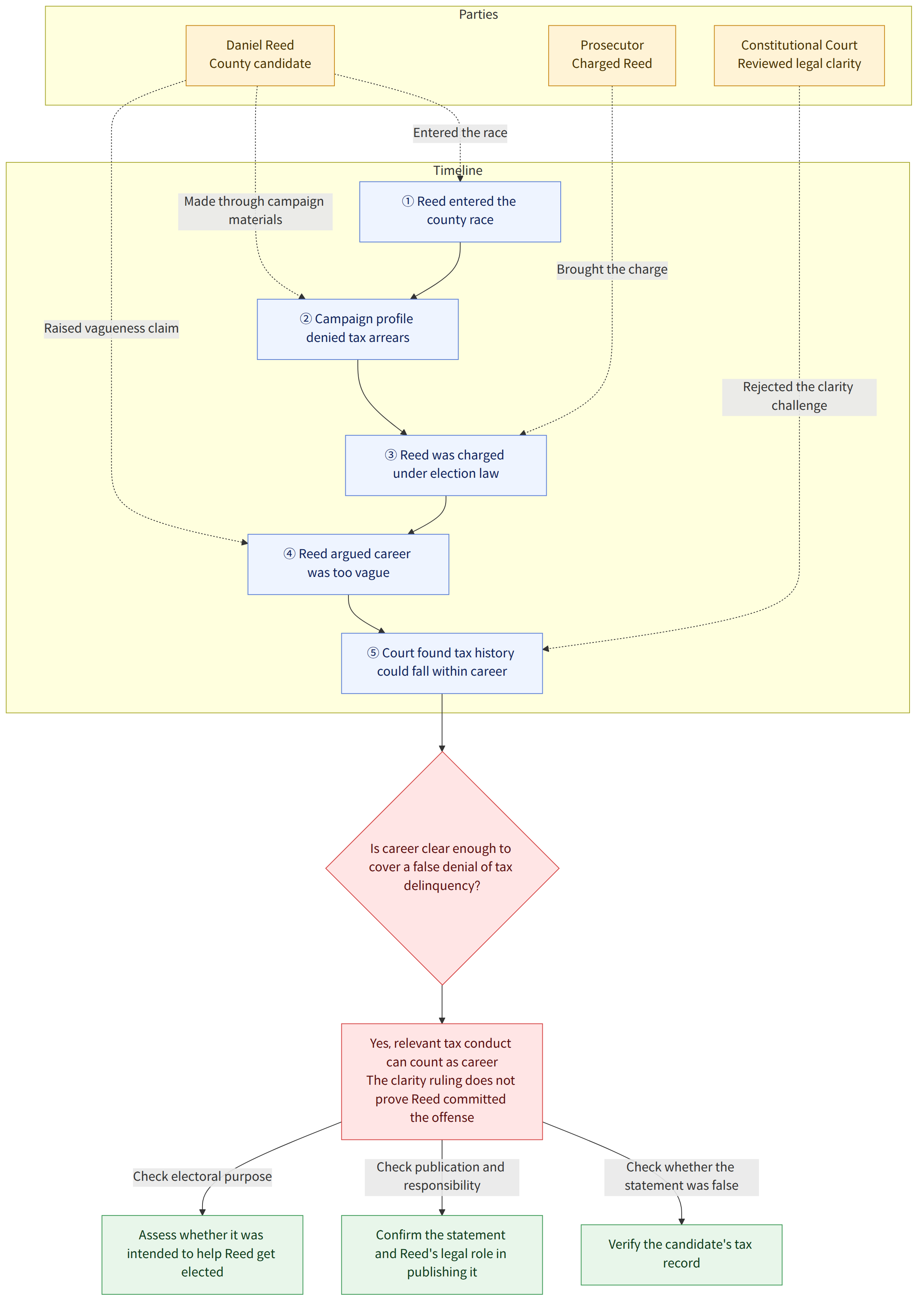
Daniel Reed had spent years building a reputation as a practical, steady public servant in his county. When he entered the race for county chief executive, his campaign team prepared a printed election profile listing his work history and public-service record. It also included a blunt assurance: Daniel had no outstanding tax arrears.
That assurance was false. Daniel had unpaid income taxes. After the statement appeared in campaign material, he was charged under Korea’s Public Official Election Act for publishing false information about a candidate. He insisted that tax arrears were not a “career” or résumé item, and that a criminal law using that word did not clearly warn candidates that it covered tax-payment history.
2. The Legal Question
The central question is whether the election law’s reference to a candidate’s “career” is clear enough to cover a false statement denying tax delinquency—or whether including tax arrears makes the provision so vague that a candidate could not reasonably foresee criminal liability.
3. What Korean Law Says
The former version of Article 250(1) of Korea’s Public Official Election Act criminalized certain false statements made with the purpose of helping a candidate get elected. The provision covered false information about matters including a candidate’s status, occupation, career, property, character, conduct, and affiliations.
The law was aimed at false statements favorable to a candidate that could distort voters’ judgment in an election. Under the former provision, the maximum penalty was five years’ imprisonment or a fine of up to 30 million won.
The word “career” is broader than a list of formal jobs or academic credentials. The Constitutional Court reasoned that, in ordinary usage, it can refer to the various experiences and events in a person’s life. In an election context, the relevant question is whether the information can help voters assess the candidate’s record or qualities.
That reasoning matters for tax arrears. Whether a candidate has met tax obligations may inform voters’ judgment of the candidate’s conduct and responsibility. The Court therefore considered it foreseeable that a false denial of tax delinquency could fall within the law’s reference to a candidate’s career.
A prosecution still has to establish the elements of the offense. In practical terms, the case may turn on points such as:
- Whether the statement was false.
- Whether it concerned the candidate and was made or published in a way covered by the statute.
- Whether the candidate acted with the purpose of helping the candidate get elected.
- Whether the candidate was responsible for making, directing, or otherwise legally participating in the publication.
A ruling that a law is sufficiently clear does not, by itself, prove that a particular candidate committed the offense. It means only that the law is not invalid for vagueness on that ground.
4. How Korean Courts Approach This
Korean courts assess election-law language in context. They consider the purpose of the provision, the ordinary meaning of its words, and how similar terms have been understood in legal practice. The goal is to protect voters from material falsehoods without treating every inaccurate or irrelevant detail as a crime.
For the constitutional clarity question, the Court concluded that a person of ordinary understanding could anticipate that a candidate’s tax-payment record might count as part of the candidate’s relevant history. It rejected the claim that this interpretation was so uncertain that it left candidates unable to foresee the law’s reach or allowed authorities to enforce it arbitrarily.
That does not mean every private financial fact automatically qualifies as a candidate’s “career.” The connection to voters’ assessment, the wording and context of the statement, and the prosecution’s proof of the statutory requirements remain important. Nor does the constitutional ruling decide whether the evidence in an individual prosecution is sufficient.
5. Applying the Law to the Case
Daniel’s argument has two separate parts, and they should not be confused.
- Was the law clear enough? The answer under the Constitutional Court’s reasoning is yes. “Career” can encompass a person’s significant past experiences and conduct, not only a formal employment history. A candidate’s tax compliance can reasonably be seen as relevant to voters’ evaluation of the candidate.
- Was Daniel’s statement false? On the fictional facts, it was: Daniel had unpaid income taxes when his campaign materials said otherwise. That factual dispute would need to be established with evidence in the criminal proceedings.
- Was the statement made for electoral advantage? The campaign setting and the favorable assurance could support that inference, but the prosecution would still need to prove the required purpose and Daniel’s legally relevant involvement. The mere fact that a statement appeared in campaign material would not answer every question about responsibility or intent.
- What did the constitutional ruling decide? It defeated Daniel’s claim that the word “career” was too vague to include tax delinquency. It did not itself determine his guilt or replace the ordinary criminal trial.
If you are dealing with a similar issue, attorney Ji-sun Ahn of Ijun Law Firm can review the procedural history, the specific facts or evidence in dispute, and the relevant court or agency notices with you. These details can help clarify which options apply to your situation.
6. Conclusion: What Happened, and What Should You Do?
Daniel’s vagueness challenge failed. The Constitutional Court held that candidates could reasonably understand that a false statement denying tax arrears might concern their relevant history and qualities as candidates. His criminal case therefore could not be dismissed simply on the ground that “career” was too unclear a word.
That was not the same as an automatic conviction. Daniel would still have the opportunity to contest whether the statement was false, whether he was responsible for it, and whether the prosecution could prove the required electoral purpose. The constitutional decision settled the meaning-and-clarity objection, not every issue in his case.
For candidates and campaign teams, the practical lessons are straightforward:
- Verify before publishing: Check tax, employment, education, and public-service claims against reliable records.
- Correct errors promptly: If campaign material contains a false statement, seek legal advice and take documented steps to correct or withdraw it.
- Keep the evidence: Preserve drafts, approvals, source documents, and communications showing who prepared and authorized each claim.