1. A Human Story
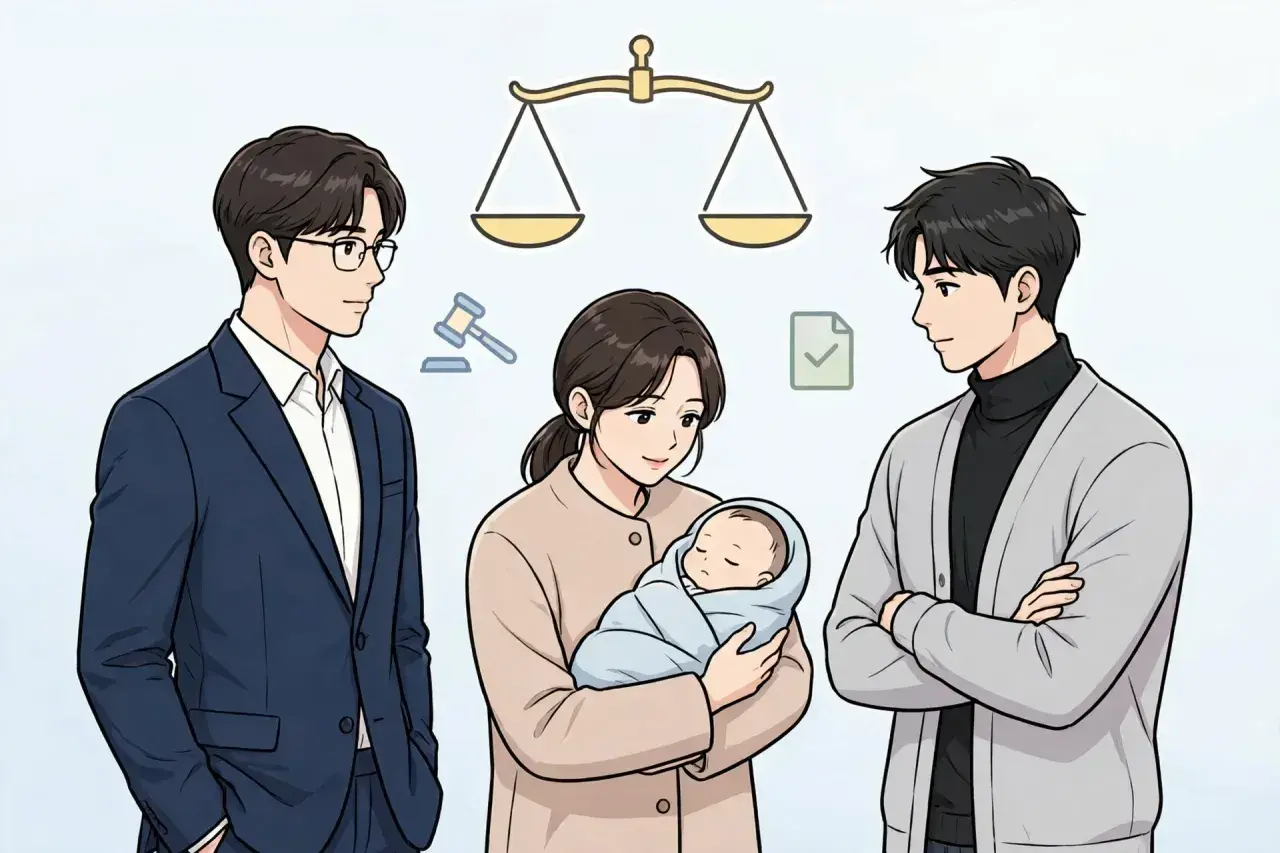
When Maya Kim gave birth to her daughter, Lily, she expected the most difficult part of the day to be over. But the dates on the family records raised a question she could not answer with a birth certificate alone.
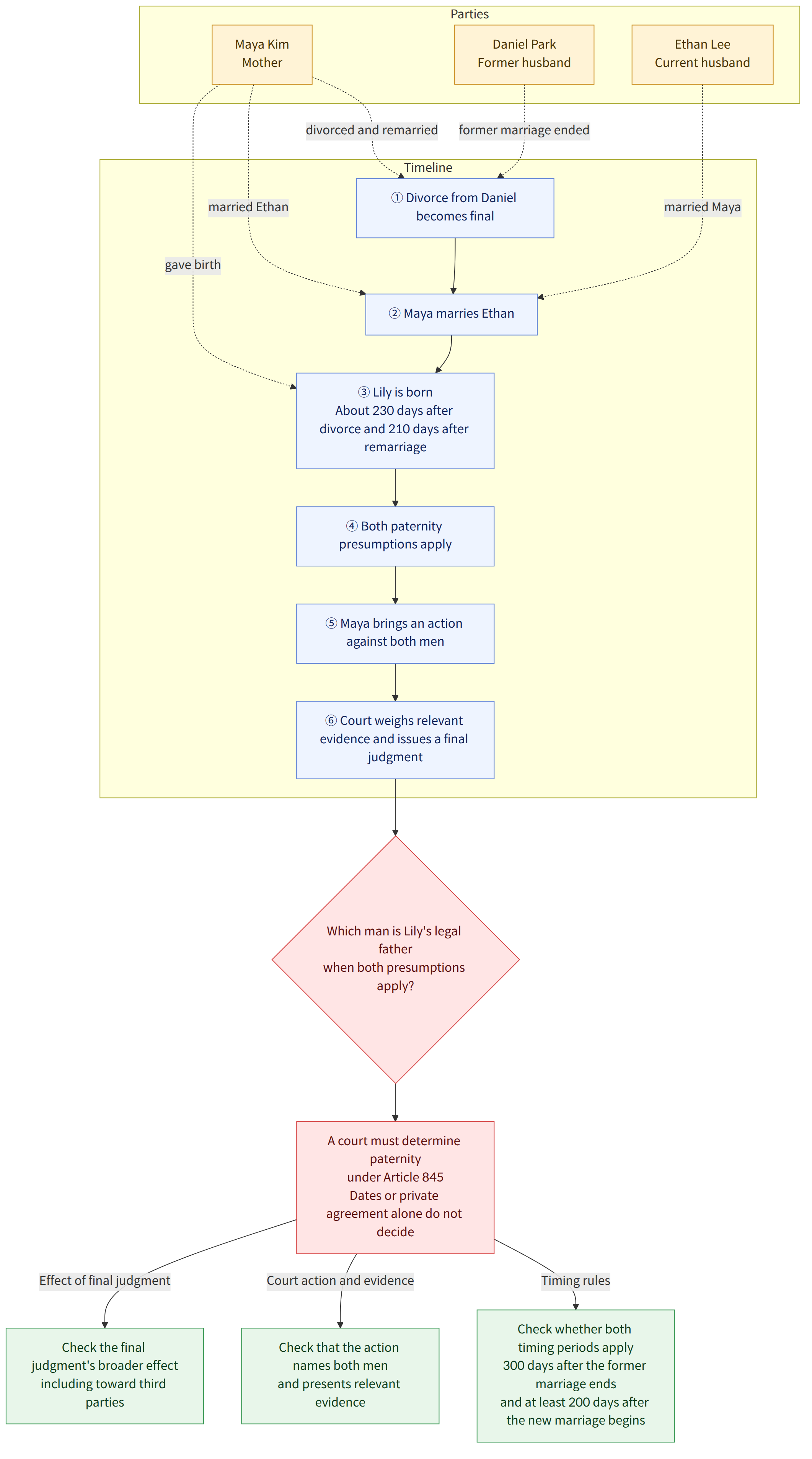
Maya’s divorce from Daniel Park had become final about 230 days before Lily was born. She had married Ethan Lee about 210 days before the birth. Maya knew who she believed Lily’s biological father to be, but the timing placed the child within two different legal windows. Both men’s names could matter under Korean law.
The uncertainty threatened to follow Lily into school, medical decisions, and official records. Maya needed a legal answer that would settle the question for her daughter—not merely a private agreement among the adults.
2. The Legal Question
When a child is born within 300 days after a previous marriage ends, but more than 200 days after a new marriage begins, does Korean law presume the former husband or the current husband to be the father—and how can that conflict be resolved?
3. What Korean Law Says
Korea’s Civil Act uses time-based presumptions to determine legal paternity. These rules help provide certainty, but they can overlap when a woman divorces and remarries within a relatively short period.
Under Article 844 of the Civil Act, a child conceived during marriage is presumed to be the husband’s child. A child born at least 200 days after a marriage begins, or within 300 days after it ends, is presumed to have been conceived during that marriage.
Applied to Maya’s dates, the rule points in two directions:
- Lily was born within 300 days after Maya’s marriage to Daniel ended, so the law may presume Daniel is her father.
- Lily was born more than 200 days after Maya married Ethan, so the law may also presume Ethan is her father.
Where those presumptions overlap, the law provides a specific solution: an action to determine the father under Article 845 of the Civil Act. It is not enough simply to choose one presumption or to rely on the adults’ agreement. The court determines which man is the child’s legal father.
The action is a family litigation case under the Family Litigation Act. A final judgment in this type of case has effect not only between the immediate parties but also toward third parties, under Article 21(1) of that Act. That broader effect helps ensure the child’s legal status is settled consistently.
4. How Korean Courts Approach This
When two legal presumptions point to different men, the court’s role is to resolve the conflict through the designated action. The dates establish why the case must be brought; they do not, by themselves, decide which man is the father.
The court considers the evidence relevant to parentage. Depending on the case, that may include genetic testing, medical or conception-related timing, and other reliable evidence. The court’s task is to reach a legally binding determination, rather than leave the child’s status dependent on competing claims or informal arrangements.
The key principle is that overlapping presumptions call for a judicial determination. Neither husband’s status should be treated as conclusively resolved merely because one marriage began or ended closer to the birth.
5. Applying the Law to Maya’s Case
Maya’s situation fits the overlap the statutes are designed to address.
- The first period applies. Lily was born about 230 days after Maya’s divorce from Daniel became final. That is within the 300-day period after the previous marriage ended, so the law presumes conception during that marriage.
- The second period applies too. Lily was born about 210 days after Maya married Ethan. That is more than 200 days after the new marriage began, so the law also presumes conception during that marriage.
- The two presumptions conflict. Daniel and Ethan are each treated as a possible legal father under the statutory timing rules. The birth record alone cannot resolve the conflict.
- The appropriate case is an action to determine the father. Maya must seek a court ruling against both Daniel and Ethan. The court can then evaluate the evidence, including genetic evidence, and decide which man is Lily’s father under the law.
- A final judgment settles the issue more broadly. Once the judgment is final, its effect extends beyond the adults in the case, helping establish Lily’s legal status for official and practical purposes.
Suppose genetic testing and the other evidence in Maya’s case establish that Ethan is Lily’s biological father. The court could then determine Ethan to be the father. But that result would follow from the evidence and the court’s judgment—not simply from the fact that Ethan was Maya’s husband when Lily was born.
If you are dealing with a similar issue, attorney Ji-sun Ahn of Ijun Law Firm can review the family registration, the marriage, separation and birth dates relevant to the parentage dispute, and any prior court records with you. These details can help clarify which options apply to your situation.
6. Conclusion: What Happened, and What Should You Do?
Maya filed the action against both Daniel and Ethan. Genetic evidence supported her belief that Ethan was Lily’s biological father, and the court’s final judgment resolved the competing presumptions in his favor. Lily’s legal parentage was no longer left to an unresolved clash between two sets of dates.
For anyone facing a similar situation:
- Check both statutory periods: 300 days after the prior marriage ends and 200 days after the new marriage begins.
- Do not assume the calendar or a private agreement settles legal parentage. Where both presumptions apply, seek advice about bringing an action to determine the father against both husbands.
- Preserve relevant records and evidence, including marriage and divorce documents and any reliable medical or genetic evidence, and consult a Korean family-law attorney about the court process.