

1. A Human Story
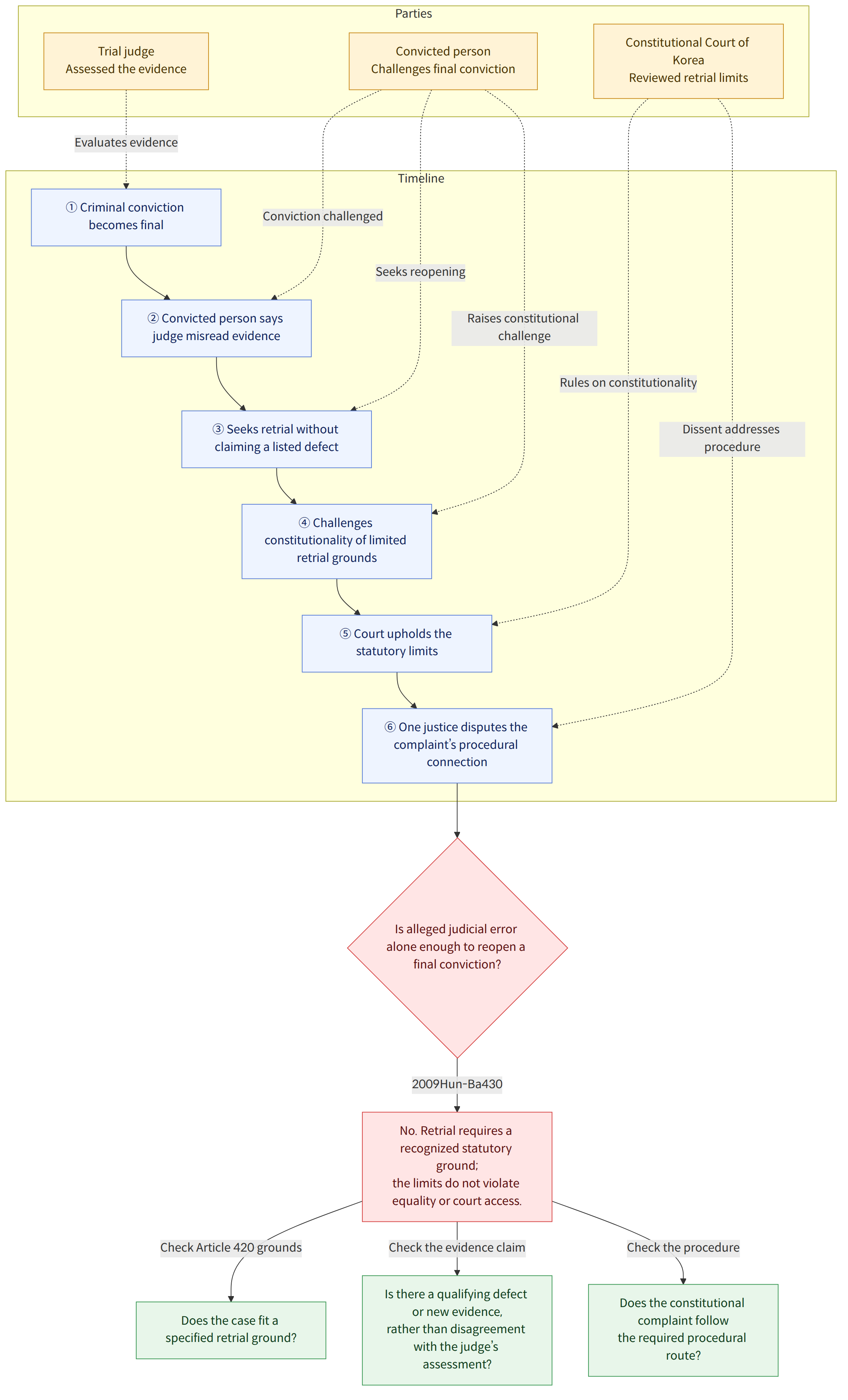
Daniel Reed had spent years trying to put his criminal case behind him. The conviction was final, but he remained certain that the judge had misunderstood the evidence. A witness’s account seemed inconsistent with the timeline, and Daniel believed the court had treated that account as decisive while overlooking facts that pointed the other way.
He wanted the case reopened—not because he had discovered that a document was forged or that a witness had admitted lying, but because he believed the judge’s conclusion was plainly wrong. When he learned that Korean law limits retrials to a defined list of grounds, Daniel asked whether excluding judicial error from that list violated the Constitution.
2. The Legal Question
The central question is whether Korea’s Criminal Procedure Act is unconstitutional because it permits retrials only on specified grounds and does not make a judge’s allegedly mistaken assessment of the evidence, standing alone, a ground for reopening a final criminal conviction.
3. What Korean Law Says
A retrial is not another ordinary appeal. It is an exceptional procedure for reconsidering a conviction that has already become final. Article 420 of the Korean Criminal Procedure Act sets out particular grounds on which a convicted person may seek a retrial. These include certain forms of fabricated or falsified evidence, false testimony in circumstances covered by the statute, and newly discovered evidence that meets the legal requirements.
The important distinction is between a specific, legally recognized defect and a claim that the trial judge simply reached the wrong conclusion. A person may strongly disagree with a court’s weighing of testimony or documents, but that disagreement does not automatically fit one of the statutory grounds.
The retrial provisions are designed for exceptional circumstances in which there is a clear basis to doubt the legitimacy of a final judgment and reason to expect that reopening the case could produce a more just result.
The Constitution protects both equal treatment under the law and access to the courts. But those guarantees do not mean that every final judgment must be open to repeated review. Finality serves important purposes: it gives legal disputes an endpoint, protects the stability of court decisions, and prevents the same disagreement over evidence from continuing indefinitely.
For a person challenging the constitutionality of a statute in Korea, the route can also depend on the procedural posture of the underlying case. A constitutional complaint under Article 68(2) of the Constitutional Court Act is a particular procedure connected to a court’s rejection of a request for constitutional review. It is not a substitute for identifying a valid retrial ground in the criminal case itself.
4. How Korean Courts Approach This
The Constitutional Court of Korea addressed this issue in a decision dated June 30, 2011, in case 2009Hun-Ba430. It held that limiting retrials to specified grounds, without treating a judge’s alleged error as an independent ground, did not violate the constitutional principle of equality or the right to access the courts.
The Court’s reasoning rests on the difference between correcting an exceptional injustice and simply repeating an appeal. If every assertion that a judge misread the evidence were enough to reopen a final conviction, the retrial process could become a continuing challenge to the original court’s evaluation rather than a remedy for a distinct and demonstrable defect.
In the Court’s view, a retrial requires a clear basis for concluding both that the final judgment suffers from a serious error and that reopening the case could lead to a more legitimate result. A bare claim that the judge’s assessment was wrong does not necessarily supply that basis.
There was a dissenting view. One justice considered that the constitutional complaint should have been dismissed because the required connection between the constitutional challenge and the underlying case was missing. That procedural disagreement did not change the Court’s conclusion on the constitutionality of the statutory retrial limits.
5. Applying the Law to the Case
Daniel’s situation can be assessed in several steps.
- His conviction is final. Because the judgment has passed beyond the ordinary appeal stage, he cannot use a retrial merely to repeat arguments that could have been made during the original proceedings or an appeal.
- He must identify a statutory ground. Daniel would need to show that his case falls within one of Article 420’s recognized categories—for example, a qualifying problem involving evidence or another circumstance specified by the statute. He cannot establish that requirement simply by saying that the judge’s view of the evidence was clearly mistaken.
- His constitutional argument faces the rule upheld by the Constitutional Court. Daniel’s claim is that the statute is unfair because it does not list judicial error as a separate retrial ground. But the Court has held that this limitation, by itself, does not violate equality or the right to access the courts. The constitutional right to seek judicial relief does not guarantee an unlimited series of proceedings after a final judgment.
- The distinction is practical, not merely formal. If Daniel later finds evidence that satisfies a statutory ground, he may be able to pursue the appropriate retrial procedure, subject to its requirements. But if the only basis remains his belief that the judge drew the wrong inference from evidence already considered, the statutory framework does not treat that belief alone as enough.
The result is difficult for someone who feels certain that the court got the facts wrong. Yet the legal system distinguishes between a possible injustice supported by a recognized new or exceptional ground and a continued dispute over how the original judge evaluated the record.
If you are dealing with a similar issue, attorney Ji-sun Ahn of Ijun Law Firm can review the provision applied in your case, the ruling or notice you received, and the dates relevant to challenging it with you. These details can help clarify which options apply to your situation.
6. Conclusion: What Happened, and What Should You Do?
Daniel’s conviction is not reopened merely because he believes the judge’s assessment was plainly mistaken. Under the rule upheld by the Constitutional Court, a judge’s alleged error, standing alone, is not a sufficient ground for retrial, and the statutory limits are not unconstitutional on that basis. His case could be reconsidered only if he can establish a qualifying ground under the Criminal Procedure Act and satisfy the relevant procedural requirements.
For readers facing a similar situation:
- Identify the precise ground. Compare the facts you can prove with the statutory retrial grounds; do not rely only on the conclusion that the original judgment was wrong.
- Preserve and verify evidence. Keep original documents, records, and reliable information about when and how any new evidence was discovered.
- Get procedural advice promptly. Retrial and constitutional procedures have specific requirements, and a lawyer can help distinguish a possible statutory ground from arguments that belonged in an appeal.

















