1. A Human Story
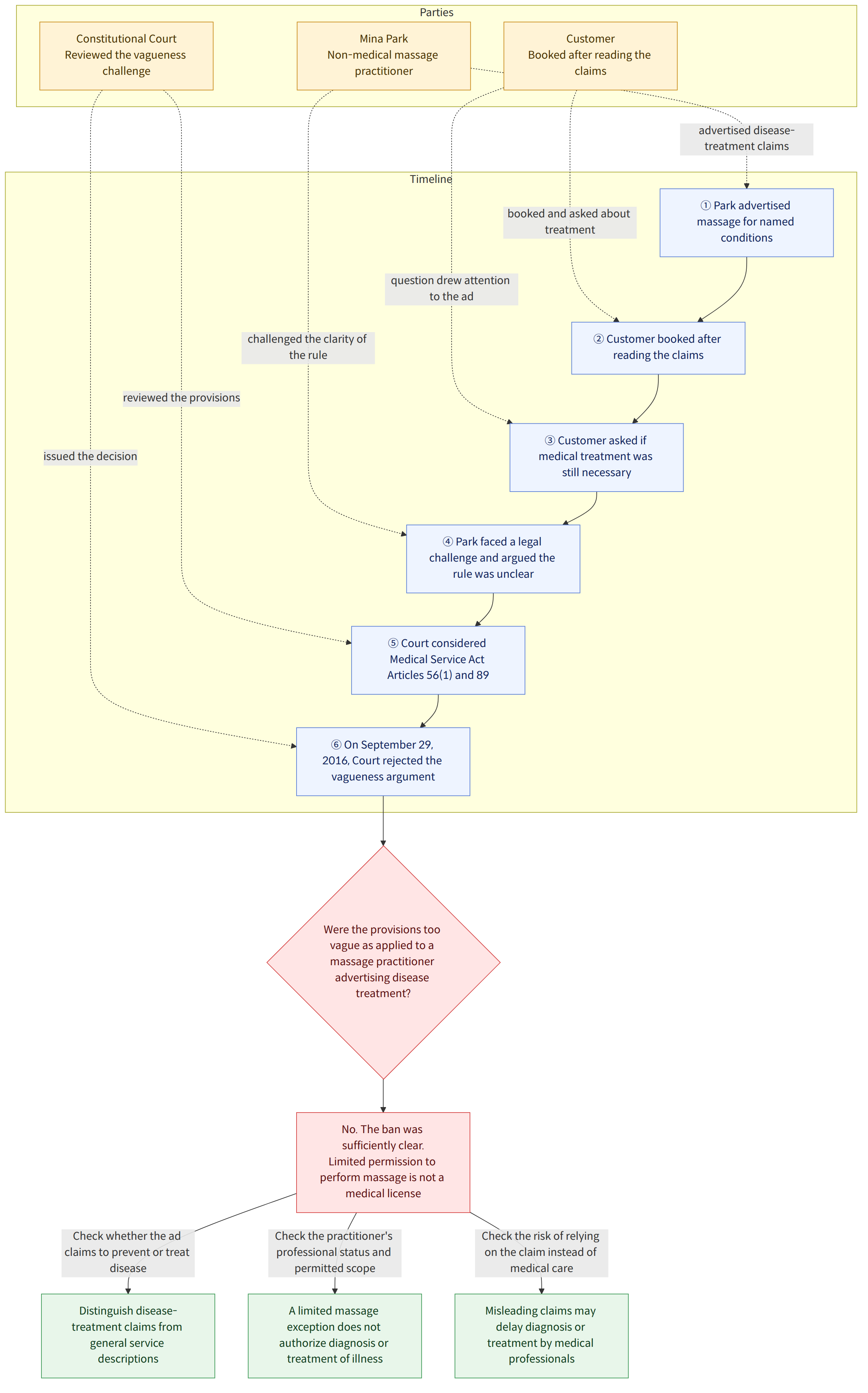
Mina Park had spent years building a small massage practice. When business slowed, she redesigned her website and added a list of conditions her sessions could supposedly address: slipped discs, sciatica, frozen shoulder, and chronic neck pain. She saw the wording as ordinary marketing. To her, it described what clients hoped to feel after a session.
A customer who had been suffering from back pain booked an appointment after reading the claims. The customer later asked whether medical treatment was still necessary. That question drew attention to Mina’s advertisement, and she found herself facing a legal challenge. Mina’s defense was straightforward: she was a massage practitioner, not a doctor, but she did not think the law made it clear that she could not advertise these services as treatment for disease.
2. The Legal Question
The central question is whether Korea’s prohibition on medical advertising by a non-medical person is too unclear to satisfy the constitutional principle that criminal rules must be sufficiently precise—particularly when it is applied to a massage practitioner who advertises that massage can prevent or treat disease.
3. What Korean Law Says
Korea’s Medical Service Act distinguishes between licensed medical professionals and massage practitioners. A massage practitioner is not a medical professional under the Act. The law allows massage practitioners to perform certain massage-related acts under a limited statutory exception, but that exception does not give them a general license to diagnose or treat illness.
The provisions at issue were Article 56(1), concerning medical advertising, and Article 89, which provides punishment for certain violations of the Act. The Constitutional Court considered the scope of those provisions as applied to a massage practitioner’s medical claims.
In plain terms: Being permitted to perform a limited form of massage does not authorize a practitioner to advertise that they can medically prevent or cure disease.
The legal distinction matters because advertising can shape whether a person seeks professional care. A claim that massage treats a named illness may sound to a consumer like a promise of medical diagnosis or treatment, even when the person making the claim is not qualified to provide it.
The relevant principles can be summarized as follows:
- A limited exception is not a medical license. Massage practitioners may carry out only the work the statute allows; they do not thereby become medical professionals.
- Medical-treatment claims are different from general service descriptions. Advertising that massage can prevent or treat a disease can lead consumers to believe that the practitioner offers medical care.
- The clarity rule does not demand perfect precision. A law is not automatically unconstitutional because its boundaries require interpretation. The question is whether people can understand the rule’s reach from its wording, purpose, and legal context.
- The restriction protects health and safety. The ban aims to reduce misleading claims, misplaced confidence, and the risk that someone will delay diagnosis or treatment by a medical professional.
The Constitutional Court reasoned that allowing a non-medical massage practitioner to advertise that massage can prevent or treat disease could mislead consumers, encourage excessive reliance on the practitioner, and foster medical acts beyond the practitioner’s lawful scope.
4. How Korean Courts Approach This
Korean courts and the Constitutional Court assess a vagueness challenge by asking whether the law gives people a workable standard for understanding what is prohibited. The Constitution requires clarity, especially where criminal punishment is involved, but it does not require legislation to list every possible advertisement or phrase in advance.
Courts consider the statutory language alongside the law’s purpose and the professional boundaries it establishes. In this setting, the distinction is not simply between a good advertisement and a bad one. It is between describing a massage service and presenting it as a means of preventing or treating disease when the advertiser is not a medical professional.
In a decision dated September 29, 2016, the Constitutional Court rejected the argument that the relevant provisions were unconstitutionally vague as applied to massage practitioners. It emphasized that illnesses such as disc conditions, sciatica, and frozen shoulder may require accurate diagnosis and treatment by medical professionals. Depending on a massage practitioner instead could create risks to an individual’s health and safety.
The Court’s central principle: The limited authority to perform massage does not include permission to promote that work as medical treatment, and the law’s purpose and context make that boundary sufficiently understandable.
5. Applying the Law to the Case
Mina’s situation can be assessed in several steps.
- Identify her professional status. Mina is a massage practitioner, not a licensed medical professional. The statutory exception allowing certain massage-related work does not erase that distinction.
- Look at what the advertisement promises. Her website did not merely say that clients could book a massage for relaxation or general comfort. It named conditions—including disc problems, sciatica, and frozen shoulder—and said or implied that her sessions could address them as diseases.
- Consider how a customer could understand those claims. A person with pain may reasonably read a disease-specific promise as an assurance of treatment. That can influence whether the person seeks medical assessment, even if Mina intended only to describe clients’ experiences.
- Apply the purpose of the restriction. The ban is designed to protect people from being misled into relying on a non-medical practitioner for conditions that may require proper diagnosis and treatment. Mina’s claims fall within the kind of advertising the Court considered particularly risky.
- Assess the clarity objection. Mina can argue that the boundary between massage and medical advertising is not obvious in every case. But the Court’s approach is that the statute, read in context, gives a sufficiently clear warning: a non-medical practitioner may not advertise massage as a way to prevent or treat disease. The fact that borderline wording may require judgment does not, by itself, make the rule unconstitutional.
The Constitutional Court’s ruling addressed the constitutionality of the provisions, not every factual question in a later enforcement or criminal proceeding. Whether a particular advertisement violates the law, and what consequence follows, depends on the evidence and the applicable procedure. But Mina cannot defeat the restriction simply by arguing that it is too vague to understand.
If you are dealing with a similar issue, attorney Ji-sun Ahn of Ijun Law Firm can review the applicable permit, business records or advertisements, and the legal grounds given by the authority with you. These details can help clarify which options apply to your situation.
6. Conclusion: What Happened, and What Should You Do?
Mina’s constitutional challenge fails. Under the Constitutional Court’s reasoning, a massage practitioner may perform the limited work the law permits but may not advertise massage as a means of preventing or treating illnesses such as disc conditions, sciatica, or frozen shoulder. Whether Mina herself is ultimately penalized would depend on the facts and legal process, but the rule is sufficiently clear to apply to disease-treatment claims like the ones on her website.
For anyone offering massage or a similar non-medical service:
- Describe the service accurately. Avoid claims that you diagnose, prevent, or treat named diseases unless you are legally authorized to provide that medical care.
- Review advertising before publication. Check websites, social media, flyers, and customer testimonials; disease-specific claims can create legal risk even if they were not intended as formal medical advice.
- Direct customers with symptoms to qualified care. Encourage medical assessment where appropriate, and do not suggest that massage replaces diagnosis or treatment by a medical professional.