1. A Human Story
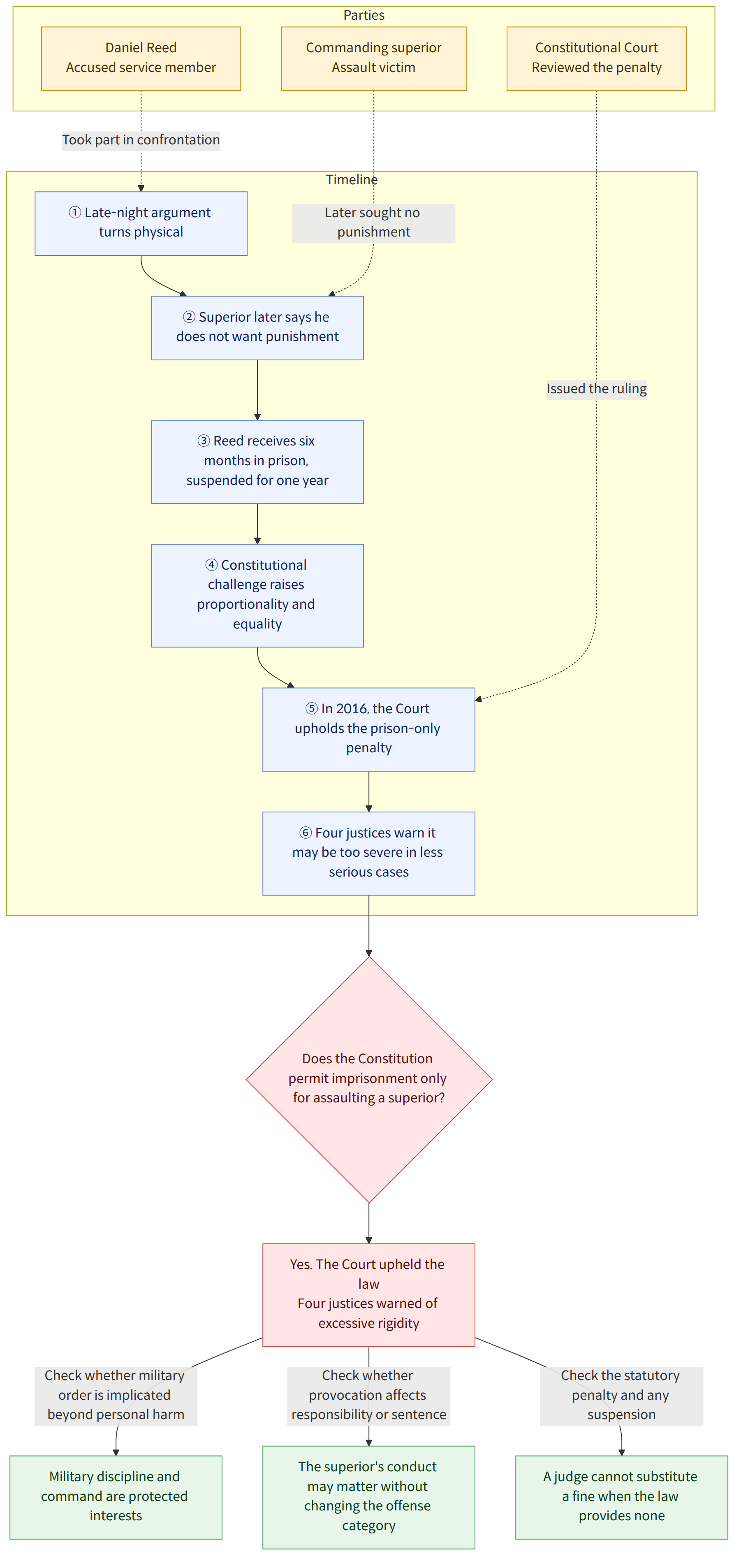
Daniel Reed had served quietly in his unit until a late-night argument with his commanding superior turned physical. Daniel believed the superior had provoked the confrontation and treated him unfairly. The superior later told investigators that he no longer wanted Daniel punished. Still, the case went to court.
The judge sentenced Daniel to six months in prison, suspended for one year. Daniel would not have to serve the prison term immediately, but the conviction and sentence remained. What unsettled him most was that the law offered no fine as an alternative. If the superior had been a civilian, Daniel thought, the outcome might have been different.
2. The Legal Question
Does the Korean Constitution permit a military offense of assaulting a superior to carry imprisonment only, with no option of a fine, even when the superior’s own conduct contributed to the dispute and later expressed a wish not to see the accused punished?
3. What Korean Law Says
The relevant provision of the Military Criminal Act addresses assault against a superior. As described in the provision considered by the Constitutional Court, the offense is punishable by imprisonment for up to five years; it does not provide a fine as an alternative penalty.
The provision treats assault against a superior as an offense against military order and the chain of command, not merely as a physical confrontation between two individuals.
That distinction has practical consequences:
- The protected interest is broader than the victim’s personal welfare. The law aims to preserve hierarchy and command within the armed forces.
- A superior’s later wishes do not automatically end the case. The offense is not made dependent solely on whether the victim asks for prosecution or later withdraws that request. The public interest in military discipline may remain even when the individual superior no longer seeks punishment.
- The available sentence is limited by the statute. A judge may impose a prison sentence and, where legally appropriate, suspend its execution. But the judge cannot replace the statutory prison penalty with a fine if the law does not authorize one.
The constitutional challenge was based on two related ideas: proportionality, meaning that punishment should match the seriousness of the conduct and the offender’s responsibility, and equality, meaning that similar cases should not be treated differently without a sound reason.
4. How Korean Courts Approach This
Korean constitutional review gives the legislature room to decide how serious an offense is and what penalties should apply. That discretion is not unlimited: a penalty may be unconstitutional if it is plainly excessive in relation to the conduct and the public interest the law protects. But the Court does not ordinarily substitute its preferred sentencing policy for the legislature’s simply because another penalty might also be reasonable.
In its 2016 decision on the provision, the Constitutional Court upheld the prison-only penalty. The majority reasoned that the military depends on a functioning hierarchy and command system. Because assaulting a superior can threaten those structures, the legislature could punish it more severely than ordinary assault without violating equality or the principle that punishment must be proportionate to responsibility.
Four justices disagreed. They considered it important that the offense did not require any additional aggravating circumstance beyond the victim being a superior. In their view, excluding a fine in every case could make the punishment disproportionate, particularly where the conduct was relatively minor or the circumstances substantially reduced the offender’s blameworthiness.
The majority accepted a tougher rule because of the military’s institutional needs. The dissent warned that a rule with no fine option may fit serious cases but be too rigid for less serious ones.
5. Applying the Law to the Case
Daniel’s case raises genuine concerns about fairness, but those concerns do not automatically make the statute unconstitutional.
- The superior’s conduct may matter, but it does not change the legal category of the offense. If the superior provoked the argument, that fact could be relevant to Daniel’s responsibility and to the sentence. It does not, by itself, remove the military’s interest in protecting its chain of command.
- The superior’s changed position is not decisive. His statement that he no longer wanted punishment could be considered as part of the circumstances. But the case concerns an alleged assault within a military hierarchy, so the public interest is not necessarily the superior’s alone to waive.
- A suspended sentence is still a prison sentence. Daniel avoided immediate imprisonment, but the court imposed a six-month term and suspended its execution for one year. Suspension can soften the immediate consequence; it does not turn the sentence into a fine or erase the conviction.
- The constitutional challenge focused on the law’s design, not simply on whether Daniel deserved a lighter sentence. The majority concluded that the legislature could reserve imprisonment for this offense because of the military interests at stake. The four-justice dissent shows that the issue was contested, but it did not determine the Court’s ruling.
On that reasoning, Daniel’s argument that the absence of a fine made the law unconstitutional would not succeed. The Constitutional Court’s ruling upheld the penalty framework. That ruling addressed the constitutionality of the statute; it did not independently decide whether every factual finding or sentencing decision in Daniel’s individual case was correct.
If you are dealing with a similar issue, attorney Ji-sun Ahn of Ijun Law Firm can review the sequence of events, records showing what each person knew or did, and the grounds stated in any formal notice with you. These details can help clarify which options apply to your situation.
6. Conclusion: What Happened, and What Should You Do?
Daniel’s constitutional challenge did not invalidate the prison-only penalty. His superior’s role in the dispute and later wish not to pursue punishment might be relevant to the facts or sentence, but neither automatically cancels the offense. Unless Daniel separately succeeds through an applicable appeal or other legal procedure, his six-month sentence, suspended for one year, remains in place.
For anyone facing a similar situation:
- Get advice quickly. Military criminal proceedings and constitutional challenges involve strict procedural rules and deadlines; do not assume that a victim’s changed position ends the case.
- Preserve evidence about the whole confrontation. Keep messages, witness details, medical records, and any evidence of provocation or mitigating circumstances for the defense and sentencing stages.
- Separate a challenge to the sentence from a challenge to the statute. Ask a lawyer which ordinary remedies are available and whether the requirements and deadline for a constitutional complaint are met.