
1. A Human Story
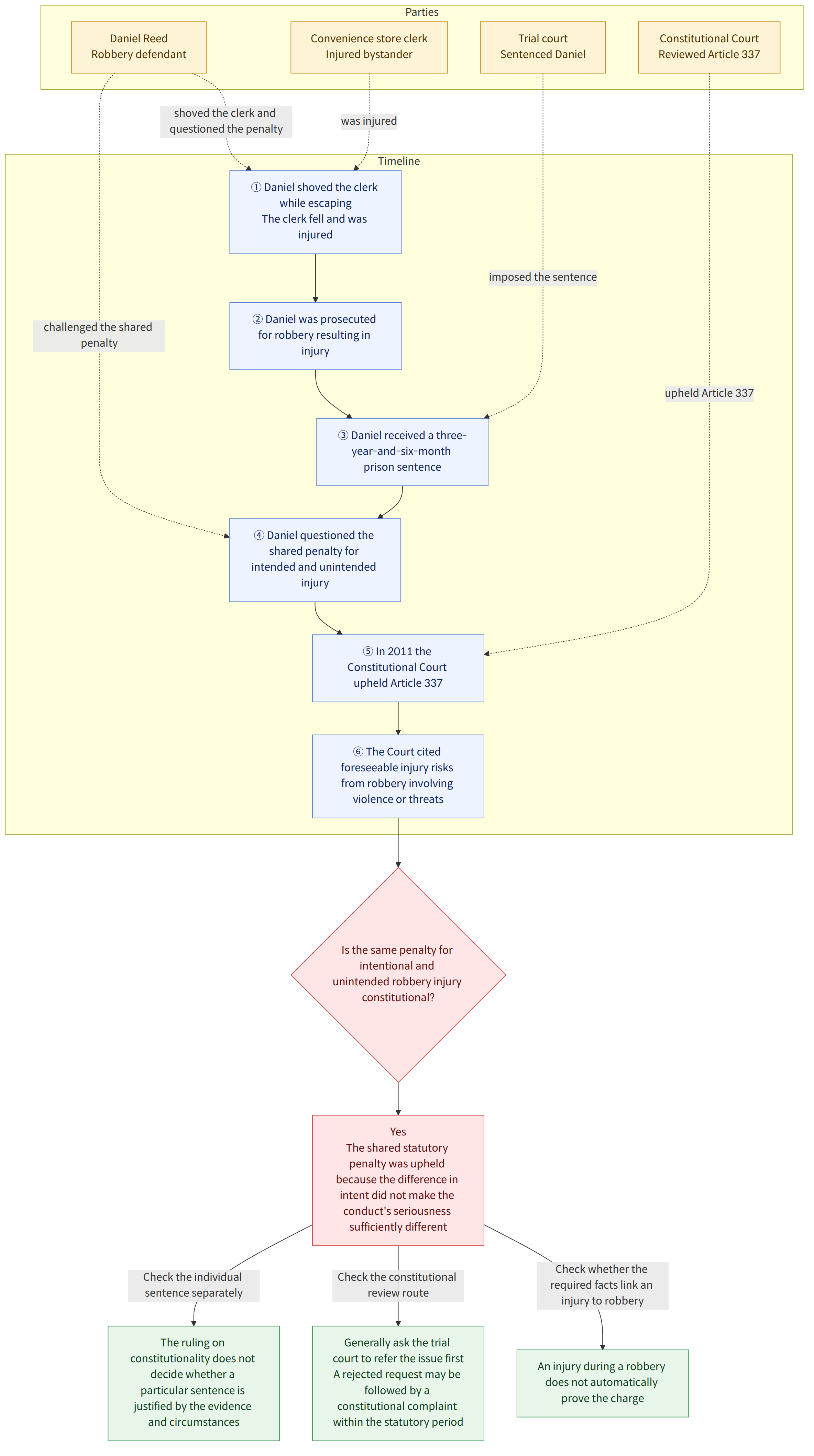
Daniel Reed did not plan for anyone to be hurt. During a late-night robbery at a convenience store, he shoved the clerk aside while trying to escape. The clerk fell against a display and suffered an injury. Daniel was later prosecuted for robbery resulting in injury—not for an assault he had set out to commit.
The court sentenced him to three years and six months in prison. Daniel could not understand why the law appeared to place him in the same sentencing category as someone who deliberately injured a victim during a robbery. If he had not intended the injury, he wondered, was the law treating him too harshly—and was that treatment unconstitutional?
2. The Legal Question
The central question is whether South Korea’s Constitution allows the same statutory penalty for robbery causing injury and robbery resulting in injury, even when the injury was not intentional.
3. What Korean Law Says
Article 337 of the Korean Criminal Act covers a robber who injures another person, as well as a robber whose conduct results in an injury. It prescribes life imprisonment or imprisonment for at least seven years for both forms.
Criminal Act, Article 337: A person who injures another, or causes another to be injured, in connection with robbery is punishable by life imprisonment or imprisonment for at least seven years.
The distinction matters in ordinary criminal law: deliberately causing an injury is not the same state of mind as causing one without intending it. But Article 337 gives both outcomes the same statutory penalty range. The constitutional question is whether that choice is unreasonable or disproportionate.
The Constitutional Court addressed that question in 2011 and upheld the provision. Its reasoning was that robbery is carried out through violence or threats, and that such conduct carries a significant, readily foreseeable risk of injury. In the Court’s view, the presence or absence of an intention to injure did not create a sufficiently large difference in the overall seriousness of the conduct to make the shared penalty unconstitutional.
The Constitutional Court reasoned that injury is a substantial and foreseeable risk of robbery involving violence or threats, and that the difference in intent does not make the conduct’s blameworthiness so different that a common statutory penalty is unconstitutional.
A constitutional challenge also has a defined route. A person seeking review of a statute under Article 68(2) of the Constitutional Court Act generally must first ask the trial court to refer the statute’s constitutionality to the Constitutional Court. If the trial court rejects that request, the person may file a constitutional complaint within the statutory period. This procedure is separate from an ordinary appeal about the conviction or sentence.
4. How Korean Courts Approach This
Korean courts examine whether a penalty provision has a reasonable basis and whether its severity is proportionate to the conduct it addresses. They do not automatically find a law unconstitutional just because it treats two situations alike, or because a defendant believes one situation is less blameworthy.
For Article 337, the Constitutional Court focused on the character of robbery itself. Violence and threats are not incidental to the offence: they are among the means by which robbery is carried out. The Court considered injury a danger that a person committing robbery can foresee, even if causing that particular injury was not the person’s purpose.
The Court also considered whether robbery causing injury was plainly less serious than other offences combining robbery with additional criminal conduct. It concluded that the combined offence’s seriousness and blameworthiness could not be regarded as lower in a way that made Article 337’s penalty unconstitutional. The Court therefore rejected the claim that using one statutory range for both outcomes violated proportionality.
That ruling concerns the constitutionality of the penalty provision. It does not mean that every injury during a robbery automatically proves the charge, nor does it decide whether a particular sentence is justified on the evidence and circumstances of an individual case.
5. Applying the Law to Daniel’s Case
Daniel’s argument has two parts: he says he did not intend to injure the clerk, and he says the law is unconstitutional because it assigns the same statutory penalty to intentional and unintended injury. The two points need to be considered separately.
- The injury’s lack of intent does not by itself defeat Article 337. The statute covers both injuring someone and causing someone to be injured in connection with robbery. If the required facts are proved, the absence of a purpose to hurt the clerk does not automatically remove the case from the provision.
- The constitutional challenge faces the 2011 ruling. Daniel’s argument closely matches the proportionality objection the Constitutional Court considered. Under that ruling, the legislature could treat the two outcomes alike because injury is a foreseeable risk of robbery involving force or threats, and the difference in intent does not necessarily make the overall conduct substantially less blameworthy.
- The constitutional ruling does not settle every issue in Daniel’s prosecution. He may still have grounds to dispute whether his conduct amounted to robbery, whether it caused the clerk’s injury, or whether the evidence supports the conviction. Those are questions about the facts and application of criminal law, not simply the validity of Article 337.
- The sentence is a separate question. Article 337 sets a statutory minimum of seven years, while Daniel received three years and six months. A sentence below that minimum would require a lawful basis for reducing the punishment under the applicable rules. The fact that the sentence is lower than the stated minimum does not, by itself, show that the provision is unconstitutional; the judgment’s reasoning and the basis for any reduction would need to be examined.
On the facts of Daniel’s story, the constitutional challenge to the shared penalty is unlikely to succeed. But that conclusion does not rule out a properly supported appeal concerning the conviction, the application of the law, or the sentence.
If you are dealing with a similar issue, attorney Ji-sun Ahn of Ijun Law Firm can review the sequence of events, records showing what each person knew or did, and the grounds stated in any formal notice with you. These details can help clarify which options apply to your situation.
6. Conclusion: What Happened, and What Should You Do?
Daniel’s claim that Article 337 is unconstitutional because it treats intentional and unintended injury alike would fail under the Constitutional Court’s 2011 decision. Korean law treats injury during robbery as a foreseeable danger of an offence carried out through violence or threats, and the Court has held that the shared statutory penalty is not, for that reason alone, disproportionate.
That does not mean Daniel has no possible legal arguments. Whether the robbery and injury were proved, and whether the sentence was lawfully determined, are distinct issues. Anyone facing a similar charge should take these practical steps:
- Review the judgment and evidence carefully. Identify what the court found about the robbery, the injury, and the connection between them.
- Ask a criminal-defense lawyer to examine the sentence. If it falls below the statutory minimum, the judgment should explain the lawful basis for that reduction.
- Observe the correct deadlines and procedure. An appeal, a request for constitutional referral, and a constitutional complaint are different steps; a lawyer can assess which route is available and when it must be taken.

















