1. A Human Story
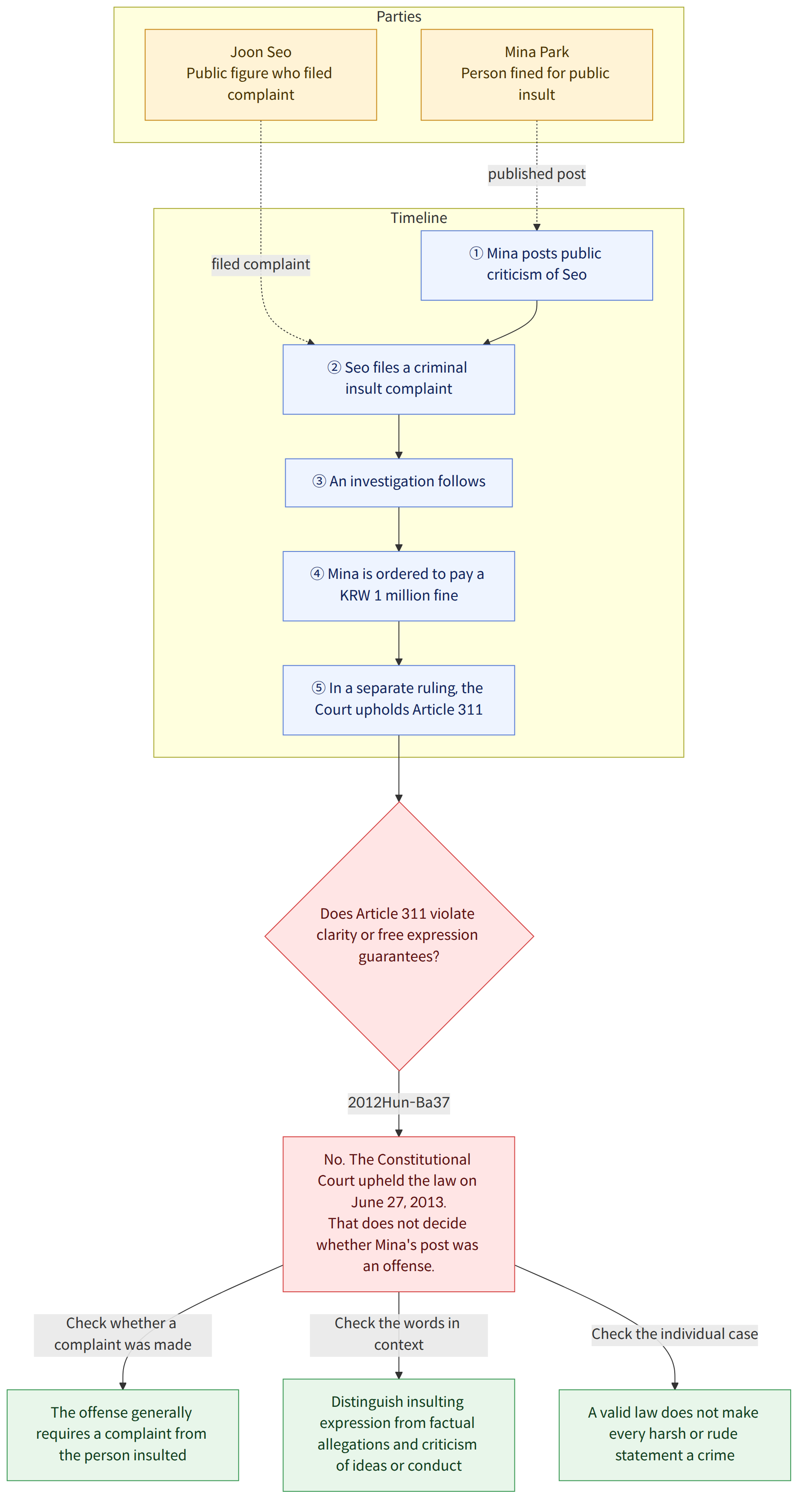
Mina Park had followed Joon Seo’s public commentary for months. She thought his opinions were shallow and, after another post left her exasperated, she wrote on her own social-media account that Seo was “intellectually lightweight” and “not up to the job of speaking on this subject.” She did not accuse him of a crime or describe a specific act; she wanted, she later said, to make clear how little she respected his views.
The post was public. Soon, Mina received a request to appear for questioning after Seo filed a complaint alleging criminal insult. An investigation followed, and she was eventually ordered to pay a fine of ₩1 million. Mina was angry and bewildered: surely, she thought, the Constitution protected her right to criticize a person whose views were already part of public debate. She began to wonder whether the law itself was unconstitutional.
2. The Legal Question
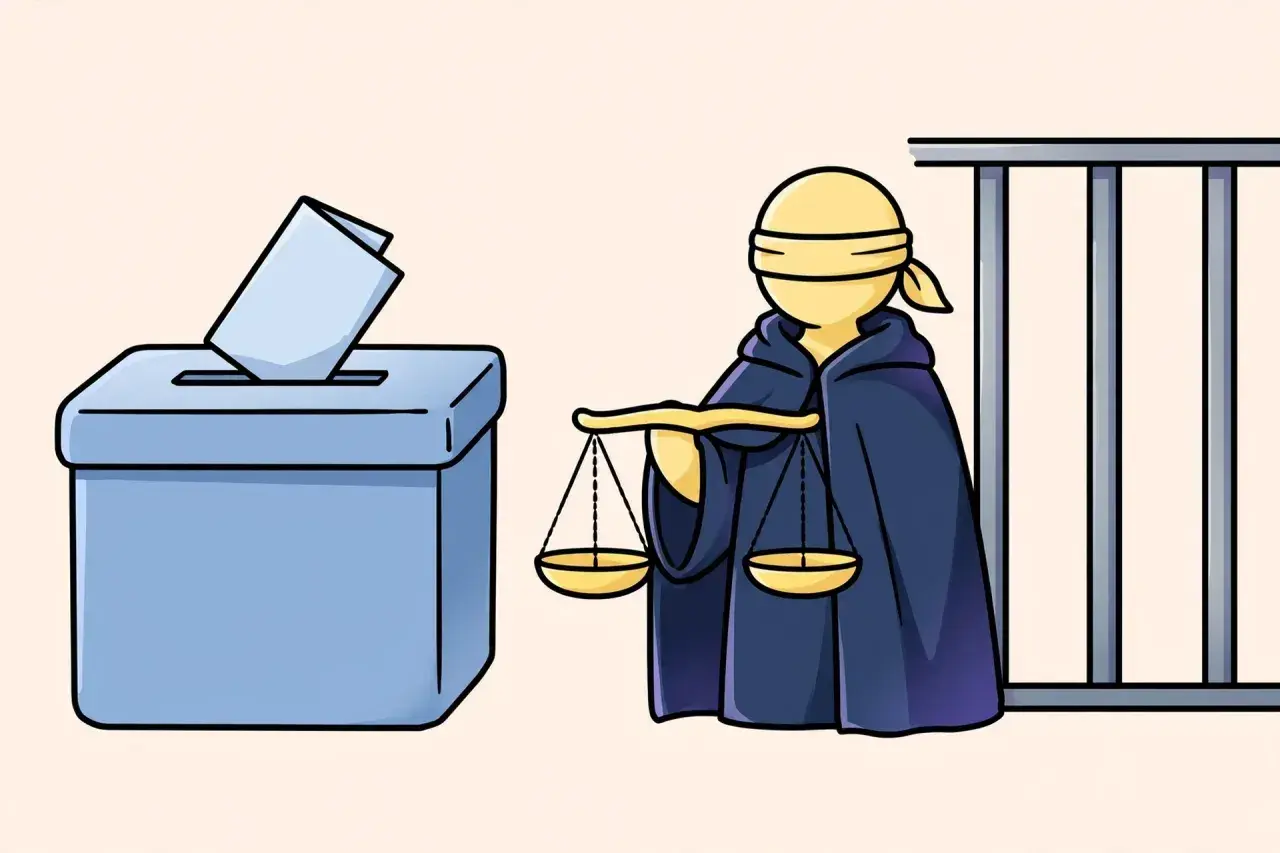
Can South Korea criminally punish a person for publicly insulting someone without violating the constitutional guarantees of clarity and freedom of expression?
A related but separate question is whether a particular post—Mina’s, for example—meets the legal requirements for the offense. A constitutional ruling that the law is valid does not automatically settle that issue.
3. What Korean Law Says
Article 311 of the Criminal Act makes it an offense to publicly insult another person. The offense is aimed at insulting expression, rather than a false factual allegation; a statement alleging a concrete fact may raise different legal questions, including defamation. The distinction is not always simple, and the words must be considered in context.
Criminal Act, Article 311: “A person who publicly insults another shall be punished by imprisonment or imprisonment without prison labor for not more than one year or by a fine not exceeding two million won.”
The offense is also complaint-based. In general, prosecution requires a complaint from the person insulted. This gives that person a role in whether the criminal process begins, though it does not mean that a complaint proves the offense.
The Constitutional Court addressed the constitutionality of Article 311 in its decision of June 27, 2013, in case 2012Hun-Ba37. It upheld the provision, rejecting the arguments that the offense was too unclear and that it impermissibly restricted freedom of expression.
The Court’s reasoning included several safeguards and features of the law:
- The statutory concept was sufficiently clear. The Court considered the meaning of “insult” understandable enough to be applied, even though judgment about expression may require attention to its setting and tone.
- Public insults can spread widely. Online remarks may be copied, shared, and seen by many people, increasing the harm to the person targeted.
- The offense requires a complaint. The person insulted must generally initiate the process by making a complaint.
- The available punishment is limited. The Court regarded the statutory penalty as comparatively modest, and noted that judges can take the seriousness of an individual case into account when sentencing.
Important distinction: Upholding Article 311 means that the law remains in force. It does not mean that every harsh, rude, or unpopular statement is automatically a crime.
Three justices dissented. They considered the provision unconstitutionally vague and thought it infringed freedom of expression. Their disagreement highlights the difficult boundary between protecting personal dignity and preserving space for robust debate.
4. How Korean Courts Approach This
Korean courts do not decide an insult case simply by asking whether the words were unpleasant. They examine the expression as a whole: the words used, the circumstances in which they were published, who could see them, the relationship between the people involved, and whether the statement attacked a person with contempt or instead contributed to criticism of an idea or conduct.
General judicial principle: The constitutional validity of the insult law does not remove the need to assess each statement in its particular context. Strong criticism and personal insult are not interchangeable categories.
That distinction matters especially online. A post may remain visible, be shared beyond its original audience, and expose its target to lasting humiliation. At the same time, the constitutional protection of expression has special importance in public debate. The challenge for a court is to avoid treating mere sharpness or disagreement as criminal while still recognizing that a public personal attack can cause real harm.
Courts also have to consider the degree of blameworthiness when deciding what consequence is appropriate. The Constitutional Court relied in part on the ability of judges to calibrate punishment, including for conduct whose wrongdoing is relatively minor. A finding that the statute is constitutional is therefore not a direction to impose the maximum penalty in every case.
5. Applying the Law to the Case
Mina’s situation can be assessed in a series of steps.
- Was the expression public? Mina posted on a public social-media account. That fact supports the “publicly” element, although the precise audience and circumstances would still matter.
- Was it directed at an identifiable person? Her post referred to Joon Seo. If readers could understand that she meant him, the target would be identifiable.
- Was it an insult rather than a factual allegation? Calling someone “intellectually lightweight” or “not up to the job” appears, on its face, to express contempt or disdain rather than allege a specific, verifiable event. That makes the insult provision a relevant legal concern. But the wording alone is not the whole analysis: the discussion’s subject, tone, surrounding posts, and whether the remarks were part of criticism of Seo’s public arguments could matter.
- Was a complaint made? In the fictional case, Seo filed one. That satisfies the procedural condition generally required for prosecution of this offense; it does not by itself establish guilt.
- Does the Constitution invalidate the law? Under the Constitutional Court’s 2013 decision, Mina could not establish that Article 311 is unconstitutional simply because it restricts insulting speech. The Court held that the provision was sufficiently clear and that its limits were not an excessive infringement of expression, given the potential reach of online insults, the complaint requirement, and the relatively limited penalty range.
The result is a distinction between the law and its application. The constitutional challenge to Article 311 fails under the Court’s ruling. Whether Mina’s particular words justified conviction, and whether a ₩1 million fine was appropriate, would depend on the record and the court’s assessment of context and seriousness. The constitutional decision alone cannot answer those case-specific questions.
If you are dealing with a similar issue, attorney Ji-sun Ahn of Ijun Law Firm can review the provision applied in your case, the ruling or notice you received, and the dates relevant to challenging it with you. These details can help clarify which options apply to your situation.
6. Conclusion: What Happened, and What Should You Do?
Mina’s constitutional argument did not remove Article 311 from the law. The Constitutional Court had already upheld it, so her belief that the insult provision was inherently unconstitutional was not a route to automatic relief. Her fine remained a matter to address through the ordinary legal process, where the exact wording, audience, context, and seriousness of the post could be examined.
For readers facing a similar situation, three practical steps can help:
- Preserve the full context. Save the post, the surrounding discussion, audience settings, and any relevant messages. A cropped quotation may hide facts that help explain whether the words were personal abuse or criticism of an argument.
- Take deadlines and procedure seriously. If you receive a request to attend questioning or a court notice, seek advice promptly. A complaint is not proof of guilt, but ignoring the process can make it harder to present your account.
- Criticize ideas without targeting a person’s dignity. Be specific about why an argument is flawed and avoid gratuitous personal labels. In online debate, a few impulsive words can travel much farther—and last much longer—than the writer expects.