
1. A Human Story
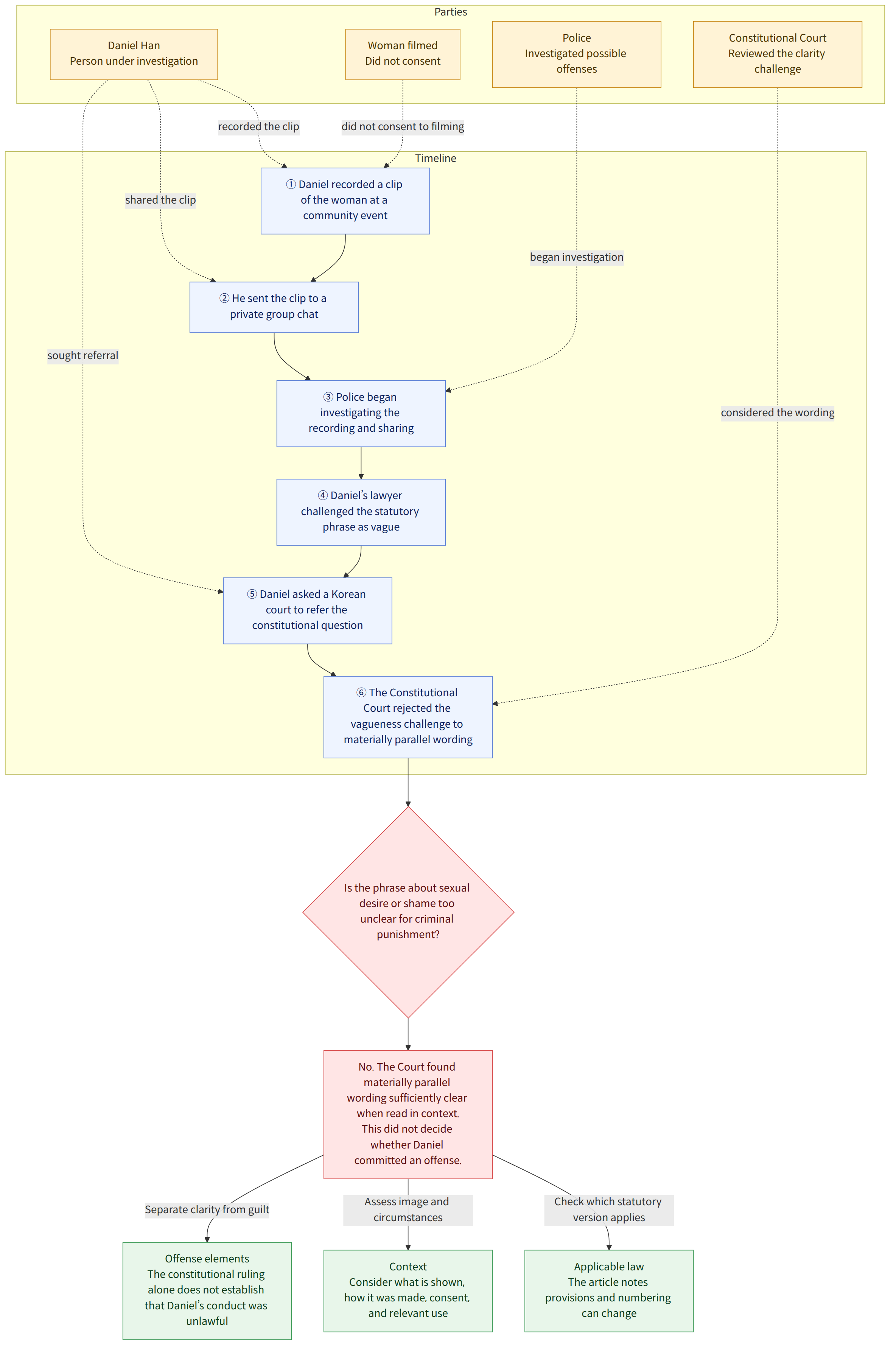
Daniel Han had always thought of himself as careful with his phone. At a crowded community event, he recorded a short clip of a woman standing near the stage. Later, he sent it to a private group chat. The woman had not agreed to be filmed or to have the clip shared, and the police began investigating whether the recording and distribution violated Korea’s law on camera-based sexual offenses.
Daniel’s lawyer raised a different question from whether the clip was offensive. The law, Daniel argued, criminalized images that could cause “sexual desire or shame”—words that seemed open to interpretation. How could a person know in advance which image crossed the criminal line? Daniel asked a Korean court to refer that constitutional issue to the Constitutional Court.
2. The Legal Question
Is the phrase “a person’s body that may cause sexual desire or sexual shame” too unclear to support criminal punishment under Korea’s principle that crimes and penalties must be defined by law?
The question is about the clarity of the legal standard. It is separate from whether Daniel’s particular recording was unlawful or whether he committed the offense.
3. What Korean Law Says
The relevant provision of Korea’s Act on Special Cases Concerning the Punishment, etc. of Sexual Crimes criminalizes specified conduct involving a camera or similar device, including taking an image of another person’s body against that person’s will when the image has the required sexual character. The applicable statutory version also addresses certain forms of distributing or displaying such images. The wording and numbering of provisions can change through amendments, so the version governing a particular case matters.
The constitutional concern is known as the void-for-vagueness principle, a part of the rule of law. People should be able to understand what conduct is forbidden, and judges should have standards that prevent arbitrary decisions. But the Constitution does not require every legal term to be mathematically exact. Some concepts need to be applied in context.
The Constitutional Court has upheld materially parallel wording in this area. It explained the phrase in substance as follows:
The words refer to an image that goes beyond merely arousing curiosity and is capable of creating or intensifying sexual desire in the offender or another person, or of causing the depicted person more than ordinary embarrassment or displeasure—namely, a sense of shame or humiliation affecting that person’s dignity. The image must also be contrary to the sexual morality of society as understood by an average person.
That interpretation supplies a framework rather than a mechanical checklist. In practical terms, the inquiry may involve:
- The image itself: what is shown and how the person’s body is depicted.
- The circumstances: where and how the image was taken, and whether the person agreed to the recording.
- The way it was made or used: including the framing, focus, or subsequent distribution where relevant to the offense charged.
- The effect on dignity: whether the image would ordinarily be understood as degrading or sexually invasive, rather than merely awkward or unwelcome.
No one item automatically decides the issue. Nor does the law make a person’s private reaction, standing alone, the entire test.
4. How Korean Courts Approach This
Korean courts generally consider statutory language in its ordinary meaning, its place in the law, and the purpose of the provision. In this setting, the Constitutional Court has reasoned that a person of ordinary understanding can grasp the phrase when it is read alongside the legal interpretation developed by the courts.
The standard is therefore neither purely subjective nor detached from the circumstances. A defendant cannot establish that an image is outside the law simply by saying that he did not find it sexual. Equally, a complainant’s understandable discomfort does not by itself prove every element of a criminal offense. The court must evaluate the image and conduct against the legal standard, taking the circumstances into account.
The Constitutional Court has also treated the protection at stake as important: the law addresses intrusive image-making and distribution that can violate a person’s sexual dignity. It has found no sufficient reason to abandon its earlier conclusion that the relevant wording is clear enough to satisfy the constitutional standard.
5. Applying the Law to Daniel’s Case
Daniel’s constitutional argument has to be considered in stages.
- Identify the rule being challenged. Daniel objects to the statutory phrase describing an image capable of causing sexual desire or shame. The Constitutional Court has considered materially parallel language in the camera-related provisions of the Act.
- Ask whether ordinary people can understand the phrase. The Court’s answer is yes. Read in context, the words refer to more than ordinary curiosity, embarrassment, or annoyance. They concern sexualized depiction or humiliation that conflicts with commonly understood standards of sexual dignity.
- Distinguish a clear legal test from an easy factual answer. Applying the standard may require judgment, but that does not necessarily make the law unconstitutional. Daniel’s clip must be assessed on its actual content and circumstances; the phrase does not decide the case automatically.
- Keep the constitutional question separate from guilt. The Constitutional Court’s conclusion that the wording is sufficiently clear does not establish that Daniel’s recording or sharing violated the law. The criminal court must still determine whether the relevant statutory elements are proved, including the nature of the image and the conduct alleged under the applicable version of the Act.
On the facts as described, Daniel’s challenge concerns the same kind of vagueness objection that the Constitutional Court has rejected. His argument that the phrase is inherently too unclear is therefore unlikely to succeed. But the available facts do not establish what the clip showed or how it was framed, so they cannot support a reliable conclusion about whether Daniel is criminally liable.
If you are dealing with a similar issue, attorney Ji-sun Ahn of Ijun Law Firm can review when the image was created or shared, any saved links and timestamps, and records of requests for removal with you. These details can help clarify which options apply to your situation.
6. Conclusion: What Happened, and What Should You Do?
Daniel’s constitutional challenge fails: Korean law does not treat the phrase “sexual desire or shame” as automatically too vague to enforce. The courts have explained it through an ordinary-person standard tied to sexual dignity and social understanding. Daniel’s criminal case, however, remains a separate question. A ruling that the law is clear enough is not a ruling that he is guilty.
For anyone facing a similar situation:
- Preserve the full context. Keep the original recording, surrounding footage, messages, and information about how the image was made or shared; do not edit or circulate it further.
- Get advice promptly. The statutory version, the precise conduct alleged, and procedural deadlines can all matter. Consult a Korean criminal-defense lawyer before making detailed statements or filing a constitutional petition.
- Do not assume consent or intent settles the issue. Whether an image falls within the law is assessed under the legal standard and the full circumstances, not solely by the photographer’s explanation or the recipient’s reaction.

















