

1. A Human Story
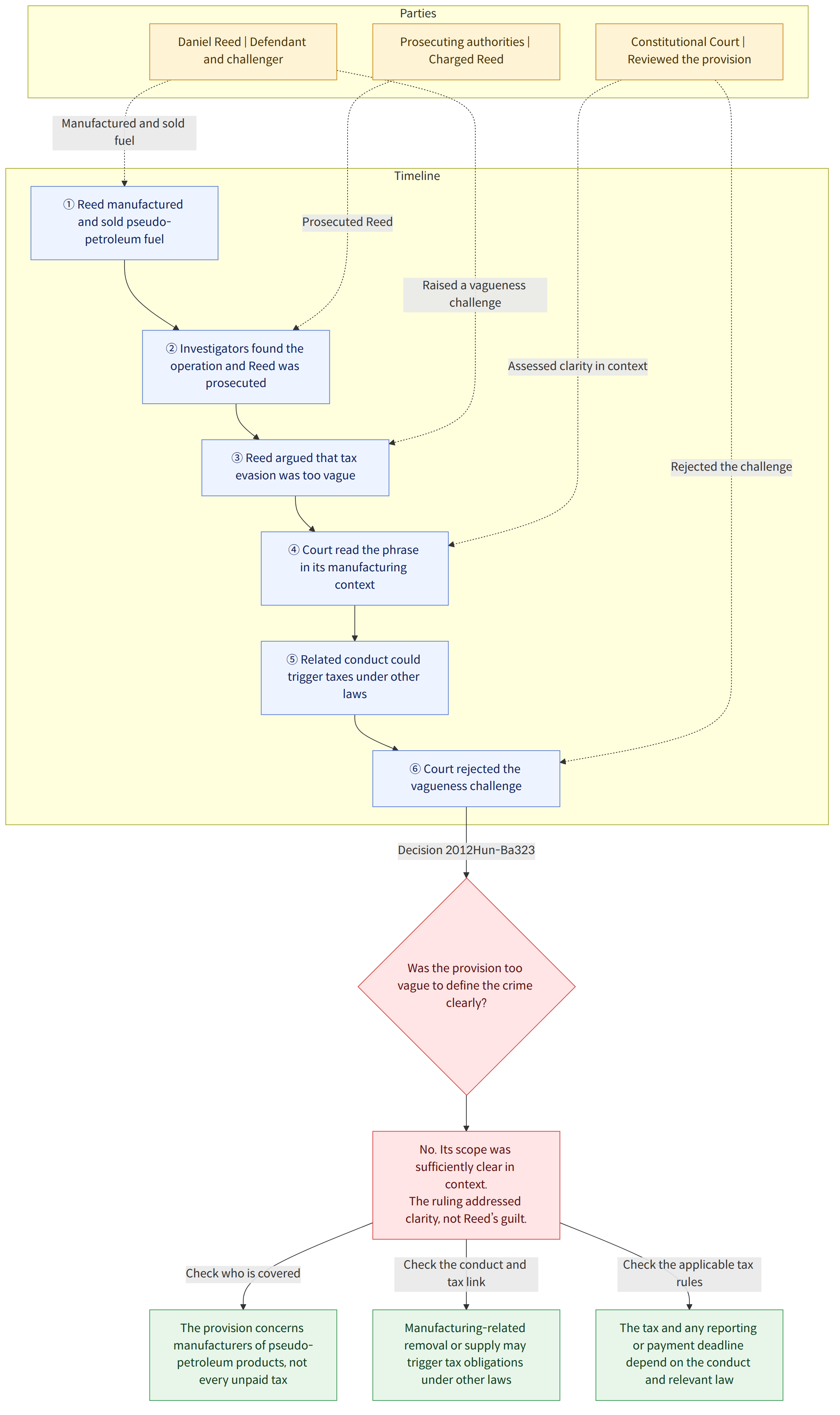
Daniel Reed thought the small workshop behind his repair garage was a temporary way to keep his business afloat. He blended and sold fuel that was made to resemble ordinary petroleum products, taking cash from customers and keeping no reliable sales records. When investigators discovered the operation, Daniel was prosecuted for tax evasion connected with pseudo-petroleum products.
His defense focused not only on what he had done, but on the words used to charge him. “Tax evasion,” he argued, could mean too many things. If a criminal law did not explain clearly what counted as evasion, he said, it should not be used to convict him. His challenge raised a larger question: how much detail must a criminal statute provide before people can understand what conduct it prohibits?
2. The Legal Question
Is a Korean criminal provision addressing tax evasion by a person who manufactures pseudo-petroleum products too vague to satisfy the constitutional principle that crimes and punishments must be defined clearly by law?
3. What Korean Law Says
Korea’s Constitution requires criminal laws to give people fair notice of prohibited conduct and to limit arbitrary enforcement. A law need not spell out every possible factual variation, but its wording must be understandable when read in context, including its subject, purpose, and relationship to other laws.
The Constitutional Court considered this issue in decision 2012Hun-Ba323. It rejected the argument that the relevant provision was unconstitutionally unclear. The key was that the phrase about tax evasion did not stand alone: the provision concerned evasion connected to the manufacture of pseudo-petroleum products.
“Evasion” means avoiding or escaping taxation. In this provision, it refers to avoiding taxes that become due through conduct connected with manufacturing pseudo-petroleum products, such as removing the product from a facility or supplying it as a business.
The Court explained that such conduct can create liability for specific taxes under other statutes. Depending on the circumstances, those taxes may include the traffic, energy and environment tax, education tax, or value-added tax. The precise obligation depends on the person’s conduct and the applicable tax law.
The Court’s reasoning can be summarized in several points:
- The provision is limited to a person who manufactures pseudo-petroleum products; it does not criminalize every failure to pay any kind of tax.
- Manufacturing-related conduct, including removal or supply of the product, may trigger a tax obligation under the relevant tax statutes.
- The provision reaches conduct in which the person evades the resulting tax, including failing to report or pay it by the applicable deadline.
- The provision was introduced to strengthen enforcement against pseudo-petroleum manufacturing, including situations in which earlier law made prosecution difficult because there had been no active act making tax assessment or collection impossible or markedly difficult.
The fact that the words “a person who evades tax” might seem broad in isolation does not make the provision unclear when the statute confines them to tax evasion connected with the specified manufacturing conduct.
A person who files a constitutional complaint under Article 68(2) of the Constitutional Court Act generally does so after a court rejects a request to refer the statute for constitutional review. That procedure allows a constitutional challenge to the law’s validity; it does not itself decide whether the accused committed the offense.
4. How Korean Courts Approach This
Korean courts assess clarity by reading statutory language in its full legal and practical setting, rather than isolating one phrase. They ask whether a person can reasonably understand the conduct covered and whether the law gives judges and prosecutors workable boundaries.
A broad word is not automatically unconstitutional. The question is whether its meaning becomes sufficiently definite when considered alongside the provision’s limits, purpose, and related laws.
In this type of case, the court looks at the connection between the specified product-manufacturing conduct and the tax liability that follows. It also considers the legislative purpose: the measure was intended to address tax evasion associated with pseudo-petroleum production, including conduct that had previously been difficult to punish under narrower rules.
That approach does not mean every tax debt is a crime. Criminal liability still depends on the statutory elements and the facts of the individual case. The constitutional ruling addressed whether the provision was clear enough—not whether any particular defendant had evaded tax.
5. Applying the Law to the Case
Daniel’s constitutional argument would be assessed in stages.
- Was the conduct within the provision’s defined setting? Daniel was not merely a taxpayer who missed an unrelated payment. He had allegedly manufactured pseudo-petroleum products. That fact placed his conduct within the specific subject matter that the provision identifies.
- Did his conduct create a tax obligation? Investigators and the court would need to determine what he manufactured, whether and how it was removed or supplied, and which tax statutes applied. Depending on those facts, a liability could arise for taxes such as the traffic, energy and environment tax or value-added tax.
- Was the resulting tax evaded? The prosecution would still have to prove the elements of the charged offense. Relevant issues could include the required reporting and payment obligations, the applicable deadlines, and what Daniel did or failed to do. The constitutional decision’s explanation that nonpayment by the relevant deadline can bring the offense to completion does not establish guilt automatically in every case.
- Does the wording give adequate notice? Read as a whole, the provision connects tax evasion to a defined category of manufacturing conduct and to the tax duties arising from that conduct. The Constitutional Court therefore concluded that the language was sufficiently clear, even though “tax evasion” might be broad if considered alone.
Daniel could still dispute the evidence, the tax calculation, whether he was the person legally liable, or whether the prosecution proved the required elements. But the claim that the provision was unconstitutional merely because the phrase “evades tax” is broad would not succeed under the Court’s reasoning.
If you are dealing with a similar issue, attorney Ji-sun Ahn of Ijun Law Firm can review the sequence of events, records showing what each person knew or did, and the grounds stated in any formal notice with you. These details can help clarify which options apply to your situation.
6. Conclusion: What Happened, and What Should You Do?
Daniel’s vagueness challenge failed: the Constitutional Court had already held that the provision was sufficiently clear when read in the context of manufacturing pseudo-petroleum products and the taxes arising from related acts. That conclusion did not by itself establish that Daniel was guilty. The prosecution still had to prove his conduct, the tax obligation, and the elements of evasion. On the assumed facts—that he manufactured and supplied the product and evaded the taxes thereby triggered—his constitutional objection alone would not defeat the charge.
For anyone facing a similar situation:
- Identify the exact charge and tax. Ask which statutory provision applies, what act allegedly created the tax liability, and which tax is at issue.
- Preserve the records. Keep production, sales, delivery, payment, and tax-filing documents; they may bear on both the amount due and what you knew or did.
- Get prompt legal advice. A Korean criminal-tax lawyer can review the charge, deadlines, tax calculations, and evidence, and distinguish a constitutional challenge from defenses to the facts.

















