1. A Human Story
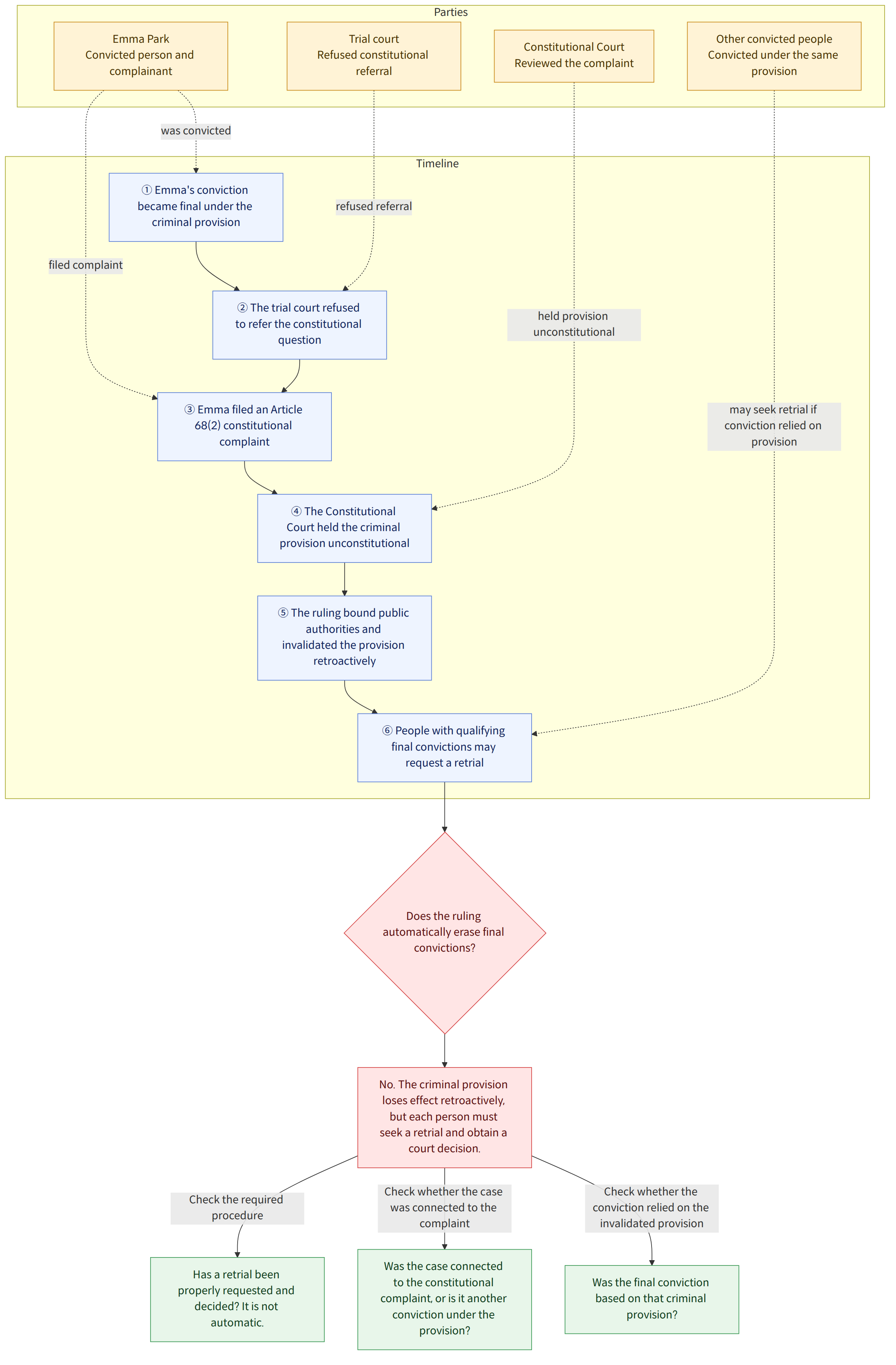
Emma Park had spent years trying to put a criminal conviction behind her. The trial was over, the judgment was final, and the law under which she had been convicted remained on the books. She believed that law violated the Constitution, but the ordinary court handling her case had refused to ask the Constitutional Court to review it.
Emma then took the route available to her: she filed a constitutional complaint under Article 68(2) of the Constitutional Court Act. While the complaint was pending, she continued to live with the consequences of the conviction. Then the decision arrived. The Constitutional Court ruled the criminal provision unconstitutional.
The ruling was a turning point, but not an instant reset. Emma still had to understand what the decision changed, whether she could reopen her own final case, and whether other people convicted under the same provision could benefit even though they had never joined her constitutional challenge.
2. The Legal Question
When the Constitutional Court upholds a constitutional complaint under Article 68(2), what happens to the law it has found unconstitutional—and what remedies are available to people whose cases have already become final under that law?
3. What Korean Law Says
Article 68(2) provides a way to bring a constitutional challenge to a law applied in a court case after the court has rejected a request to refer the law’s constitutionality to the Constitutional Court. A decision accepting that complaint has consequences beyond the person who filed it.
A ruling upholding an Article 68(2) complaint binds courts, other state institutions, and local governments. In other words, public authorities must give effect to the Constitutional Court’s decision; it is not merely advice about how a law should be read.
The timing of the law’s loss of effect depends on what kind of provision has been struck down:
- Ordinary laws or provisions: They lose effect from the date of the Constitutional Court’s ruling.
- Criminal laws or provisions: They lose effect retroactively. The rule is designed to prevent an unconstitutional criminal provision from continuing to support punishment for past conduct.
A final judgment does not necessarily close every door. If the case connected to the constitutional complaint has already been decided with final effect, the party may seek a retrial. This possibility applies regardless of whether the underlying case was civil, criminal, or administrative.
A retrial is a remedy to request, not an automatic cancellation of the old judgment. The person must apply through the proper procedure, and the court must deal with the case under the rules governing retrials.
There is an additional consequence when the unconstitutional provision is criminal. A person may seek a retrial of a final conviction based on that provision even if their case was not the case that gave rise to the constitutional complaint. The key point is whether the conviction rested on the criminal provision that the Constitutional Court invalidated.
4. How Korean Courts Approach This
Korean courts treat a Constitutional Court ruling on constitutionality as binding. Once a provision is held unconstitutional, courts cannot continue applying it as though the ruling had not happened. This is especially significant in criminal matters, where the retroactive effect of a ruling against a penal provision may provide a basis to reopen final convictions.
At the same time, courts distinguish between the effect of the constitutional ruling and the outcome of an individual retrial. The ruling establishes that the provision cannot stand; it does not, by itself, issue a new judgment in every person’s case. A person seeking relief must use the available retrial procedure, show that the relevant final judgment falls within the applicable grounds, and obtain a decision in that proceeding.
The distinction between a case related to the constitutional complaint and one that is not also matters. For a final case connected to the complaint, the law permits a retrial request regardless of whether the case was civil, criminal, or administrative. For a case unrelated to the complaint, the special reach described here concerns final convictions based on the unconstitutional criminal provision.
5. Applying the Law to the Case
Emma’s situation can be assessed in four steps.
- Her challenge used the relevant procedure. The trial court had refused to refer the constitutional question, so Emma pursued an Article 68(2) complaint concerning the law applied in her case.
- The Constitutional Court’s decision binds the authorities. Once the Court upheld the complaint and declared the criminal provision unconstitutional, courts and other public bodies were bound by that ruling.
- The criminal provision lost effect retroactively. Because the provision was part of a criminal law, it did not merely become unavailable for future cases on the date of the decision. The ruling also reached backward in the way described for unconstitutional penal provisions.
- Emma may seek a retrial despite the final judgment. Her conviction was the case connected to the constitutional complaint, and it had already become final. She therefore has grounds to apply for a retrial. The old conviction is not erased automatically, but the retrial process gives the court a way to reconsider it in light of the constitutional ruling.
The same principle may assist Daniel Cho, who was convicted under the same criminal provision in a separate case and had no role in Emma’s challenge. Because his final conviction was also based on the provision the Constitutional Court struck down, he may seek a retrial even though his case was unrelated to Emma’s complaint. That does not guarantee a particular result in the retrial; it means he is not excluded from seeking one merely because he was not the constitutional complainant.
The result would be different in an ordinary civil or administrative case unconnected to the constitutional complaint. A final case related to the complaint may be reopened regardless of its type, but the broader rule for unrelated cases described here applies to final convictions founded on the unconstitutional criminal provision.
If you are dealing with a similar issue, attorney Ji-sun Ahn of Ijun Law Firm can review the judgment in the original case, the scope and date of the constitutional ruling, and records that may support further proceedings with you. These details can help clarify which options apply to your situation.
6. Conclusion: What Happened, and What Should You Do?
Emma’s Constitutional Court victory did not automatically erase her conviction. It did, however, give her a legal basis to apply for a retrial because her final criminal case was connected to the successful Article 68(2) complaint. Daniel, although absent from the constitutional proceedings, may also apply because his separate final conviction rested on the same unconstitutional criminal provision.
For readers facing a similar situation:
- Get the exact ruling and identify the provision it invalidated. The wording and scope of the Constitutional Court’s decision matter.
- Compare the final judgment with that provision. Gather the judgment and related court records to establish whether the conviction was based on the invalidated criminal rule or whether a final case was connected to the constitutional complaint.
- Ask a Korean lawyer promptly about a retrial application. The ruling creates a route to relief, but the application must be made through the proper procedure; the decision does not reopen a case by itself.