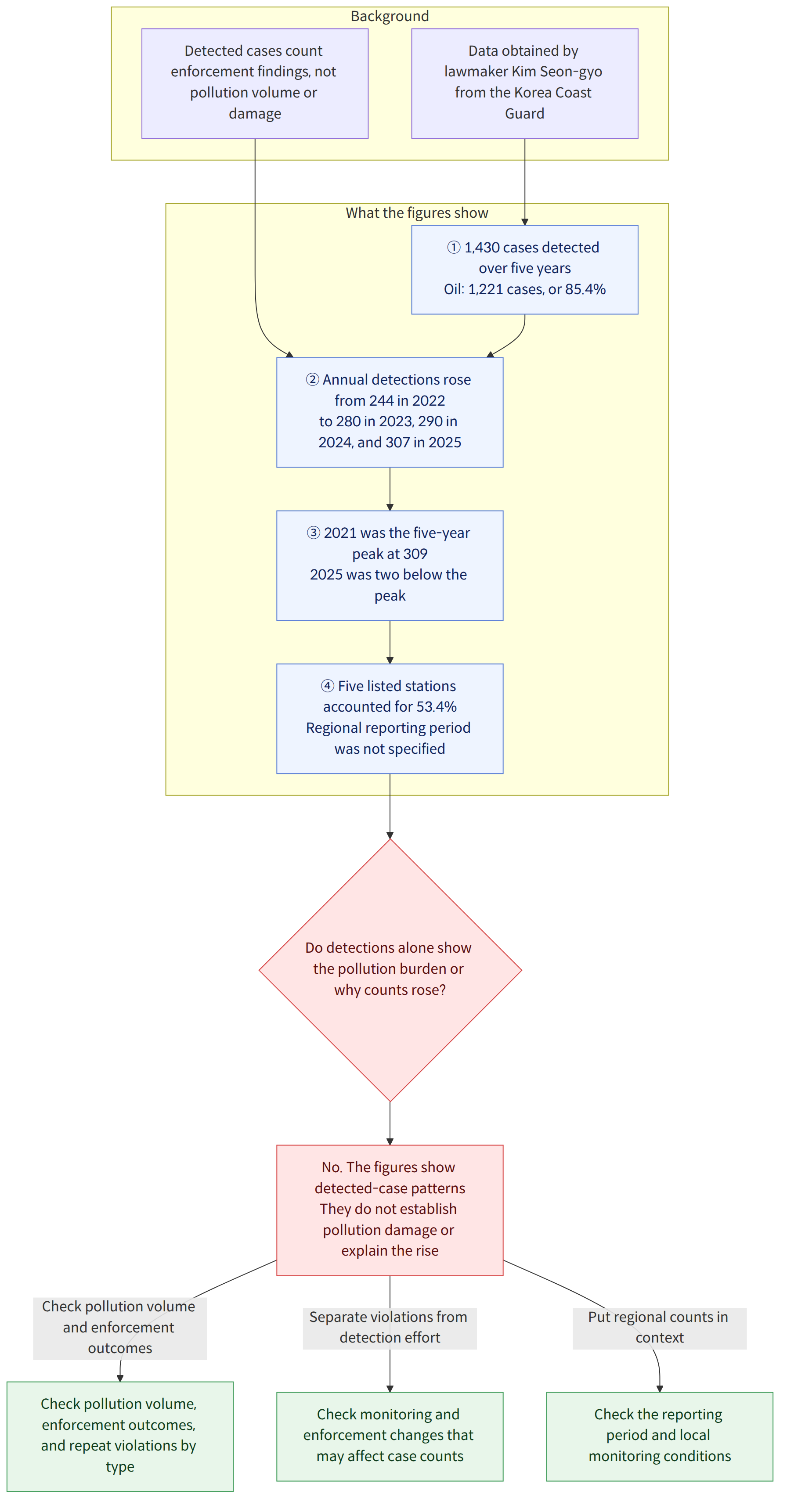
A total of 307 maritime illegal-dumping cases were detected in 2025. The number rose from 244 in 2022 to 280 in 2023 and 290 in 2024, marking an increase for four consecutive years through 2025. However, the year with the most cases detected in the past five years was 2021, with 309.
Background and context
The figures were reported based on the “Recent Five Years of Maritime Illegal-Dumping Cases Detected” (최근 5년간 해양 불법투기 적발 현황), data that the office of People Power Party (국민의힘) lawmaker Kim Seon-gyo obtained from the Korea Coast Guard (해양경찰청). The data show a total of 1,430 illegal-dumping cases detected over the past five years. The number of cases detected counts violations identified during enforcement; it does not directly indicate the amount of pollutants dumped into the sea or the extent of pollution damage.
By type, oil accounted for the largest share, at 1,221 cases (85.4%). Waste accounted for 161 cases (11.3%), air pollutants for 27 (1.9%), and hazardous liquid substances for 21 (1.5%). The detection statistics therefore highlight the large share of oil in enforcement against maritime illegal dumping. However, this percentage alone does not establish that oil accounts for the same share of overall pollution damage.
The regional figures presented were 261 cases in Busan, 161 in Yeosu, 145 in Mokpo, 100 in Ulsan, and 96 in Tongyeong. The five Coast Guard stations (해양경찰서) in these areas accounted for 53.4% of all cases detected. However, the article did not specify the reporting period for the regional figures, making it difficult to compare directly how many cases were detected in each area over a given period with statistics from other periods.
The number of cases detected has risen steadily in recent years, but the 2025 figure was two below the five-year high of 309 in 2021. Therefore, “increased for four consecutive years” and “the highest in five years” do not mean the same thing. The former refers to the upward trend since 2022; the latter means that 2021 was the peak for the entire period.
What this news means
The increase in cases detected can be seen as a sign that continued monitoring and management of maritime illegal dumping are important. At the same time, these figures alone cannot determine whether illegal dumping itself increased or whether more cases were found because enforcement and monitoring were strengthened. Changes in the number of cases detected may reflect both violations and the processes for finding and counting them, but the report did not include data that could distinguish between these effects.
The large share of oil cases shows why it is important to examine which types of dumping are most often detected when assessing pollution management and monitoring. However, the number of cases detected is not equivalent to the volume spilled or the extent of damage. To assess the environmental significance of the statistics more specifically, it would be necessary to know how much pollution each case caused, as well as the enforcement outcomes and rates of repeat violations for each type.
It is also notable that more than half of all cases were detected by the five Coast Guard stations in Busan, Yeosu, Mokpo, Ulsan, and Tongyeong. The available data do not show whether the concentration of detections in these areas reflects differences in the incidence of illegal dumping itself or differences in monitoring conditions across ports and waters. Kim Seon-gyo said illegal discharges at sea are serious crimes that threaten marine ecosystems and fishermen’s livelihoods, and called for expanded continuous monitoring networks at major ports and in key waters, along with stronger on-site inspections and advance guidance.
For example, readers who live or work along the coasts of Busan or Yeosu can look at whether the reporting period, types of cases detected, pollution volumes, and enforcement outcomes are disclosed together, rather than concluding from regional case counts alone that the waters near them are more polluted. Information distinguishing the scale of violations from enforcement conditions is also needed to interpret why some areas have higher case counts.
What is known and what remains unknown
What is known
- A total of 307 maritime illegal-dumping cases were detected in 2025.
- The number increased each year: 244 in 2022, 280 in 2023, 290 in 2024, and 307 in 2025.
- Oil accounted for 1,221 of the 1,430 cases detected over the past five years, or 85.4%.
- The regional figures presented were 261 cases in Busan, 161 in Yeosu, 145 in Mokpo, 100 in Ulsan, and 96 in Tongyeong.
- Kim Seon-gyo called for expanded continuous monitoring networks and stronger on-site inspections and advance guidance.
What remains unknown
- It is not known whether the increase in detections was influenced more by an actual rise in illegal dumping or by stronger enforcement and monitoring.
- The report did not state how enforcement actions or penalties for the detected violations were tallied.
- The reporting period for the regional case counts was not specified.
- It has not been established how much pollution or ecological and livelihood damage resulted from the cases detected in each category.
What readers should check
- When reviewing related statistics, readers should check whether the reporting period and enforcement and monitoring criteria are provided along with the annual figures.
- Before comparing regional case counts, readers should first check whether the reporting periods are the same for each area.
- Checking whether pollutant volumes by type and enforcement outcomes or penalties are disclosed alongside the number of cases detected can clarify what the statistics do and do not show.