Terror in the Gallery
Ji-soo Kim walked into the courtroom with a heavy heart and trembling hands. She was the key witness in a violent assault case involving an acquaintance, Min-ho Park. She had considered refusing to testify out of fear of retaliation, but the sense of justice and the court's subpoena eventually led her to the witness stand. The solemn atmosphere and the presence of security guards offered her a fleeting sense of security.
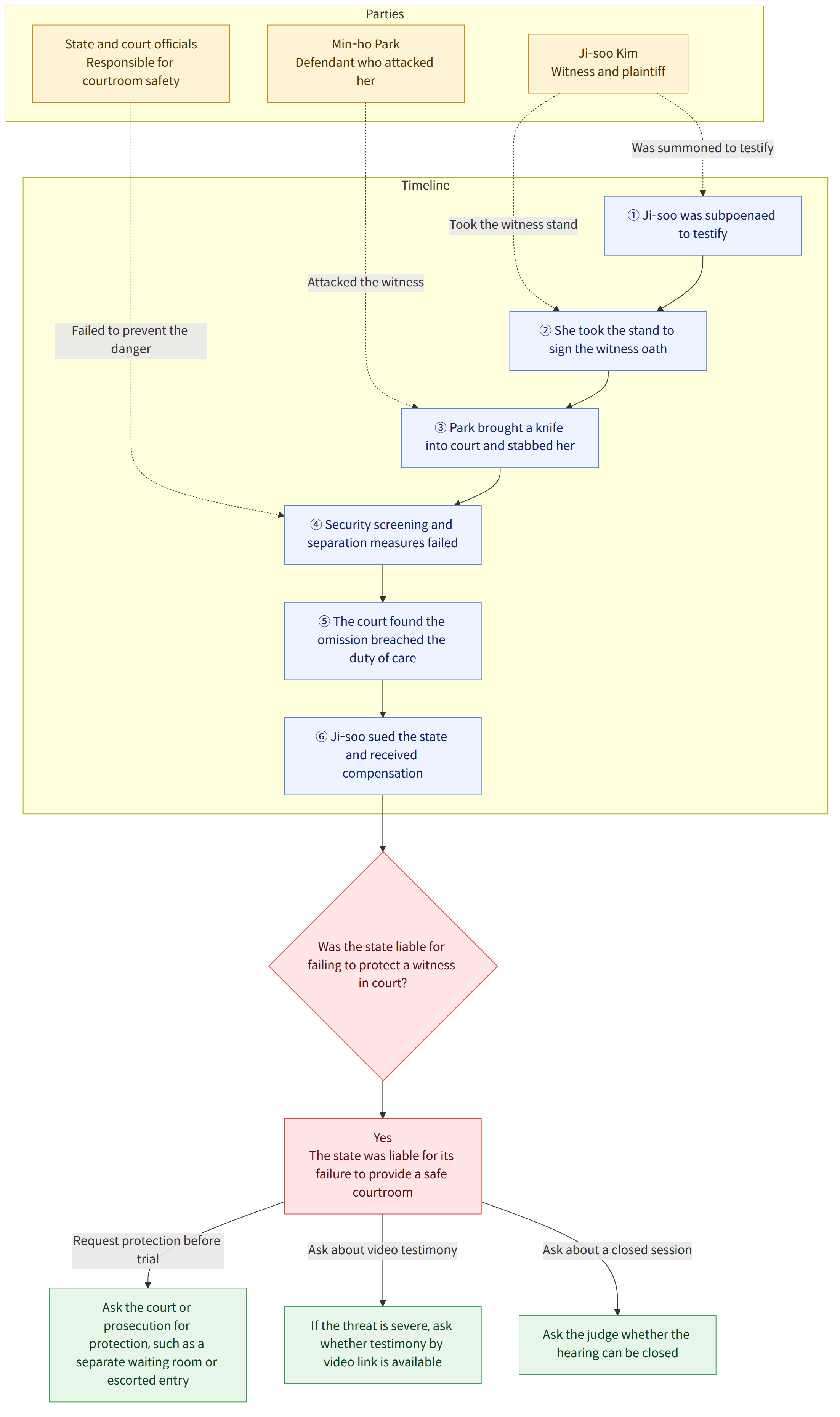
As the trial commenced, Ji-soo was called to the front. While she leaned over to sign the witness oath—a moment of total vulnerability—Min-ho Park, who had been sitting in the gallery, lunged at her. From his pocket, he drew a 28cm kitchen knife that had somehow bypassed security. Before anyone could react, he stabbed her multiple times in the head and back. The silence of the courtroom was shattered by screams as the hall of justice turned into a crime scene.
Ji-soo survived, but she was left with severe physical injuries and permanent psychological trauma. She had trusted the state to keep her safe while she performed her civic duty. Now, she asks: "Why didn't the state protect me?"
The Legal Question: Can You Sue the Government?
This case raises a critical question regarding the National Compensation Act: Does the state owe a specific legal duty to protect witnesses from violence within a courtroom, and is it liable for damages if it fails to do so?
What Korean Law Says: Duty of Care and Omission
Under Article 2(1) of the National Compensation Act, the state is liable for damages if a civil servant, in the course of their duties, causes harm to another person intentionally or through negligence by violating laws and regulations.
National Compensation Act Article 2 (Liability for Damages)The State or local governments shall, if any public official causes damage to another person by intent or negligence in the course of his/her official duties in violation of the Acts and subordinate statutes... compensate for such damage.
In the context of state liability, a "violation of law" does not only mean breaking a written statute. Korean courts interpret this broadly:
- Fundamental Mission of Protection: The state has a primary, extra-legal duty to intervene when there is an imminent and grave risk to a citizen's life or limb.
- Duty to Act (Actionable Omission): Even if there is no specific written protocol for every scenario, the state must take action to eliminate predictable dangers. Failing to do so is considered a legal violation through omission.
- Judicial Cooperation: Because the law compels citizens to testify as witnesses, the state assumes a reciprocal duty to ensure their safety during the process.
How Korean Courts Approach This
Korean courts generally hold that the Presiding Judge and court security personnel have the authority and responsibility to maintain order under the Court Organization Act. When there is a foreseeable risk of retaliation—common in criminal trials—the court and the prosecution must coordinate to segregate the witness from the defendant.
Judicial precedents suggest that allowing a 28cm knife into a courtroom is a prima facie failure of security. The court views the protection of witnesses not just as a courtesy, but as a prerequisite for the functioning of the judicial system.
Applying the Law to Ji-soo's Case
In Ji-soo's situation, the court found the state clearly liable for several reasons:
First, the fact that Min-ho Park entered the courtroom with a large weapon indicates a gross failure in the court's security screening process. Second, the court failed to provide adequate physical distance or barriers between a known violent defendant and a terrified witness.
By failing to take these basic preventative measures, the court officials breached their duty of care. The court ruled that this "omission" was a violation of the law, as the state failed in its primary mission to protect a citizen in a high-risk environment it created by summoning her.
Conclusion: What Happened, and What Should You Do?
Ji-soo Kim successfully sued the state and received compensation for her medical bills and emotional distress. While the ruling could not erase the trauma, it held the government accountable for its failure to maintain a safe environment for justice.
If you find yourself in a similar situation, fearful of testifying due to potential violence, consider these practical steps:
- Request Witness Protection: Before the trial, formally request protection from the prosecution or the court. This can include separate waiting rooms and escorted entry.
- Ask for Video Testimony: If the threat is severe, you may be allowed to testify via a video link from a secure, undisclosed location rather than appearing in the same room as the defendant.
- Request a Closed Session: You can ask the judge to clear the gallery to minimize exposure to the defendant's associates.
The courtroom must be a sanctuary for truth. If the state demands your cooperation in the pursuit of justice, it must, in turn, guarantee your safety from the moment you step through its doors.