
This year marks the 20th anniversary of the publication of Richard Dawkins’s The God Delusion. The book mounts a sustained critique of religion, particularly Christianity, and its fourth chapter, “Why There Almost Certainly Is No God,” is the central discussion among its 10 chapters. The book has sold more than 3 million copies and been translated into more than 30 languages, but it has been as controversial as it has been influential.
Background and context
Dawkins is an evolutionary biologist who became well known for The Selfish Gene (1976). Along with Christopher Hitchens, Daniel Dennett and Sam Harris, he was dubbed one of the “Four Horsemen of New Atheism.” The book also drew attention against a backdrop of concern about the relationship between religion and political power. The original article recounts that, during a 1999 U.S. Republican presidential primary debate, George W. Bush answered “Christ” when asked to name the political philosopher or thinker with whom he most identified.
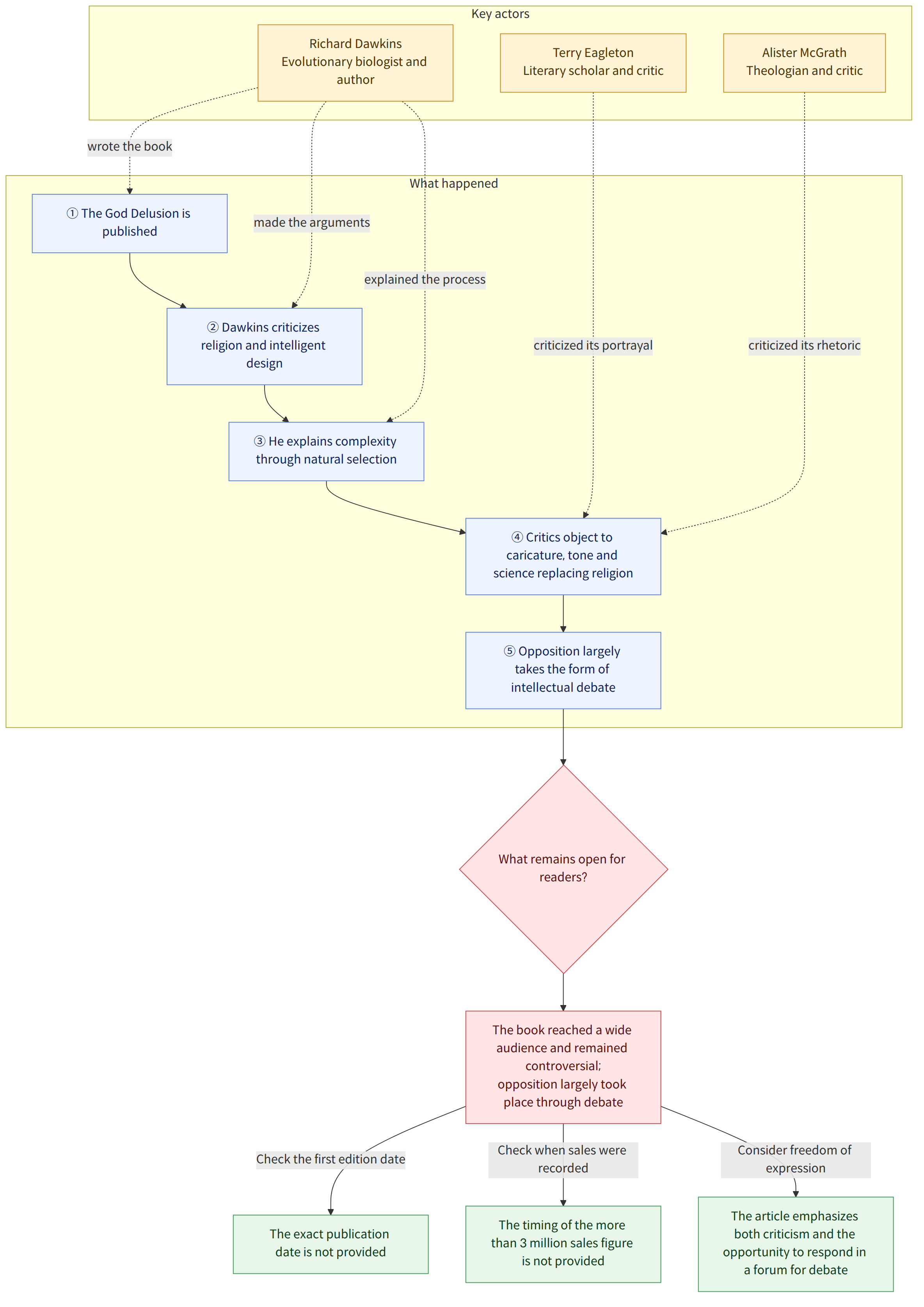
The book’s central dispute concerns intelligent design—the claim that nature’s complexity stems from the intentions of an intelligent designer. Dawkins argues that invoking a designer does not resolve the problem of explaining the complexity of living things. By the same logic, he says, one must ask whether an even more intelligent being created the designer.
In response, the book explains how complexity can arise through natural selection—the process by which genetic variations advantageous in a given environment are passed on to subsequent generations. In Dawkins’s account, living things evolved gradually from a simple starting point, and complexity does not arise through chance alone. Among random genetic variations, those that offer an advantage for survival and reproduction in a particular environment are retained through natural selection.
What this means
The objections to The God Delusion fell into three broad categories: that it portrayed religious belief as simpler and more ridiculous than it really is; that Dawkins’s tone was too harsh and aggressive; and that it put science in the place of religion. Literary scholar Terry Eagleton criticized Dawkins and others for depicting religious belief as a crude caricature “that would make even a first-year theology student wince,” while theologian Alister McGrath described Dawkins’s rhetoric as “sharp and aggressive.”
The existence of these objections does not mean Dawkins was significantly excluded from public debate. The original article explains that opposition to the book largely took the form of intellectual debate. This shows that discussions of freedom of expression need to consider not only the right to criticize, but also the opportunity to respond to criticism and the preservation of a forum for debate.
Dawkins speculated that religion could be a byproduct of other evolved tendencies. He suggested that religion might have roots in tendencies such as intuitively attributing purpose, or the capacity for children to trust adults so they can avoid danger. This should be read as a hypothesis Dawkins put forward, rather than as an established fact about the origins of religion.
He wrote that religion serves four functions: explanation, exhortation, consolation and inspiration. At the same time, he argued that the fact that religion offers people comfort does not prove the truth of religious belief. For example, if a reader were to judge whether a belief is true solely on the basis that it offers them comfort, Dawkins’s distinction would require them to consider the comforting function and the question of truth separately. The point is not to deny the value of comfort, but to argue that emotional benefit and evidence-based judgment should not be treated as the same thing.
What is established and what remains unknown
Established facts
- The God Delusion criticizes religion, particularly Christianity, and its fourth chapter is presented as the central discussion among its 10 chapters.
- The book has sold more than 3 million copies and been translated into more than 30 languages.
- The main objections were that it caricatures religious belief, uses an aggressive tone and presents science as if it were a new religion.
- Dawkins described four functions of religion and argued that comfort does not prove truth.
- The original article says that Dawkins is now more controversial for his comments related to transgender identity than for his criticism of religion.
What remains unknown
- The exact publication date of the first edition of The God Delusion is not provided.
- The original article does not say when the sales figure of more than 3 million copies was recorded.
What readers can check
- When reading the book’s arguments, readers can distinguish among its assessment of religion, its explanation of natural selection and its speculation about the origins of religion.
- When discussing the comfort or social functions of religious belief, readers can consider whether describing those functions and examining the evidence for a belief’s truth are the same question.
- Regardless of whether they agree with the criticism of religion, readers can better understand the issues at stake by examining both the arguments used and the objections raised.