
The Dream of Permanency Meets a Harsh Reality
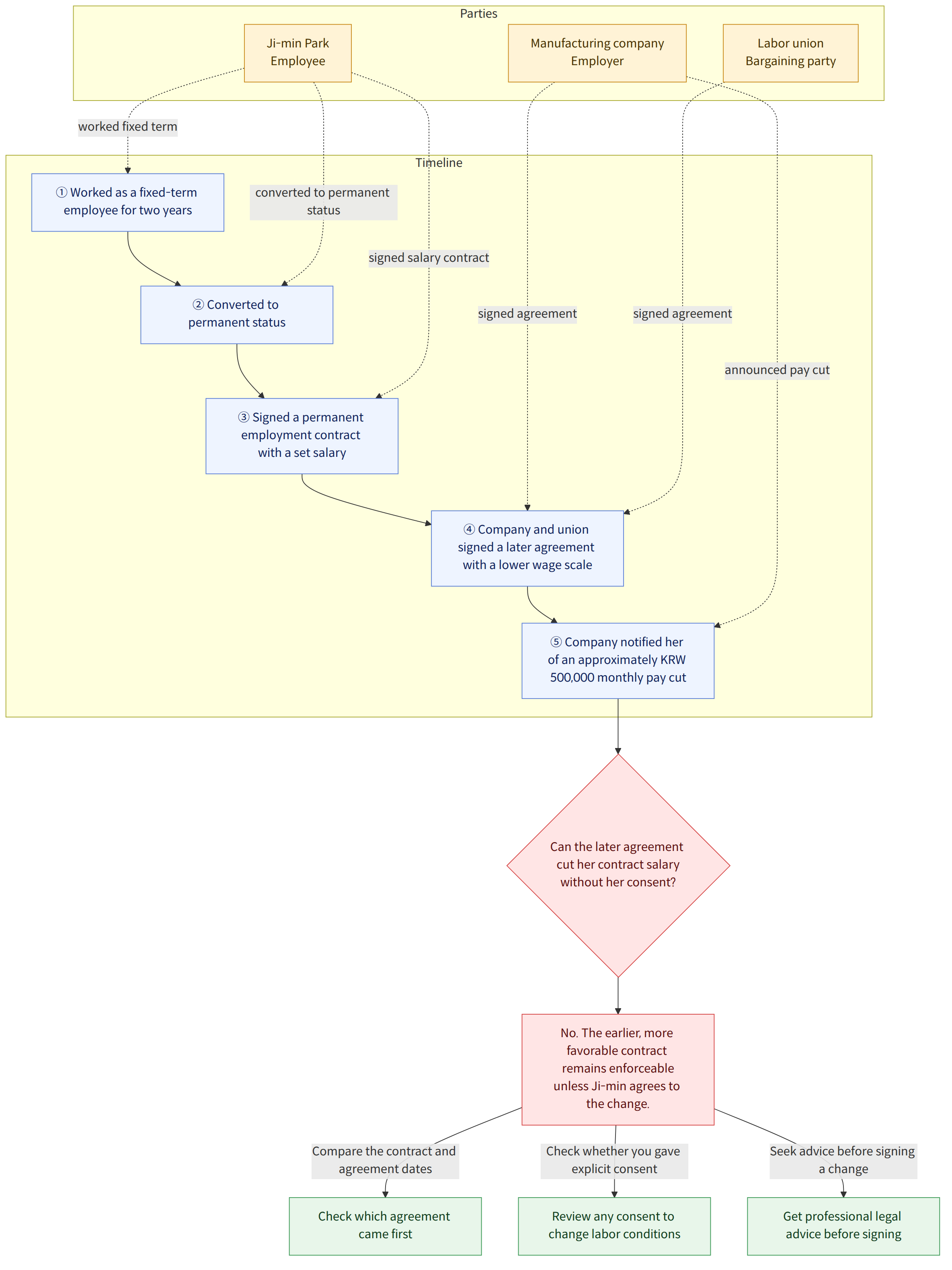
Ji-min Park had worked as a fixed-term employee at a mid-sized manufacturing firm for two years. Her hard work paid off when she was officially converted to permanent status under the law. She signed a new employment contract with a satisfying salary, feeling that her career was finally on solid ground. She was ready to dedicate her future to the company.
However, the honeymoon period was short-lived. A few months after Ji-min became permanent, the company and the labor union signed a new collective agreement. This agreement introduced a specific wage scale for "converted permanent workers" that was significantly lower than what Ji-min had negotiated in her individual contract. The company notified her that her monthly pay would be slashed by approximately 500,000 KRW, claiming that "collective agreements always override individual contracts."
Ji-min was devastated. Is it legally possible for a deal made between the union and the company to take away the salary she had already secured in her own signed contract?
Does a Collective Agreement Always Take Precedence?
This case centers on a critical legal question: Can a new collective agreement retroactively worsen the conditions of an already valid individual employment contract?
Under the Trade Union and Labor Relations Adjustment Act of Korea, a labor contract that falls below the standards set by a collective agreement is considered void. However, the law is more nuanced when the individual contract is better than the collective agreement, especially when that contract was signed before the new agreement came into existence.
The 'Principle of Favorability' in Korean Labor Law
One of the fundamental doctrines in Korean labor law is the 'Principle of Favorability' (유리성의 원칙). This principle suggests that the most beneficial conditions for the employee should take priority.
Core Judicial Principle"Even if a collective agreement is changed to the disadvantage of employees, it cannot retroactively strip away vested rights or more favorable conditions set in an individual contract without the specific consent of the employee."
Based on this principle, the legal interpretation follows these points:
- Ban on Retroactive Application: A collective agreement generally applies from the moment it is signed. It cannot reach back in time to downgrade the status of a worker who already finalized their contract as a permanent employee.
- Priority of More Favorable Terms: If an individual contract offers better terms than a collective agreement, the individual contract remains valid and enforceable.
How Korean Courts Approach This Issue
While Korean courts respect the autonomy of collective bargaining, they do not allow it to be used as a tool to arbitrarily strip away an individual's established rights. The Supreme Court has consistently ruled that if a worker has already secured a specific wage level through an individual contract, a subsequent collective agreement between the union and the employer cannot lower that wage unless the worker personally agrees to the change.
In Ji-min Park's situation, because she had already secured her salary through a formal contract before the union's deal was struck, the company cannot use the union deal as a shield to cut her pay.
Applying the Law to Ji-min's Case
Let’s look at the step-by-step reasoning for Ji-min:
First, Ji-min is a permanent employee who signed a contract before the new collective agreement was enacted. Her rights to that specific salary were already "vested."
Second, the company’s attempt to lower her pay based on a later agreement constitutes a violation of the existing individual contract. Without her explicit consent to amend her contract, the 500,000 KRW deduction could be considered unpaid wages (wage arrears).
Therefore, Ji-min has the legal right to demand the full salary stated in her original permanent employment contract.
Conclusion: Your Contract is Your Shield
Ultimately, Ji-min Park does not have to accept the pay cut. The law stands on her side, prioritizing the specific agreement she made with her employer over a later, less favorable union deal.
If you find yourself in a similar situation, keep these two tips in mind:
- Check the Timelines: Always compare the date you signed your permanent contract with the date the collective agreement was signed. If your contract came first, you have a strong legal standing to maintain your current benefits.
- Be Cautious with 'Consent' Forms: Companies may ask you to sign a "Consent to Change Labor Conditions" to align your contract with a new collective agreement. Signing this could legally waive your rights to your higher salary. Always seek professional legal advice before signing such documents.
Your individual contract is a binding promise. Don't let a subsequent agreement wash away the security you've worked so hard to achieve.