
1. The Paycheck Crisis: A Tale of Two Workers
Ji-hoon Kim (34), a dedicated factory worker earning 1.8 million KRW a month, was paralyzed with fear. After a failed business venture years ago, his debts had finally caught up with him. He recently received a notice stating that his wages would be garnished. To Ji-hoon, his salary was more than just money; it was his rent, his food, and his only hope. He wondered if the bank would take every last won, leaving him homeless.
In another part of the city, Young-min Choi (45), a marketing director earning 7 million KRW per month, faced a similar fate after a personal guarantee for a friend's loan went south. Despite his high income, he worried that a massive garnishment would make it impossible to support his children’s education and pay his mortgage. How does the law balance the rights of creditors with the basic needs of these workers?
2. The Core Legal Question
In both cases, the central issue is: "When a creditor initiates a compulsory execution against a debtor's wages, is there a legal limit to how much they can take?" Korean law must determine the 'exempt amount' that is strictly off-limits to creditors to ensure the debtor's survival.
3. What Korean Law Says: The Brackets of Protection
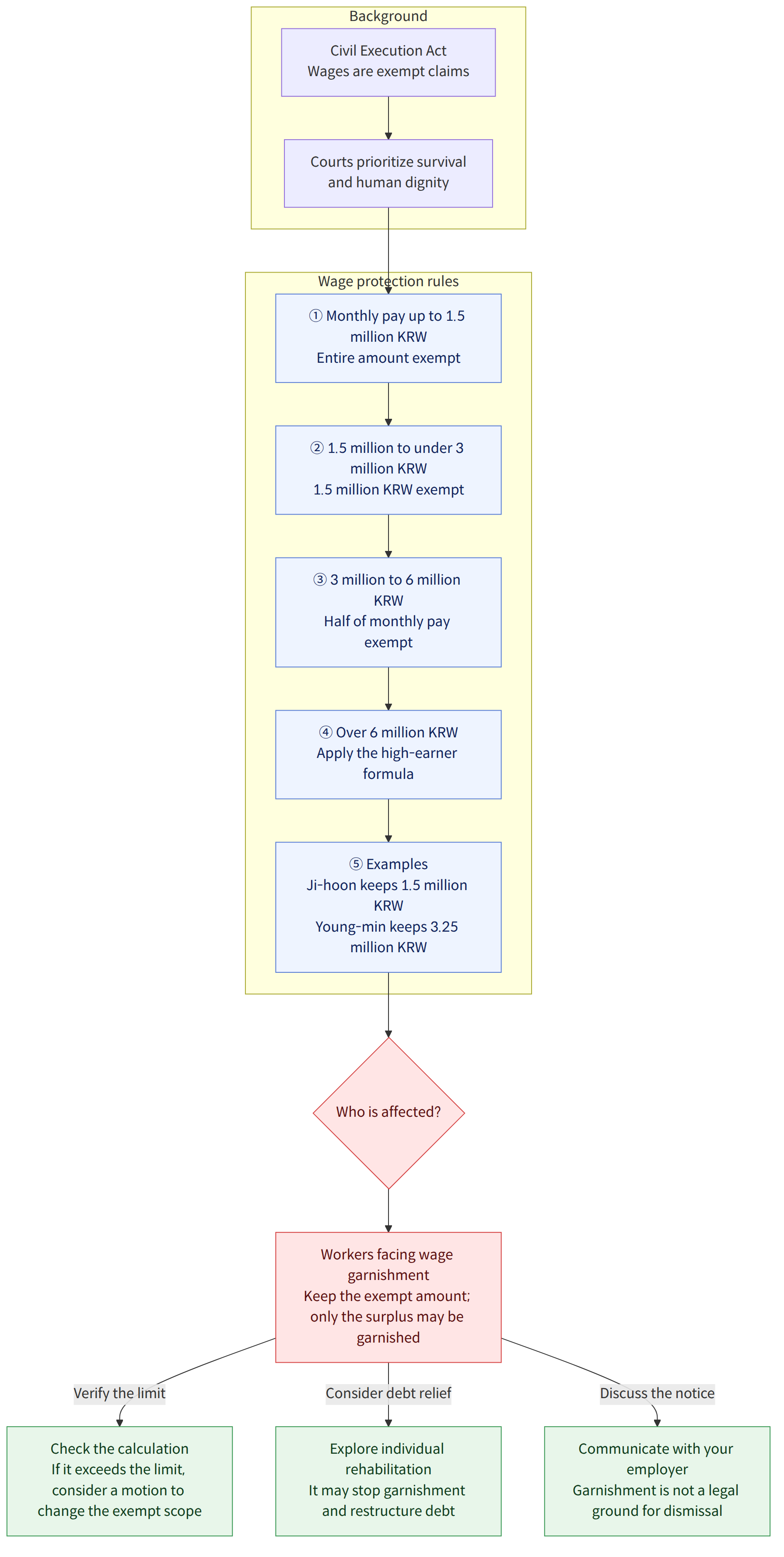
Under the Civil Execution Act of Korea, wages are protected as 'exempt claims' to prevent debtors from falling into absolute poverty. The amount that cannot be garnished is divided into four main categories based on monthly income:
- Monthly salary of 1.5 million KRW or less: The entire amount is exempt. Creditors cannot touch a single won.
- 1.5 million KRW to less than 3 million KRW: A fixed amount of 1.5 million KRW is exempt. Only the surplus can be garnished.
- 3 million KRW to 6 million KRW: One-half (1/2) of the monthly salary is exempt.
- Over 6 million KRW: A specific formula is used to calculate the exempt amount for high earners.
Formula for High Earners (Over 6M KRW):[3 million KRW + (1/2 of monthly salary - 3 million KRW) × 1/2]
4. How Korean Courts Approach Wage Garnishment
Korean courts prioritize the "Right to Survive" and "Human Dignity" over the creditor's right to collect. The judicial principle is that if a creditor seizes a person's entire income, the debtor becomes a burden to society, losing the ability to ever rehabilitate financially. Therefore, the law mandates a 'minimum living expense' shield that adjusts according to the debtor's income level, ensuring that even those in debt can maintain a basic standard of living.
5. Applying the Law: Ji-hoon and Young-min
Let's calculate the actual protected amounts for our two characters.
First, Ji-hoon Kim. With a salary of 1.8 million KRW, he falls into the second bracket. The law protects 1.5 million KRW. This means the bank can only garnish 300,000 KRW per month. Ji-hoon can breathe a sigh of relief knowing his rent money is safe.
Second, Young-min Choi. Since he earns 7 million KRW, we apply the high-earner formula:
- Half of his salary is 3.5 million KRW.
- The formula: 3 million + (3.5 million - 3 million) × 0.5 = 3.25 million KRW. Therefore, Young-min keeps 3.25 million KRW for his living expenses, and the creditor can garnish the remaining 3.75 million KRW.
6. Conclusion: A Path Forward and Practical Tips
In the end, Ji-hoon was able to maintain his basic lifestyle with his protected 1.5 million KRW, giving him the stability to apply for a debt adjustment program. Young-min also managed to keep nearly half of his salary, allowing his family to stay afloat while he worked through his financial obligations.
If you find yourself in a similar situation, consider these three tips:
- Verify the Calculation: Ensure the creditor or the court-ordered execution doesn't exceed the legal limits. If they do, you can file a 'Motion for Change of Scope of Exempt Claims' with the court.
- Look into Debt Rehabilitation: If garnishment is imminent, it is often a sign that you cannot handle the debt alone. Programs like 'Individual Rehabilitation' (Gaein Hoesaeng) can stop garnishment entirely and restructure your debt.
- Communicate with Your Employer: While a garnishment notice to your company can be embarrassing, remember that it is a civil matter and not a legal ground for dismissal in Korea. Be proactive in explaining the situation to your HR department.
This column is for informational purposes only and does not constitute legal advice. Legal outcomes may vary based on specific circumstances.