1. A Human Story
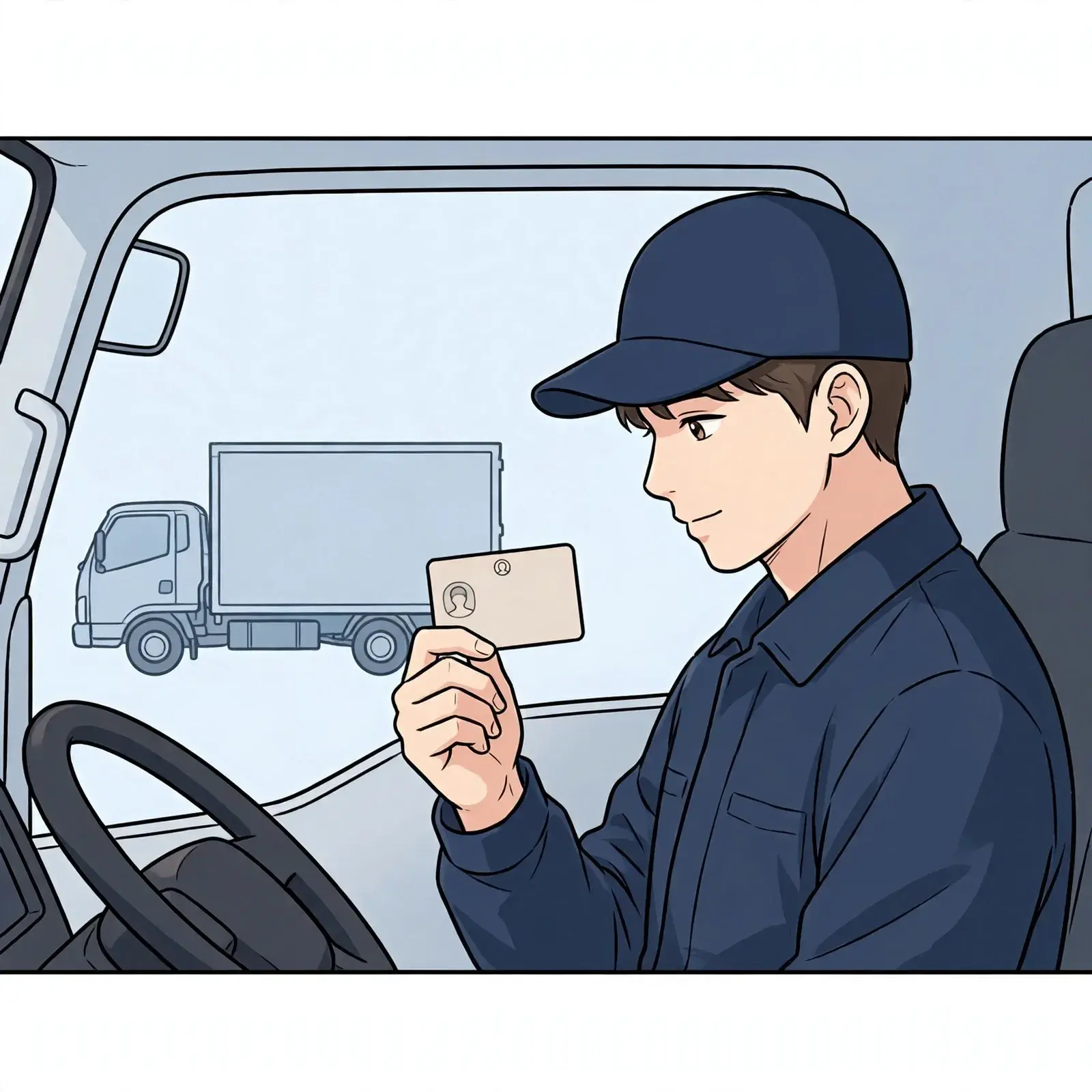
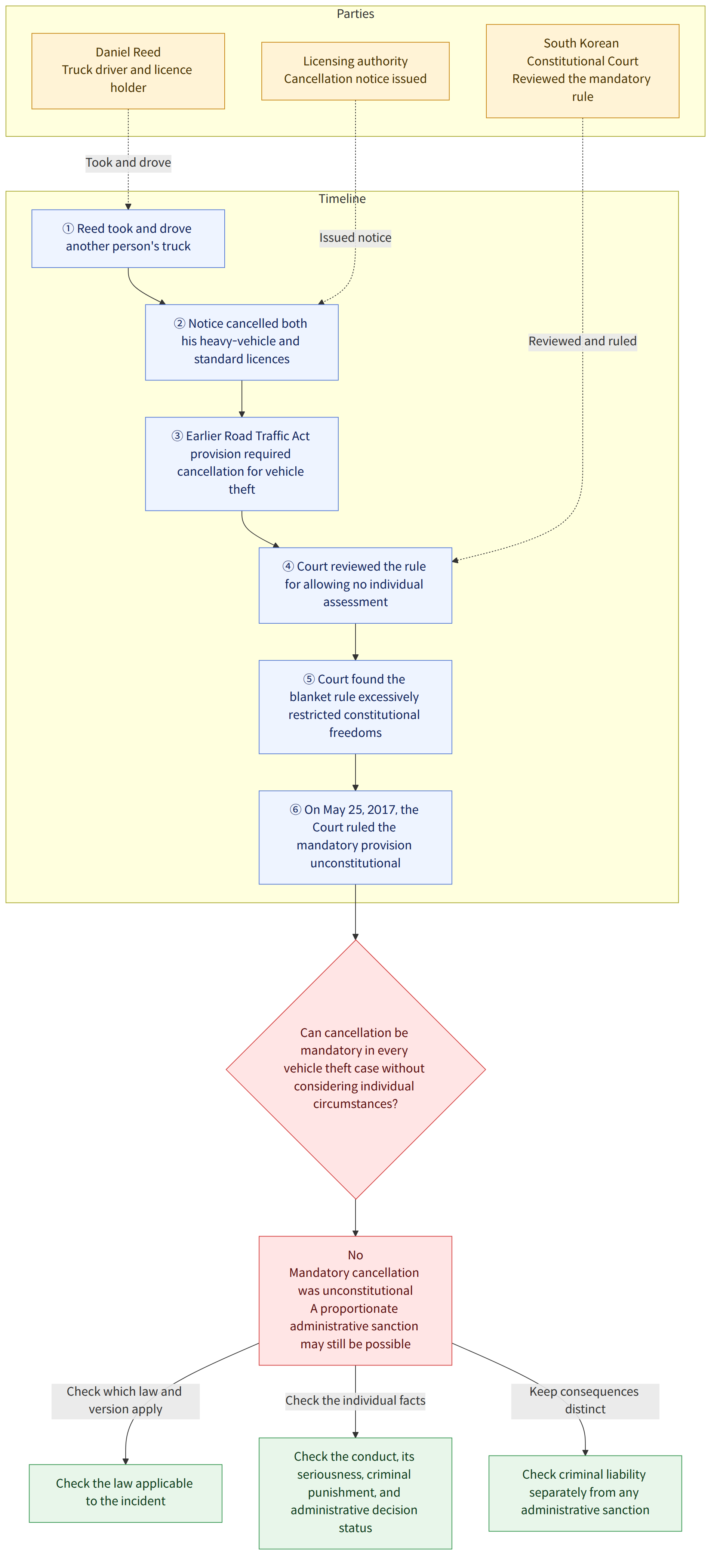
Daniel Reed made his living driving heavy vehicles. One evening, after a dispute at a depot, he took a truck that belonged to someone else and drove it away. The truck was recovered, but the incident brought serious criminal consequences—and a notice cancelling both his heavy-vehicle licence and his standard driving licence.
For Daniel, the second consequence threatened his livelihood. He depended on his licences to work, yet the cancellation notice treated the theft itself as enough to require the same outcome as every other vehicle theft. It did not appear to distinguish between the circumstances of the act, its seriousness, or the penalty imposed in the criminal case.
2. The Legal Question
Can the government constitutionally require the cancellation of a person’s driving licence in every case where that person steals someone else’s vehicle, without allowing officials to consider the particular facts?
3. What Korean Law Says
The provision considered by the Constitutional Court appeared in an earlier version of South Korea’s Road Traffic Act. It required cancellation when a licensed driver stole another person’s motor vehicle or similar vehicle. The purpose was to strengthen the administrative response to vehicle theft and prevent traffic dangers or disruptions associated with the use of stolen vehicles.
The Court did not reject that public-safety goal. It focused instead on whether an automatic, unavoidable cancellation was a proportionate way to pursue it. The relevant constitutional protections include freedom of occupation and the broader freedom to act as one chooses, both of which can be affected when a person loses the legal ability to drive.
A serious public purpose does not, by itself, justify a sanction that ignores every difference between individual cases. The measure must not burden a person’s constitutional freedoms more than is necessary to achieve that purpose.
The Court’s reasoning can be summarised in three points:
- The sanction must fit the wrongdoing. Stealing a vehicle can justify a strong response, but the appropriate response may depend on how serious and blameworthy the conduct was.
- Individual circumstances matter. Relevant factors may include how the theft occurred, the manner of the conduct, the degree of unlawfulness, and whether the person was criminally punished.
- Discretion can protect public safety without making cancellation universal. The law could allow licence cancellation or suspension where appropriate, leaving room to choose a sanction proportionate to the case.
The decision concerned the earlier statutory provision and the wording that made cancellation mandatory for stealing another person’s vehicle. It should not be read as a blanket rule that vehicle theft has no consequences, or as a guarantee that a licence will remain valid in every case. The law applicable to a particular incident and the status of any administrative decision must be checked separately.
4. How Korean Courts Approach This
In constitutional review, the key question is not simply whether a measure serves a legitimate public interest. Courts also examine whether the measure is suitably tailored and whether the burden it imposes is excessive in relation to that interest.
Here, the Constitutional Court recognised the importance of preventing traffic risks and protecting the safe, orderly use of roads. But it found that a rule requiring cancellation in every vehicle-theft case left no room to account for the differences between cases. The rule could apply without regard to the circumstances leading to the theft, the way it was carried out, the offence’s seriousness, or the level of criminal punishment.
The Court held that excluding any consideration of the individual case imposed an excessive restriction on the licence holder’s freedom of occupation and general freedom of action.
The Court therefore ruled, on May 25, 2017, that the mandatory-cancellation provision was unconstitutional. Its decision did not erase the distinction between criminal and administrative consequences: criminal liability for theft is a separate matter, and a properly justified administrative sanction may still be possible under the law that applies.
5. Applying the Law to the Case
Daniel’s case raises the precise constitutional problem identified by the Court.
- The government had a legitimate objective. A person who takes and drives another person’s truck may create risks on the road. Deterring vehicle theft and maintaining traffic safety are important public interests.
- But the rule imposed the same consequence automatically. If cancellation followed solely from the fact of theft, the decision-maker could not weigh whether Daniel’s conduct was especially dangerous or serious, how it came about, or what punishment he received in the criminal process.
- The lost licences affected more than convenience. Daniel relied on his heavy-vehicle licence for work. Cancelling both that licence and his standard licence could therefore interfere substantially with his ability to earn a living, as well as his ordinary freedom to drive.
- A less rigid approach was available. The law could permit officials to cancel or suspend a licence when the circumstances warranted it, rather than compel cancellation in every case. That would preserve the ability to protect road users while allowing the sanction to match the conduct.
On the facts described, the constitutional objection is not that Daniel should face no consequences. It is that the relevant provision left no room to decide whether mandatory cancellation was justified in his particular case. That absence of individual assessment was the feature the Court found constitutionally excessive.
6. Conclusion: What Happened, and What Should You Do?
Daniel’s licences should not be treated as automatically cancellable solely because he stole someone else’s vehicle under the mandatory-cancellation rule the Constitutional Court struck down. The Court’s ruling protects against that across-the-board result; it does not decide every question about any later or separate licence action. The precise legal basis, applicable version of the Road Traffic Act, and procedural history still matter.
If you face a similar situation:
- Read the cancellation notice carefully. Identify the statutory provision relied on, the date of the alleged conduct, and any deadline to challenge the decision.
- Preserve evidence about the circumstances. The manner of the conduct, its seriousness, and the outcome of the criminal case may matter when an individual assessment is legally available.
- Get prompt advice from a Korean lawyer or legal-aid service. Do not assume the ruling automatically restores a cancelled licence or prevents every form of suspension or cancellation; ask what remedy and deadline apply to your case.