
1. A Human Story
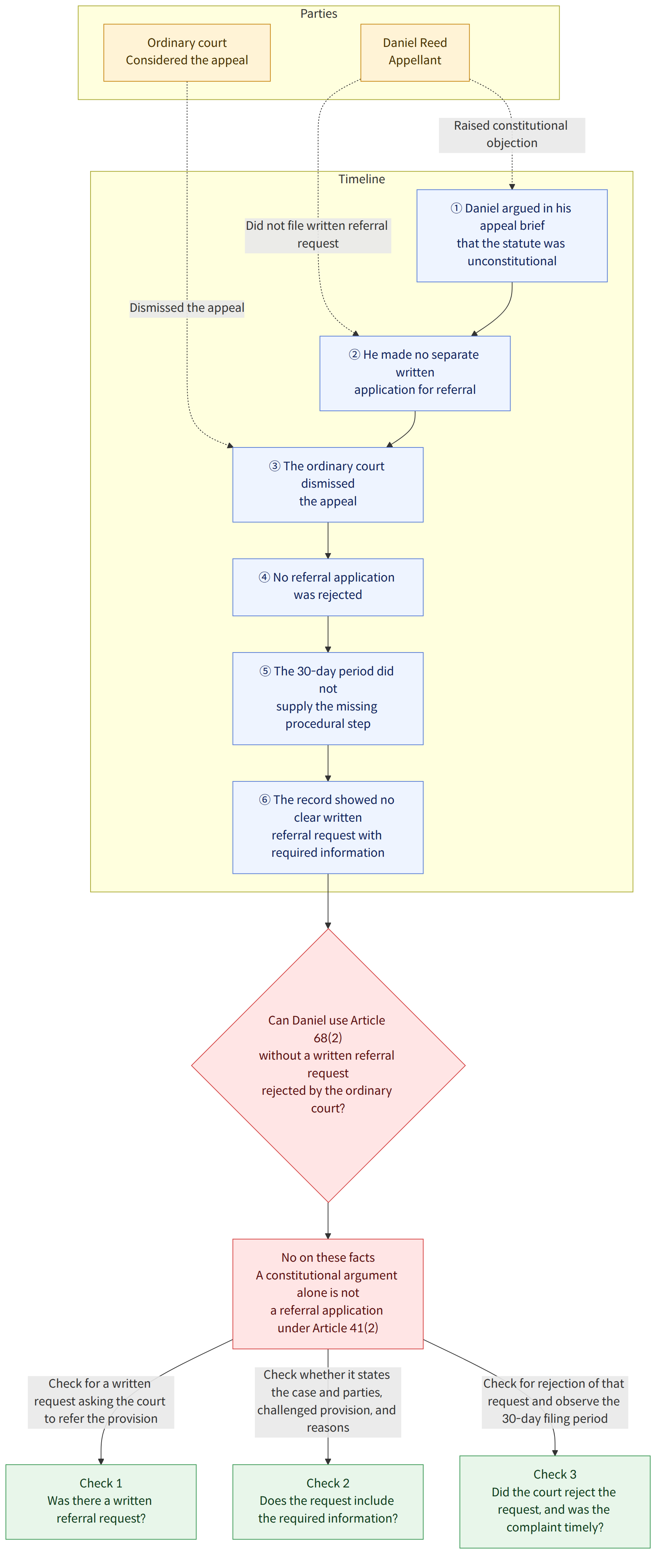
Daniel Reed had spent months challenging a decision that affected his small business. The law applied by the court, he believed, treated businesses like his unfairly. In his appeal brief, he wrote that the relevant provision was unconstitutional and asked the court to consider the constitutional problem.
The appeal was dismissed. Daniel then learned that Korean law allows a person to bring a constitutional complaint under Article 68(2) of the Constitutional Court Act after an ordinary court rejects a request to refer a law for constitutional review. He had not filed a separate written request asking the court to make that referral. Still, with 30 days in mind, he wondered whether his constitutional argument in the appeal brief was enough.
2. The Legal Question
Can a person file an Article 68(2) constitutional complaint after losing an appeal if they argued that a law was unconstitutional, but never formally applied in writing for the ordinary court to refer that law to the Constitutional Court?
3. What Korean Law Says
Korean law provides a specific route for a party in an ongoing case to ask the ordinary court to refer a statute to the Constitutional Court. The request is not merely a general objection to the law: it must be made in writing and include the information required by statute.
Article 41(2) of the Constitutional Court Act requires the party’s application for referral to be in writing and to state the matters listed in Article 43(2) through (4).
Those required matters include:
- The case and the parties involved.
- The statute or statutory provision alleged to be unconstitutional.
- The reasons the provision is alleged to be unconstitutional.
If the ordinary court rejects a party’s application for referral, Article 68(2) provides a route to challenge that rejection before the Constitutional Court. The application to the ordinary court and the later constitutional complaint are separate procedural steps. The 30-day period for filing the constitutional complaint does not itself create the first step or excuse its absence.
The key distinction is between raising a constitutional concern and making a written application for referral that meets the statutory requirements.
4. How Korean Courts Approach This
Korean courts treat these requirements as procedural conditions for using the Article 68(2) route. The ordinary court must have been asked to refer the challenged provision, and the Constitutional Court complaint must follow the ordinary court’s rejection of that request. A person cannot normally skip that sequence simply by raising constitutional language during the underlying litigation.
That does not mean every filing must carry a particular heading. What matters in a real case is the document’s substance and whether it clearly contains the required request and information. But a passing constitutional objection—or an argument that a law is unfair or invalid without a sufficiently clear written referral request—does not automatically become an application under Article 41(2).
Article 68(2) is not a general appeal from an unfavorable judgment. It provides a specific remedy following the ordinary court’s rejection of a proper request for constitutional referral.
5. Applying the Law to Daniel’s Case
Daniel’s situation turns on procedure, not on whether his constitutional argument was persuasive.
- He identified a constitutional concern. His appeal brief said the statute was unconstitutional. That put the issue before the appellate court as an argument, but it did not necessarily ask the court to refer the law to the Constitutional Court.
- He made no formal written referral application. Daniel did not submit a written application setting out the case and parties, the precise provision he challenged, and his reasons for alleging unconstitutionality. On these facts, his appeal argument did not satisfy the statutory application requirement.
- The ordinary court therefore issued no rejection of such an application. The appeal was dismissed, but that is not the same procedural event as rejecting an application for referral. The two decisions serve different purposes.
- The 30-day period cannot cure the missing step. Filing quickly after the appeal decision would not turn the earlier constitutional argument into a referral application, nor would it supply the required rejection decision.
The result would be different only if the record showed that Daniel’s written filing, despite its title or format, actually made a clear referral request and included the required information, and that the court rejected it. That is not what happened in this scenario.
6. Conclusion: What Happened, and What Should You Do?
Daniel could not use Article 68(2) merely because he had argued that the statute was unconstitutional in his appeal brief. He had neither made the required written application for referral nor received a decision rejecting one. His appeal’s dismissal did not substitute for that missing procedural step, so the 30-day clock alone did not give him access to an Article 68(2) complaint.
For anyone considering this route:
- Make the referral request in writing in the underlying case, and clearly identify the case, the exact statutory provision, and why it is unconstitutional.
- Keep proof of the filing and the court’s decision. The later constitutional complaint depends on what was requested and how the ordinary court responded.
- Check the deadline and procedural requirements promptly with a Korean lawyer. Do not assume that mentioning constitutionality in an appeal brief preserves the Article 68(2) route.