
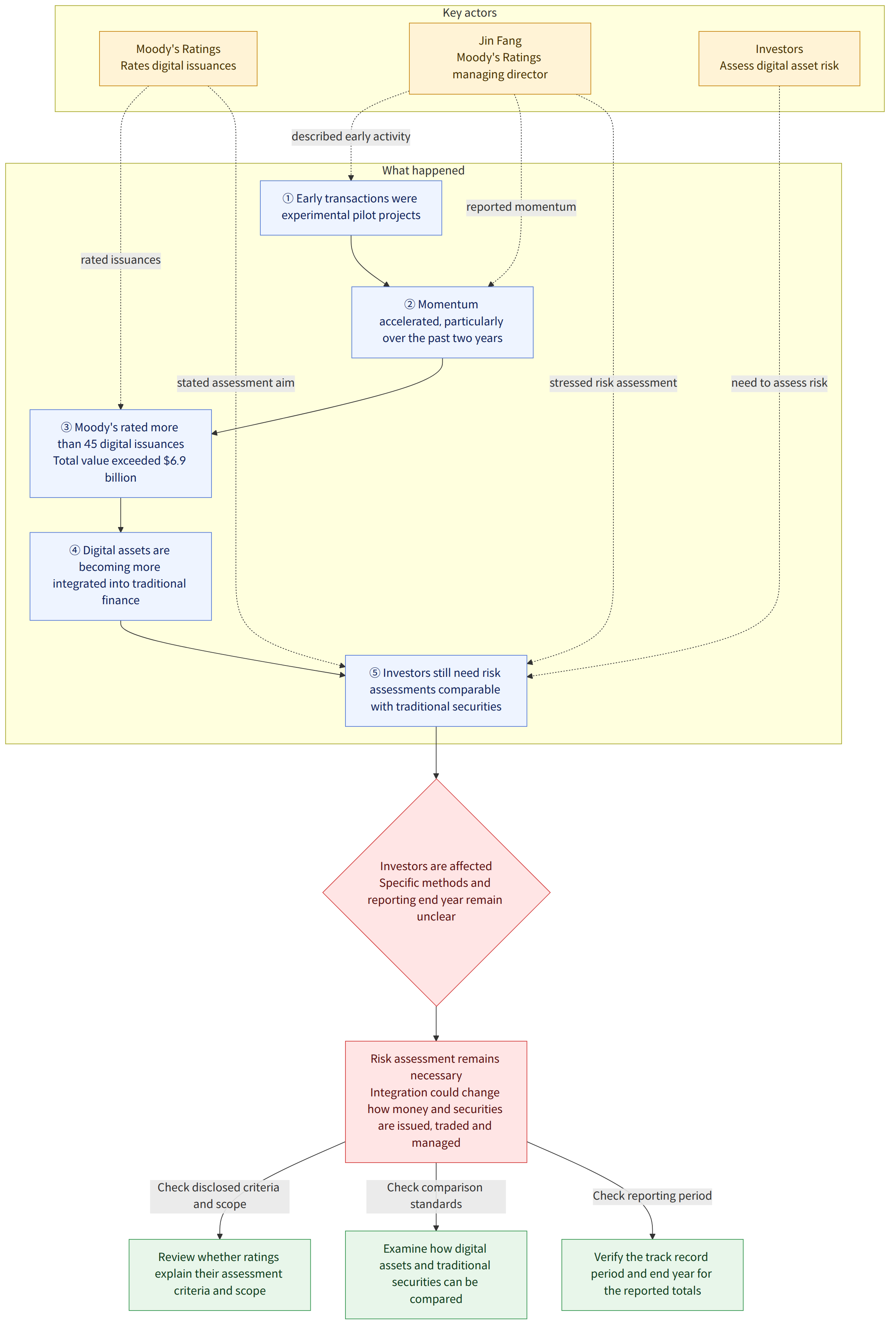
Moody’s Ratings says that while deeper integration of digital assets into traditional finance could change how money and securities are issued, traded and managed, the need to understand investment risk will not go away. The company aims to help investors assess tokenized assets (rights or assets represented using digital technologies such as blockchain) against standards comparable to those for traditional securities as such assets become more common.
Jin Fang, managing director of Moody’s Ratings’ Asia Sovereign and Sub-Sovereign Ratings Group and head of its Asia digital economy strategy, said investor interest in digital assets is likely to grow but stressed the need to assess risk. He spoke with The Korea Times (코리아타임스) at the 2026 Korea Blockchain Week (코리아 블록체인 위크).
Background and context
Moody’s Ratings has rated more than 45 digital issuances worldwide during the reporting period cited in the source. These include digital bonds and tokenized funds, and the issuances total more than $6.9 billion.
Jin Fang said early transactions were confined to experimental pilot projects, but momentum has accelerated, particularly over the past two years. However, the source does not say how much the number or value of issuances increased during that period. It is therefore important to distinguish between the reported acceleration and a quantified increase that can be verified.
What this means
As tokenized assets become more widespread, investors need to consider not only that an asset is in digital form, but also how its risks can be compared with those of existing securities. This is significant because market participants need to understand the basis and scope of an assessment when reviewing digital issuances.
For example, if an investor is considering both a digital bond and a security in a traditional form, it may be important to determine the standards under which their risk assessments can be compared. The source does not explain which assessment criteria or methods Moody’s Ratings actually uses. The company’s stated aim of making assessments comparable should therefore not be taken to mean that specific assessment methods have been disclosed.
What is confirmed and what remains unknown
What is confirmed
- Moody’s Ratings said that the integration of digital assets into traditional finance could change how money and securities are issued, traded and managed.
- Jin Fang said investor interest is likely to grow but that risk assessment remains necessary.
- The source reported that Moody’s Ratings had rated more than 45 digital issuances, including digital bonds and tokenized funds, with a total value of more than $6.9 billion.
- Jin Fang said early transactions were experimental pilot projects and that momentum had accelerated, particularly over the past two years.
What remains unknown
- The source does not say what criteria or methods Moody’s Ratings uses to assess the risks of digital assets.
- The start of the track record period is given as January 2018, but the year for February 2 and the end of the reporting period are unclear.
- The source does not establish how much the number or value of issuances increased over the past two years.
What readers should check
- When encountering ratings for digital issuances, readers should check whether the assessment criteria and scope have been disclosed. The source alone does not reveal Moody’s Ratings’ specific methods.
- When comparing digital assets with traditional securities, readers should examine the standards under which the two can actually be compared. The company’s stated aim of making assessments comparable does not establish what the detailed criteria are.
- When citing a track record of more than 45 issuances and more than $6.9 billion, readers should check whether the reporting period and its end year are clearly stated. The source does not give the year for February 2.