
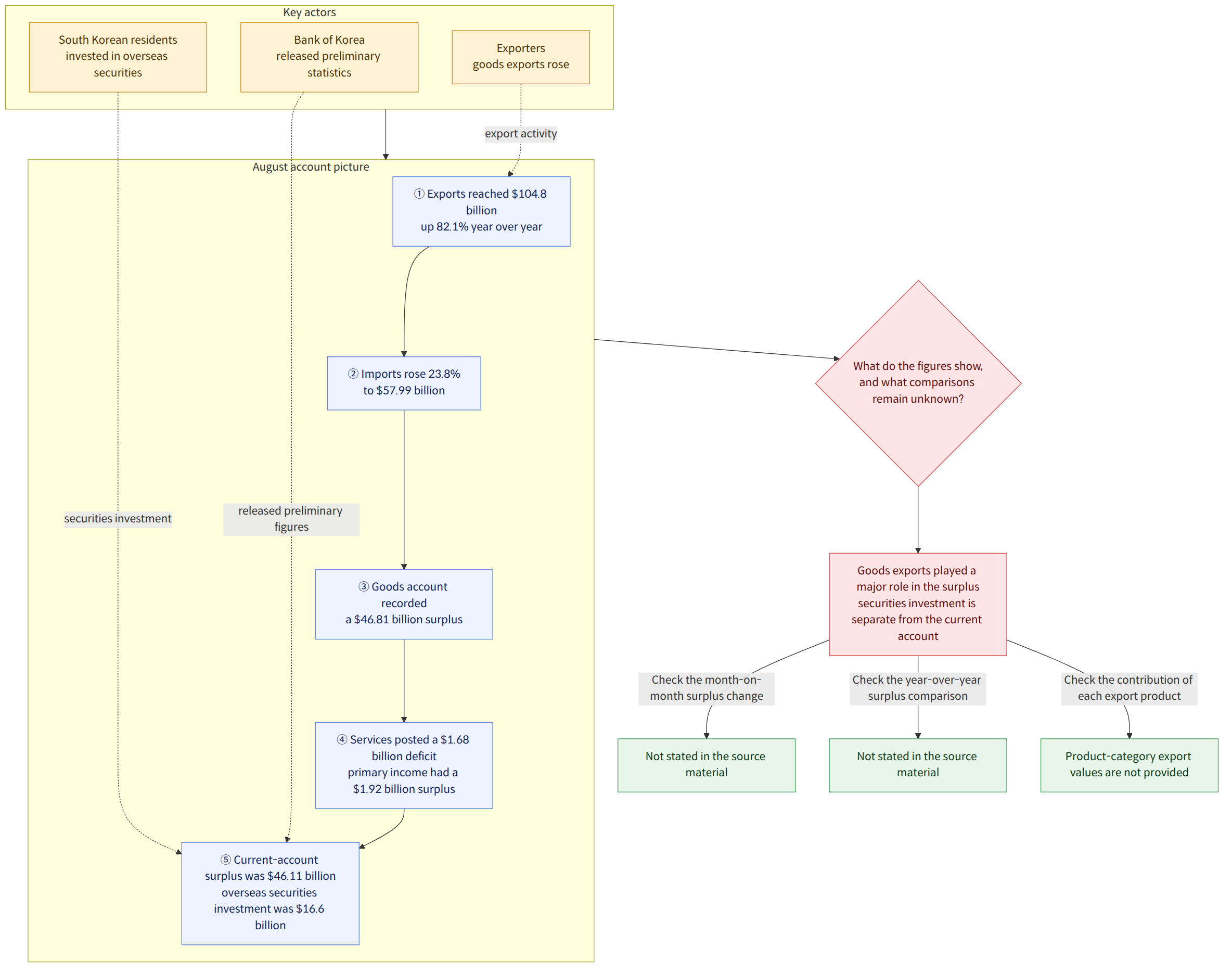
South Korea continued to post a current-account surplus in August. According to reports citing preliminary statistics released by the Bank of Korea (한국은행), the August current-account surplus was $46.11 billion, the second-largest monthly figure on record. The surplus exceeded $40 billion for three consecutive months, from June through August. The headline cited strong exports as a reason the surplus continued, but the reports provided do not establish whether the surplus was larger than the previous month.
Background and context
The current account is an indicator that brings together receipts and payments from transactions between countries, including trade in goods and services and investment income. The goods account, which reflects the difference between exports and imports, was at the center of the August surplus. It posted a $46.81 billion surplus.
Exports totaled $104.8 billion, up 82.1% from the same month a year earlier. Exports of information technology products, including semiconductors, rose 162.6%, while exports of non-IT products increased 8.1%; export value exceeded $100 billion for the third consecutive month. Imports also rose 23.8%, to $57.99 billion. Imports of raw materials and capital goods continued to increase, while consumer goods imports also returned to growth.
In contrast to the goods account surplus, the services account posted a deficit of $1.68 billion. The travel account deficit widened to $770 million amid the peak overseas travel season, while the transport account recorded a $520 million surplus. Reports said higher export freight rates contributed to the larger transport account surplus. The intellectual property charges account posted a deficit of $390 million.
The primary income account, which includes investment income, recorded a $1.92 billion surplus, although the surplus narrowed. The dividend income account posted an $1.18 billion surplus. Seasonal factors, including quarterly dividend payments concentrated in May, August and November, were cited as contributing to the smaller surplus.
What this news means
The increase in exports and the goods account surplus show that exports of goods played a major role in South Korea’s external transactions. These figures may help track overseas sales trends for exporting companies, but they do not by themselves establish that individual companies’ sales or profits increased. Imports also rose, so the surplus should not be attributed to export growth alone.
The services account deficit and the increase in overseas securities investment reflect trends distinct from trade in goods. Spending by people traveling overseas is recorded in the travel account, while investors’ purchases of foreign securities are recorded in the financial account. For example, even if an exporting company increases its overseas sales, that alone does not show that domestic spending on travel or investors’ purchases of foreign assets moved in the same direction.
In particular, South Korean residents’ overseas securities investment totaled $16.6 billion, the second-largest figure on record. Stock investments rose by $10.15 billion, although the increase was smaller, while debt securities, such as bonds, increased by $6.44 billion—the largest increase on record. In other words, there were capital flows that would not be captured by looking at the current-account surplus alone.
Points reported differently across coverage
The English-language report headline and the headline of a follow-up report both led with the continuing current-account surplus and strong exports. The provided English-language article shows only the headline and reporter information, while the Korean-language report included details on the surplus and the goods, services and income accounts, as well as the financial account. No differing figures appear among the information that can be verified.
What is confirmed and what remains unknown
Confirmed facts
- The current-account surplus in August was $46.11 billion, the second-largest monthly figure on record.
- The goods account posted a $46.81 billion surplus, while the services account recorded a $1.68 billion deficit.
- Exports totaled $104.8 billion, up 82.1% from the same month a year earlier.
- South Korean residents’ overseas securities investment totaled $16.6 billion, the second-largest figure on record.
What remains unknown
- The source material provided does not state how the current-account surplus changed from the previous month.
- It does not give the change in the surplus compared with the same month a year earlier.
- It does not provide export values by product category, so the contribution of each export product to the surplus cannot be determined.
What readers should check
- To assess the trend in the surplus, readers should compare the month-on-month and year-on-year figures separately in monthly statistics released later.
- For a more accurate picture of strong exports, it is useful to look not only at total export value but also at growth rates for IT and non-IT products and at import growth.
- To distinguish the current account from investment fund flows, readers should examine the goods, services and income accounts separately from financial-account indicators.
References
- Other coverage consulted: en.yna.co.kr
- Other coverage consulted: hani.co.kr