
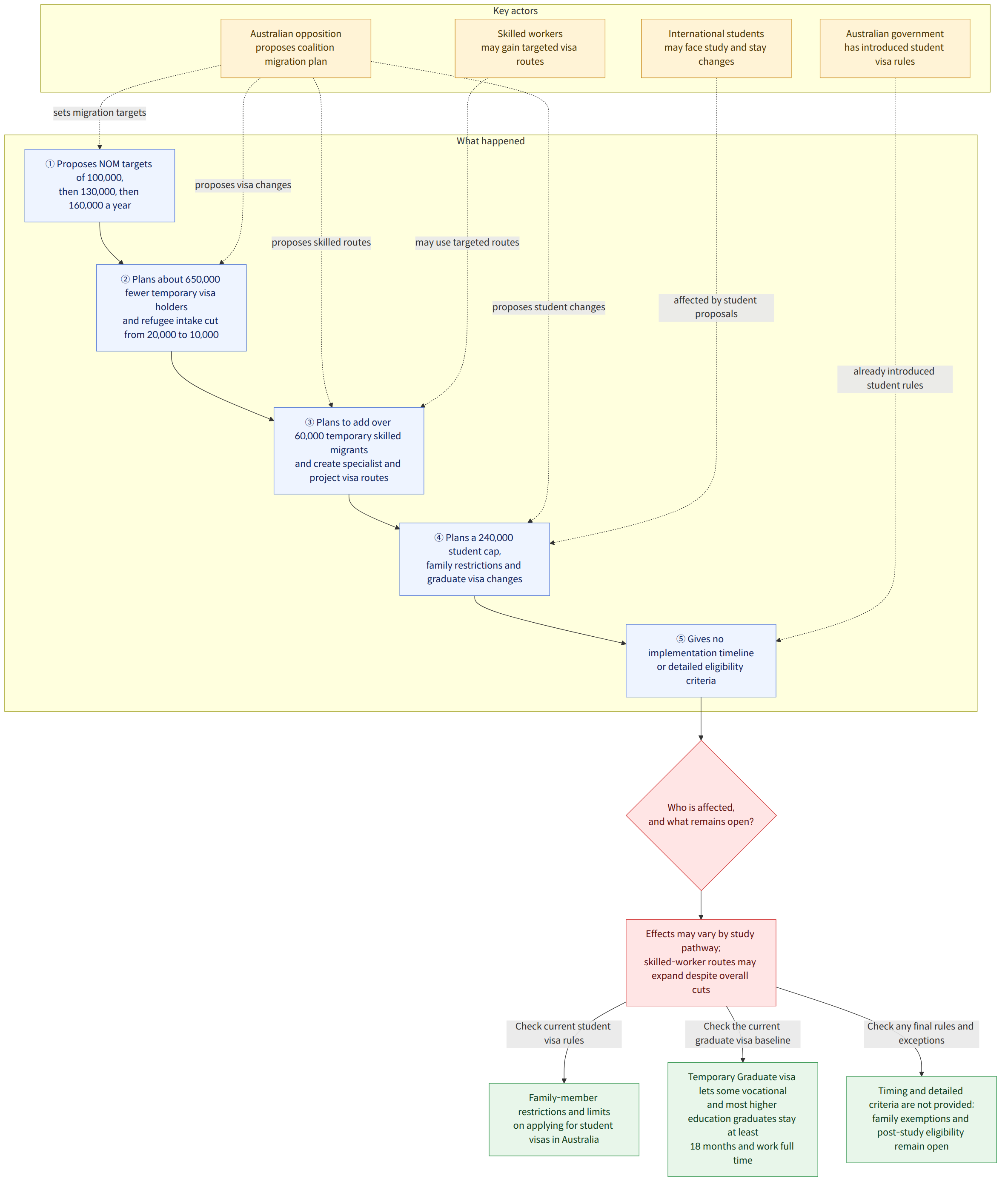
The Australian opposition’s proposed coalition government plan would lower Net Overseas Migration (NOM; 순해외이주)—the number of people arriving in Australia from overseas minus the number of people leaving—to 100,000 a year in both 2028–29 and 2029–30, then raise it to 130,000 in the third year and 160,000 in 2031–32. It said it would reduce the number of temporary visa holders by about 650,000 over four years and cut the annual refugee intake from 20,000 to 10,000. By contrast, it plans to increase temporary skilled migration by more than 60,000 over four years.
The proposal also signals changes to international students’ accompanying family members and opportunities to stay after graduation. It includes plans to cap new international student enrolments at 240,000, abolish the Temporary Graduate visa (임시 졸업비자), and allow post-study temporary transition visas (학업 후 임시 전환비자) for doctoral graduates, students in health and education, and students at regional universities. However, this is an opposition plan, and the information provided does not specify when it would take effect or set out detailed criteria.
Background and context
The opposition said it would cut by about a third the number of “core” temporary residents, excluding visitors and New Zealanders. It plans to cap the permanent migration program at its current level of 185,000 a year. However, it said it could also lower the permanent migration cap if necessary to keep migration below the number of homes completed over the long term.
The plan would not reduce the arrival of skilled workers across the board, even as it cuts the overall number of temporary visa holders. In addition to increasing temporary skilled migration by more than 60,000 over four years, the opposition said it would create specialist fields under the Skills in Demand visa (숙련 인력 수요 비자), bringing in up to 5,000 additional people a year, and issue 15,000 “Skilled Projects” visas (숙련 프로젝트 비자) a year, tied to specific projects. The latter is intended to address worker shortages by linking workers to particular projects.
The international student policy targets not only enrolment numbers but also accompanying family members and post-graduation stays. The opposition set a goal of reducing the share of higher education enrolments held by international students to below 25%; the original report said the share was 31% in 2024. It plans to cap new international student enrolments at 240,000.
According to another report, changes to student visas already introduced by the Australian government include restrictions on accompanying family members and measures preventing some visa holders from applying for student visas while in Australia. The opposition plan overlaps with government policy on restrictions on accompanying family members and applications from within Australia, but its proposal to abolish the Temporary Graduate visa differs from the government’s approach. The original report explained that the Temporary Graduate visa allows some vocational education graduates and most higher education graduates to stay in Australia for at least 18 months and work full time.
What this news means
For people planning to study in Australia, the ability to bring family members and stay after graduation could matter as much as the number of places available. If the proposal to restrict most applications by students’ accompanying family members is implemented, it could affect the choices of international students planning to bring their families. However, it has not yet been determined which family members would be exempt or whether the exceptions under the opposition plan would be narrower than the government’s current restrictions.
For students considering staying after graduation, abolishing the Temporary Graduate visa could be a particularly significant change. On the other hand, the opposition plan would make exceptions, allowing doctoral graduates, students in health and education, and students at regional universities to obtain post-study temporary transition visas. So rather than concluding that opportunities to stay after graduation would be reduced equally for all international students, it is more accurate to say that, if the plan is implemented, its effects could vary depending on a person’s field and study pathway.
For skilled workers, their occupation and type of employment could become important. That is because the opposition has said it would increase specialist fields under the Skills in Demand visa and visas for specific projects, despite its plan to reduce the overall number of temporary visa holders. For example, someone seeking work in Australia who has skills needed for a specific project could have a different pathway from the general temporary visa system if the proposal is implemented. This is an interpretation of the direction set out in the plan; the information released does not specify actual eligibility or application procedures.
The process could also directly affect people considering applying for refugee protection. The proposal says people applying for a protection visa (보호비자) from within Australia would have to apply within 30 days, and that the assessment process would be strengthened. The information provided does not say who would be subject to this measure, what criteria would apply, or when the 30-day period would begin.
Opposition Leader Angus Taylor said the plan would represent the largest reduction in immigration in Australian history. He argued that the policy, developed with the Parliamentary Budget Office (의회예산처), would be budget-neutral and strengthen rather than weaken the economy. This is the opposition leader’s assessment; it does not mean the plan’s economic effects have been confirmed after implementation.
What is known and what is not yet known
What is known
- The net overseas migration target is 100,000 a year in both 2028–29 and 2029–30, rising to 130,000 in the third year and 160,000 in 2031–32.
- The plan would reduce the number of temporary visa holders by about 650,000 over four years and lower the annual refugee intake from 20,000 to 10,000.
- Permanent migration would be capped at about 185,000 a year, while temporary skilled migration would increase by more than 60,000 over four years.
- The opposition said it would abolish the Temporary Graduate visa and restrict most applications by international students’ accompanying family members, while allowing some students to obtain post-study temporary transition visas.
- Temporary visa holders seeking to extend their stay with a second or subsequent visa would have to apply from overseas, while working holiday participants would be able to apply for second- and third-year visas from within Australia.
What is not yet known
- The information released does not say when each measure would take effect if the opposition’s plan became government policy.
- It does not explain how the reduction of about 650,000 temporary visa holders or the net overseas migration targets would be calculated or achieved.
- No confirmed exceptions or detailed criteria have been provided for restrictions on international students’ applications for accompanying family members.
- The information does not specify when the 30-day deadline would begin for people applying for protection visas from within Australia, or how the strengthened assessment process would work.
What readers should check
- If you are planning to study in Australia, distinguish the opposition’s announcement from government policy currently in force. Although the two policies overlap on accompanying family members and applications for student visas from within Australia, their detailed eligibility rules and scope cannot be assumed to be the same.
- If staying after graduation or bringing family members is central to your plans, look for announcements on whether the Temporary Graduate visa will be abolished and on the detailed criteria for exceptions for doctoral graduates, students in health and education, and students at regional universities.
- If you are considering applying for a protection visa or a second or subsequent temporary visa in Australia, check when and to which applications the proposed 30-day deadline and overseas application requirement would actually apply.
References
- Other coverage consulted: theconversation.com