
A Helping Hand and a Dream Home
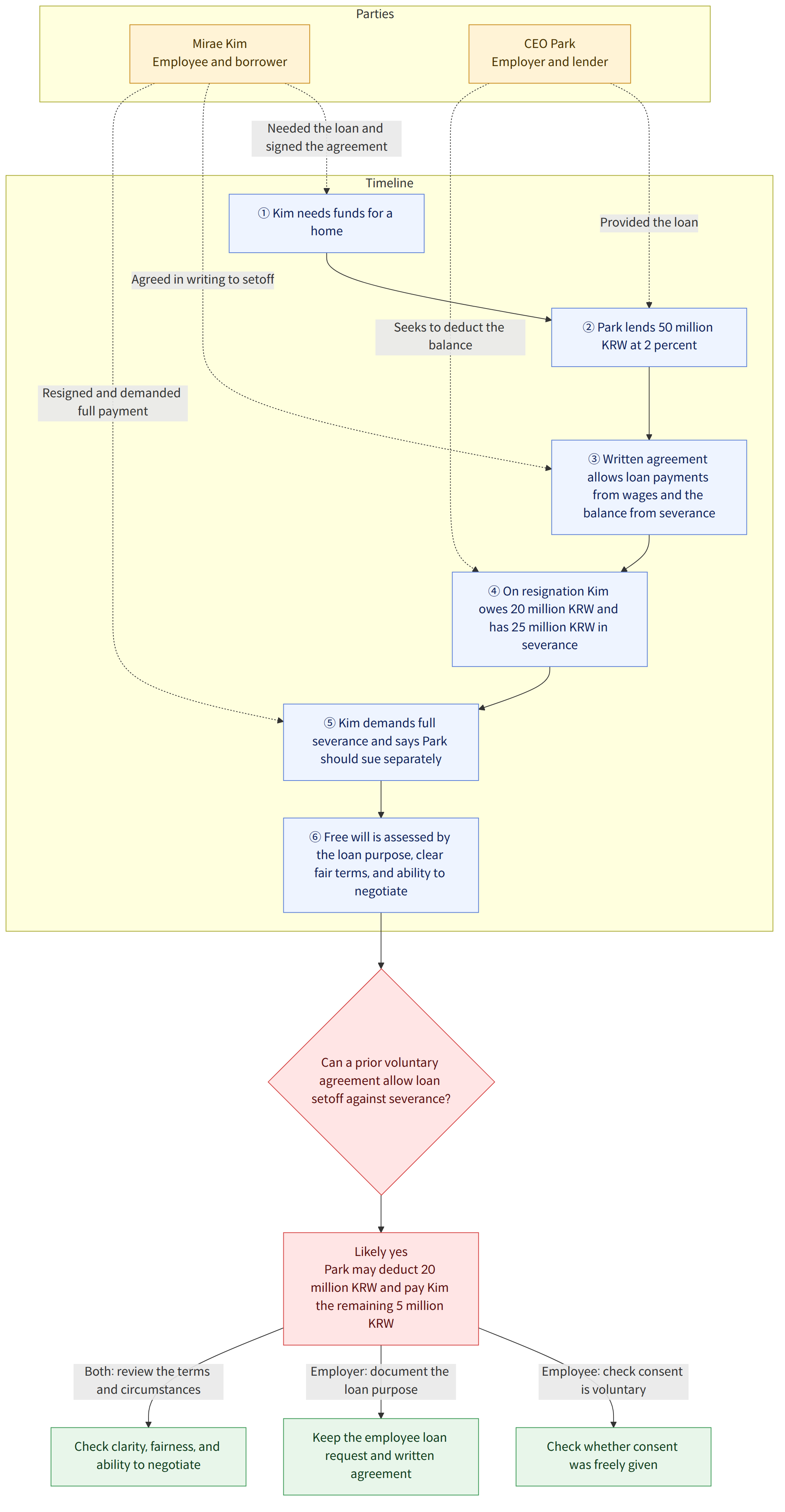
Mirae Kim, an employee at a growing tech firm, faced a dilemma three years ago: she found her dream honeymoon home but was short on funds. Her employer, CEO Park, stepped in with a generous offer—a 50 million KRW loan at a rock-bottom 2% interest rate. Grateful, Mirae signed a contract stating that monthly installments would be deducted from her paycheck, and any remaining balance would be "set off" from her severance pay upon resignation.
Fast forward to today: Mirae is leaving for a better opportunity. She still owes 20 million KRW on the loan, and her total severance pay is calculated at 25 million KRW. However, on her last day, Mirae changed her tune. Citing labor laws she read online, she demanded the full 25 million KRW in cash, telling CEO Park to sue her separately for the loan balance if he wanted his money back.
The Core Legal Question
The central issue in this case is: Can an employer legally deduct an outstanding loan balance from an employee's severance pay based on a prior mutual agreement?
What Korean Law Says: The Full Payment Principle
The Korean Labor Standards Act (LSA) provides heavy protection for an employee's earnings to ensure their livelihood isn't compromised.
Labor Standards Act, Article 43 (Payment of Wages)(1) Wages shall be paid in full directly to the employee in currency.
This is known as the "Full Payment Principle." Generally, even if an employer has a claim against an employee (like a loan or damages for negligence), they cannot unilaterally deduct that amount from the paycheck. Furthermore, Article 21 specifically prohibits offsetting wages against "advances" or loans made on the condition of forced labor.
How Korean Courts Approach This: The 'Free Will' Exception
Historically, the Supreme Court was very rigid, allowing almost no deductions except for overpaid wages. However, the legal landscape shifted with a landmark ruling that recognized the validity of a set-off if it was truly voluntary.
According to the Supreme Court, a set-off agreement is valid if there are "objective and reasonable grounds to believe the consent was based on the employee's free will." Because there is always a risk of an employer coercing a worker, the courts apply a very strict standard to determine if that "free will" actually existed.
- Factor 1: Was the loan initiated at the employee's request and for their benefit?
- Factor 2: Are the terms of the agreement fair and clear?
- Factor 3: Does the employee's position or the circumstances suggest they could negotiate freely with the company?
Applying the Law to Mirae’s Case
Looking at Mirae Kim's situation, the court would likely rule in favor of CEO Park.
First, the loan was not forced upon her; she requested it for her personal housing needs. Second, the agreement to deduct the balance from her severance pay was explicitly documented in writing at the time of the loan. Third, this was a welfare-oriented gesture (low interest), not a tool to trap her in forced labor.
Because the agreement was made for Mirae’s benefit and she signed it voluntarily, the court would likely view the set-off as a legitimate exercise of her free will. CEO Park is legally entitled to deduct the 20 million KRW and pay her only the remaining 5 million KRW of her severance.
Conclusion: What Happened, and What Should You Do?
Ultimately, Mirae’s attempt to use the "Full Payment Principle" as a loophole fails because her initial consent was deemed valid. She receives the net balance of her severance, and CEO Park avoids the headache of a separate civil lawsuit.
For those in similar situations, keep these practical tips in mind:
- For Employees: Understand that a written consent for a set-off is a powerful legal document. Do not sign it thinking it is unenforceable. Ensure you have a clear plan to repay any company loans before you resign.
- For Employers: Never rely on verbal agreements. Always maintain a written paper trail including the employee’s loan request, a formal loan agreement, and a specific "Set-off Consent Form" (상계동의서). Demonstrating that the loan was a benefit to the employee is key to making the deduction hold up in court.
This column provides general legal information and should not be construed as professional legal advice for a specific case.