
1. A Day in the Life of Dr. Ji-hoon Lee
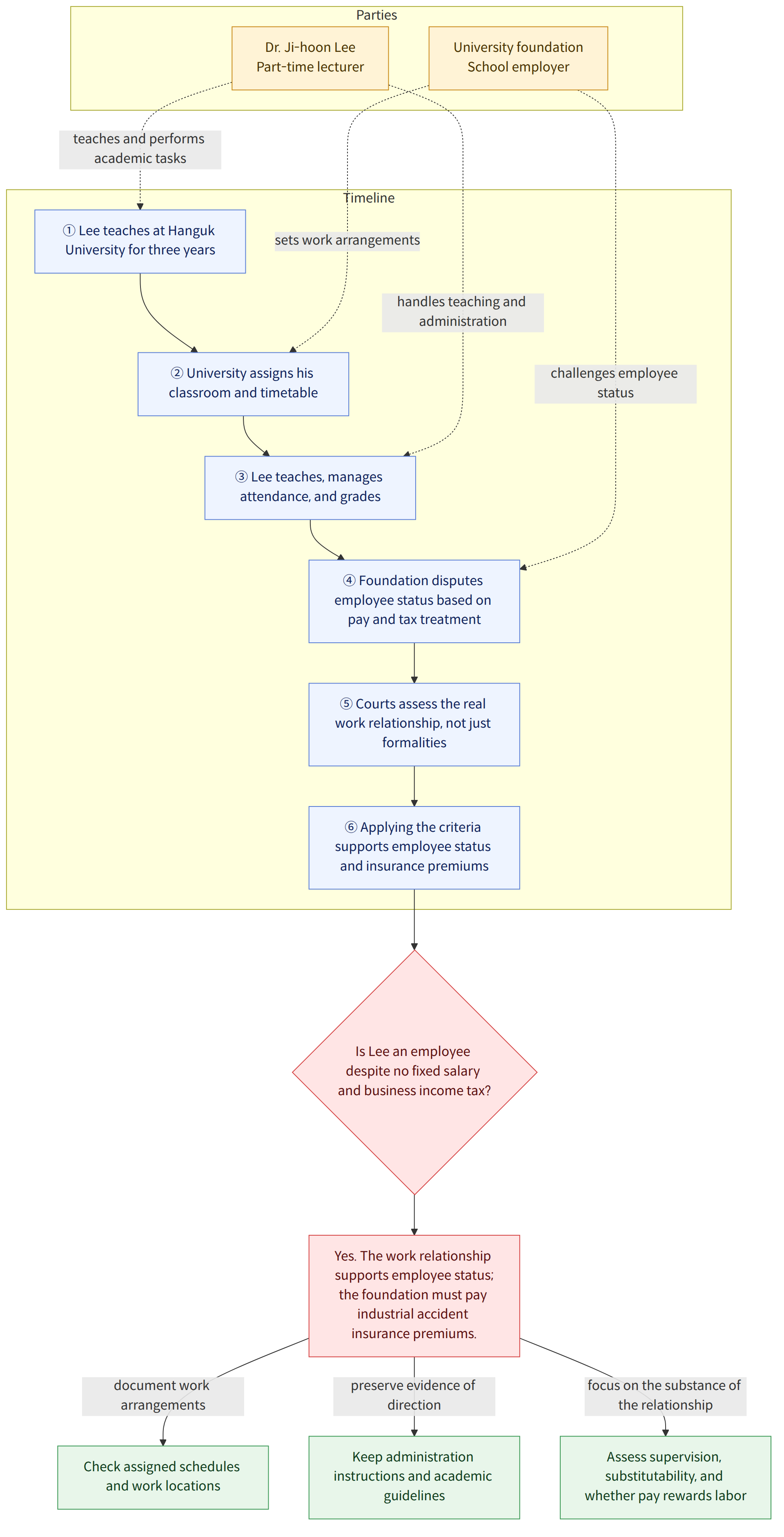
Dr. Ji-hoon Lee has been a dedicated part-time lecturer teaching 'Introduction to Philosophy' at Hanguk University for the past three years. Every semester, he meets his students in a classroom assigned by the school, following a strict timetable set by the administration. From designing exam questions and managing student attendance to the meticulous task of grading and inputting scores at the end of the term, his routine is deeply integrated into the university's system.
However, the university foundation held a different view. They argued, "Dr. Lee, you don't have a fixed monthly salary, and you pay business income tax instead of earned income tax like a freelancer. Why should we pay for your industrial accident insurance?" Dr. Lee found himself in a legal gray zone, wondering why he wasn't recognized as a 'worker' despite being a vital cog in the university machine.
2. The Core Legal Question
The central issue in this case is whether a part-time university lecturer who lacks a fixed base salary and is not enrolled in the standard four major social insurances can be considered an 'employee' under the Labor Standards Act. If recognized as such, the school foundation is legally required to pay premiums for Industrial Accident Compensation Insurance.
3. How Korean Law Defines an 'Employee'
The South Korean Labor Standards Act provides a broad definition of an employee:
Article 2, Paragraph 1, Subparagraph 1 of the Labor Standards ActThe term "employee" means a person who provides labor to a business or workplace for the purpose of earning wages, regardless of the type of occupation.
According to judicial precedents and labor law principles, the determination of employee status depends on the 'substantive relationship of subordination' rather than the formal name of the contract (e.g., service contract, appointment contract). Key criteria include:
- Whether the employer determines the content of the work and whether the worker is subject to internal rules or personnel regulations.
- Whether the employer exercises specific and individual direction and supervision over the work process.
- Whether the time and place of work are designated and binding.
- Whether the worker can hire a third party to perform the tasks (substitutability).
- Whether the remuneration is in the nature of payment for the labor provided.
4. The Approach of Korean Courts
The Supreme Court of Korea has consistently recognized the employee status of part-time university lecturers. The courts view them not as independent contractors simply sharing knowledge, but as individuals working under the direction of the university within its organizational structure.
Crucially, the Supreme Court has ruled that "the mere fact that business income tax was withheld or that the individual is enrolled in regional health insurance does not negate employee status." In other words, the reality of the work relationship takes precedence over economic or administrative formalities.
5. Applying the Law to Dr. Lee's Case
Analyzing Dr. Ji-hoon Lee's situation through this legal lens makes the conclusion clear.
First, Dr. Lee must teach specific subjects in classrooms and at times designated by the university. This indicates a high level of binding force regarding time and location.
Second, he performs administrative tasks such as submitting syllabi, managing attendance, and grading, all according to the university’s academic calendar. This means he operates under the specific direction and supervision of the institution.
Third, if Dr. Lee has a personal emergency, he cannot simply hire another lecturer to take his place. There is no substitutability in his work.
Ultimately, even if his pay is calculated by multiplying an hourly rate by the number of hours taught, the substance of that payment is wages paid in exchange for labor provided to the university.
6. Conclusion: What Happened to Dr. Lee?
The court would rule that Dr. Ji-hoon Lee and other part-time lecturers are indeed employees under the Labor Standards Act. Therefore, the order for the school foundation to pay industrial accident insurance premiums is legally sound. Dr. Lee can now continue his research and teaching with the legal protections he deserves.
For those in similar situations, here are two practical tips:
- Don't be fooled by labels: Even if your contract says 'freelancer' or 'consultant,' and even if you pay 3.3% business tax, you may still be a legal employee. What matters is the reality of your daily work and your relationship with the employer.
- Document everything: Keep records of your assigned schedules, emails containing work instructions from the administration, and academic guidelines. These will serve as critical evidence if you ever need to prove your employee status in court.
The law helps those who stand up for their rights. Ensure that the value of your labor is properly recognized.
This column is for general informational purposes only. For legal advice regarding specific cases, please consult with a qualified professional.