1. Minsu’s Dilemma: A Loyal Employee at a Tiny Print Shop
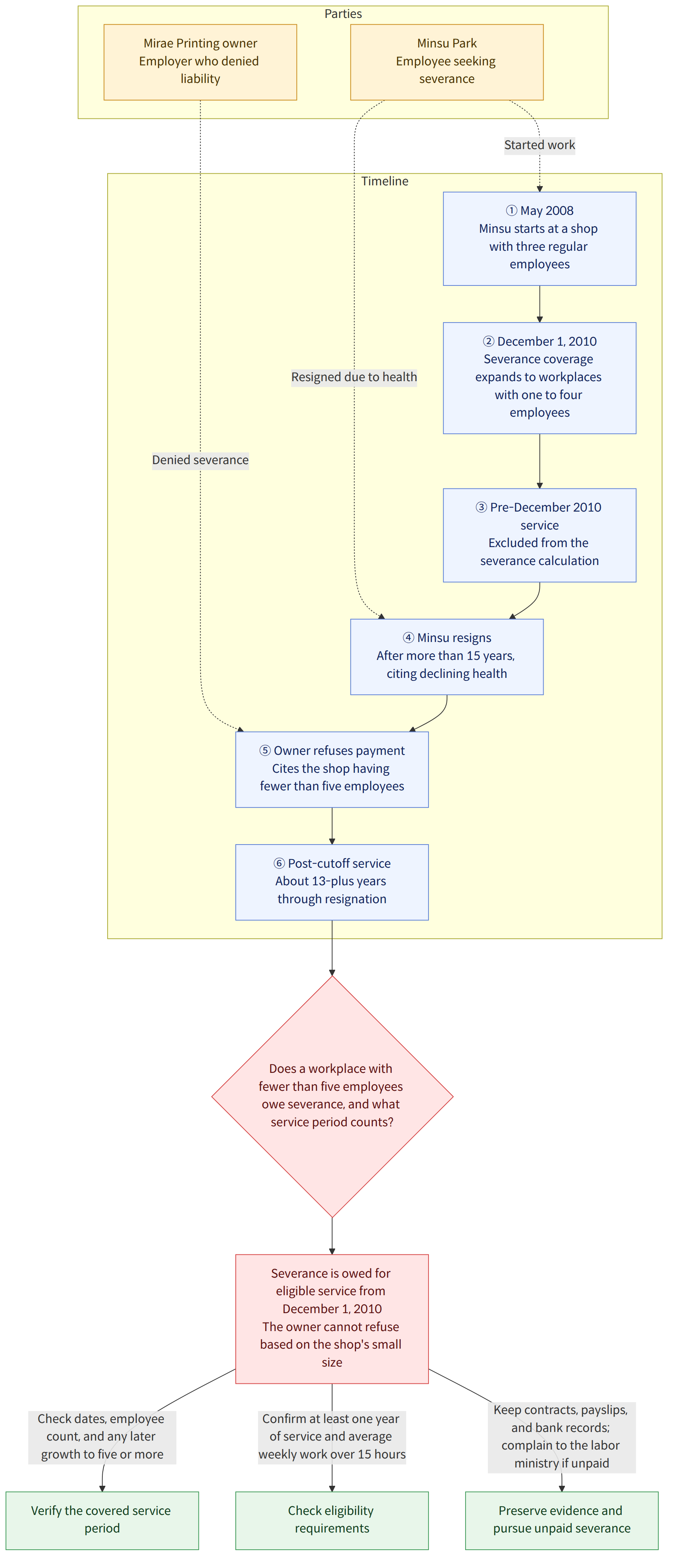
Minsu Park started working at 'Mirae Printing,' a small neighborhood print shop in Seoul, in May 2008. At the time, it was a modest operation with only three regular employees, including the owner. Despite the small scale, Minsu worked there diligently for over 15 years, enjoying the family-like atmosphere.
Recently, however, Minsu decided to resign due to declining health. When he cautiously approached the owner about his severance pay (known as toejikgeum in Korea), the response was cold. "Minsu, you know we’re a small shop with fewer than five people. I’m pretty sure the law says we don't have to pay severance for businesses this small."
Minsu was caught off guard. Having dedicated over a decade of his life to the shop, he wondered: Is it true that working for a micro-business means forfeiting the right to a retirement nest egg?
2. The Core Legal Question
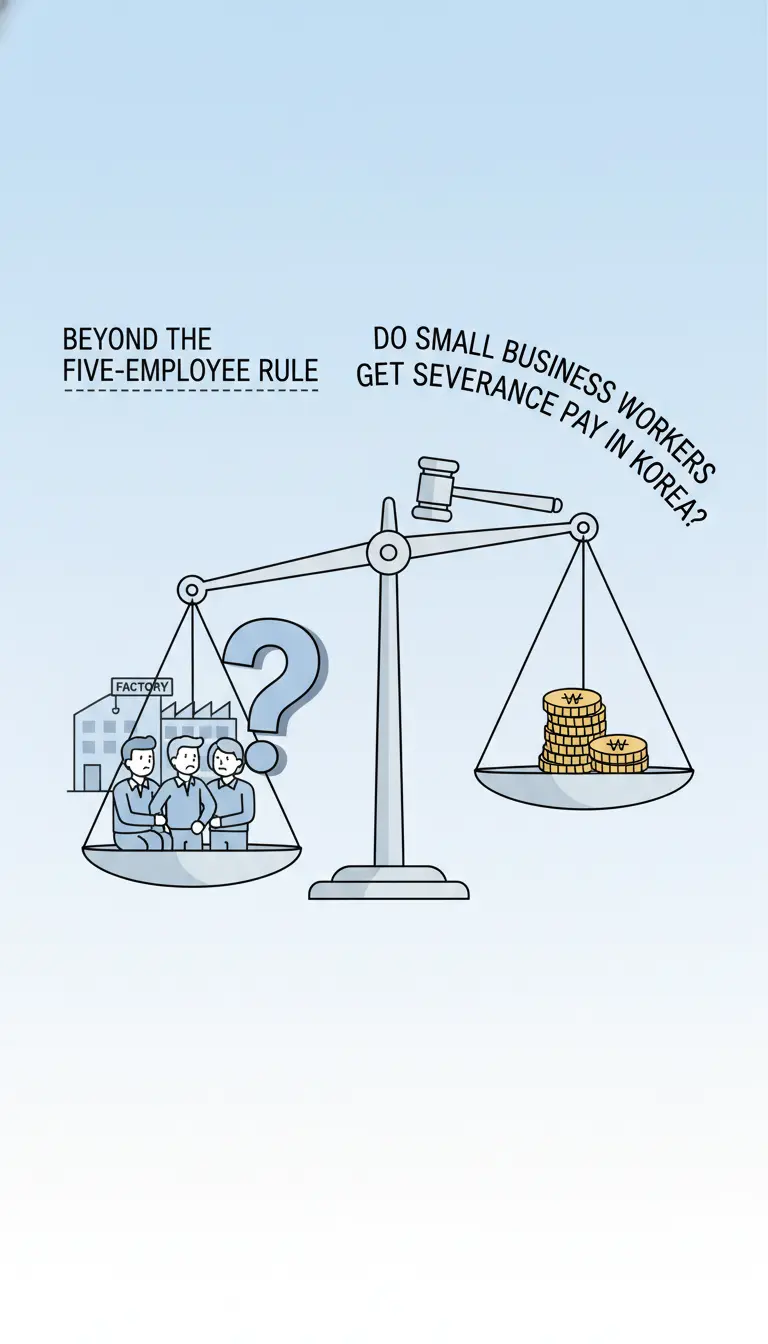
The central issue in this case is whether the Employee Retirement Benefit Security Act applies to small workplaces with fewer than five regular employees. Furthermore, for long-term employees like Minsu, what is the starting point for calculating this benefit?
3. What Korean Law Says
In the past, many labor protections in South Korea were limited to businesses with five or more employees. However, the law has evolved to protect nearly all workers.
Article 3 of the Act on the Guarantee of Employee Retirement BenefitsThis Act shall apply to all businesses or workplaces using employees.
To allow small businesses time to adjust, the Korean government implemented the following timeline:
- Universal Expansion: Since December 1, 2010, the retirement benefit system has been expanded to cover all businesses, including those with one to four employees.
- The 2010 Cut-off: According to the supplementary provisions of the Act, for businesses with fewer than five employees, the service period prior to December 1, 2010, is not included in the calculation of continuous service years for severance pay.
- Eligibility Requirements: An employee must work for at least one year and average more than 15 hours of work per week over a four-week period.
4. How Korean Courts Approach This
Korean courts view severance pay as a "deferred wage" and a vital social safety net for workers' post-retirement lives. Consequently, the judiciary does not permit employers to waive this obligation based on the small scale of the business or financial hardship.
Since the 2010 amendment, courts have consistently ruled that even for micro-businesses, the service period starting from December 1, 2010, must be compensated. Failure to pay severance is treated as a criminal offense under the Labor Standards Act (wage theft).
5. Applying the Law to Minsu’s Case
When we apply these principles to Minsu Park's situation, the legal outcome is clear:
First, the owner of Mirae Printing is incorrect. Although the shop has only three employees, it has been legally required to provide severance pay since December 1, 2010.
Second, regarding the calculation period, Minsu began working in 2008. However, because his workplace was a micro-business (< 5 employees), the law only recognizes his service from December 1, 2010, onwards for severance purposes. Unfortunately, the two and a half years he worked between 2008 and late 2010 are legally excluded from the calculation.
Third, Minsu is entitled to severance pay for the approximately 13-plus years of service from December 2010 to his current resignation date. This is a mandatory legal right that the owner cannot refuse.
6. Conclusion: What Happened, and What Should You Do?
In the end, Minsu is entitled to a substantial severance payment for his service after December 2010. He should present the legal facts to his employer. If the owner still refuses, Minsu can file a formal complaint with the Ministry of Employment and Labor to recover his unpaid wages.
For readers in a similar position, here are two practical tips:
- Verify the Date and Employee Count: If you work in a very small shop, remember that your severance pay clock effectively started on December 1, 2010. If the business grew to 5 or more employees later, the calculation might become more favorable for the later period.
- Keep Your Documentation: Always retain copies of your employment contract, monthly payslips, and bank transfer records. These are crucial evidence if you ever need to prove your tenure and average wage to the labor board.
Legal rights are for those who claim them. Regardless of your company's size, make sure you receive the retirement benefits you have earned through your hard work.