1. A Lonely Departure: Ji-ho Park’s Story
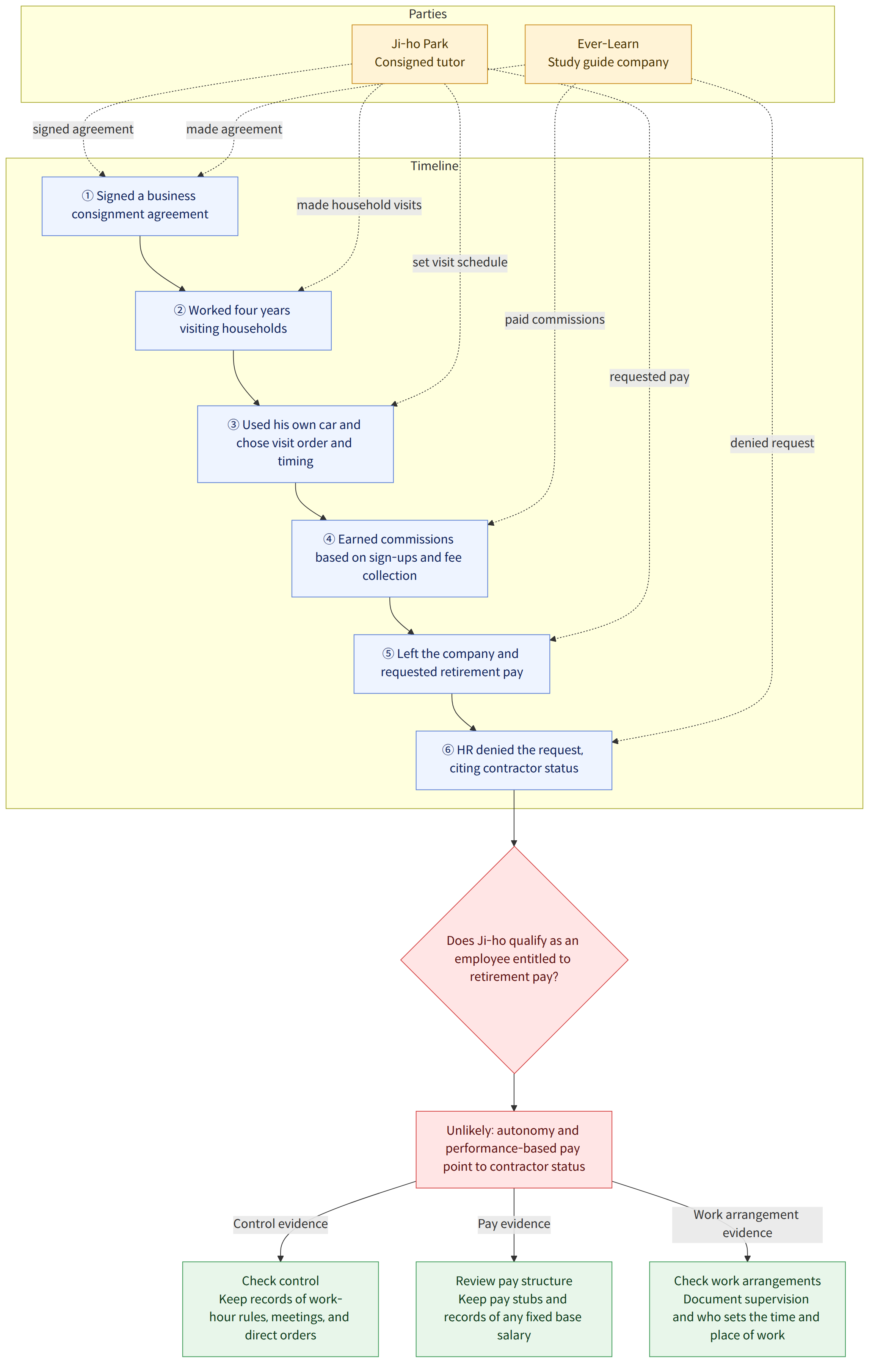
For four years, Ji-ho Park dedicated his life to 'Ever-Learn,' a prominent Korean study guide company. Every afternoon, he drove his own car to visit various households in his assigned district. His routine involved checking children's progress, promoting new workbooks, and collecting monthly fees. In his heart, Ji-ho felt like a proud, long-term employee of Ever-Learn.
However, when Ji-ho decided to move on and visited the HR department to discuss his severance pay (retirement pay), he was met with a cold reality. The HR manager pulled out his file and pointed to the 'Business Consignment Agreement' he had signed years ago. "Ji-ho, you aren't an employee. You are an independent contractor. Therefore, you aren't eligible for retirement pay," the manager stated. Feeling betrayed and confused, Ji-ho decided to seek legal counsel to understand if his four years of hard work truly counted for nothing.
2. The Core Legal Question
Can a 'consignment teacher' or 'tutor' who signs a business commission contract with a study guide company be legally recognized as an "employee" under the Labor Standards Act of Korea to claim retirement pay?
3. What Korean Law Says About Employee Status
The Korean Labor Standards Act prioritizes substance over form. It does not matter if the contract is titled "Consignment," "Freelance," or "Service Agreement." The court looks at whether the person provided labor in a subordinate relationship for the purpose of earning wages.
According to the Supreme Court, the criteria for a "subordinate relationship" include:
- Whether the employer determines the content of the work and if work rules/personnel regulations apply.
- Whether the individual receives specific and direct supervision from the employer during the work process.
- Whether the employer designates the time and place of work and if the individual is bound by these.
- Whether the compensation is fixed (base salary) or varies based on performance (commissions).
- The ownership of tools/materials and whether income tax is withheld at the source.
4. How Korean Courts Approach This
Generally, the Supreme Court of Korea has maintained a strict stance regarding study guide tutors. In most precedents, these tutors are not recognized as employees. The courts reason that these individuals operate more like independent business owners rather than traditional subordinates.
Judges often highlight that the "commission" paid to these tutors is not a reward for the quantity of labor or hours worked. Instead, it is a result-oriented payment determined solely by the teacher's performance—such as recruiting new members or successfully collecting fees.
5. Applying the Law to Ji-ho’s Case
When we look at Ji-ho’s situation through the lens of legal criteria, several factors weigh against him.
First, there was a lack of direct supervision. Ji-ho used his own vehicle and had the freedom to decide the order and specific timing of his home visits. If Ever-Learn did not dictate his every move or require him to clock in and out at a central office, the "subordinate" link is weakened.
Second, the nature of his pay is critical. Ji-ho’s income fluctuated entirely based on how many new students he signed up and the fees he collected. Under Korean law, such performance-linked commissions are often viewed as a business profit shared with a contractor, rather than a wage paid to a worker.
Finally, the lack of fixed working hours. Ji-ho worked in the field, not at a desk provided by the company, and his hours were largely determined by his own schedule and his clients' availability. This autonomy strongly suggests a contractor relationship rather than employment.
6. Conclusion: What Happened, and What Should You Do?
Unfortunately, Ji-ho Park is unlikely to receive retirement pay. Because his work involved high levels of autonomy and his pay was strictly performance-based, the law views him as an independent professional who took on the risks and rewards of a business. He left the company with a hard-learned lesson about the legal nuances of consignment contracts.
If you find yourself in a similar situation, here are two practical tips:
- Check the Level of Control: If your "employer" starts dictating your specific working hours, requiring you to attend daily meetings, or giving you direct orders on how to perform your tasks, you may actually be an employee. Document these instances carefully.
- Review Your Pay Structure: If you receive a fixed base salary regardless of performance, your claim for employee status becomes much stronger. Keep records of your pay stubs and any internal communications regarding your compensation.
Understanding the reality of your contract today can prevent a painful legal surprise when you decide to leave tomorrow.
This column provides general legal information and should not be taken as specific legal advice for individual cases.