1. A Difference Based Only on a Label
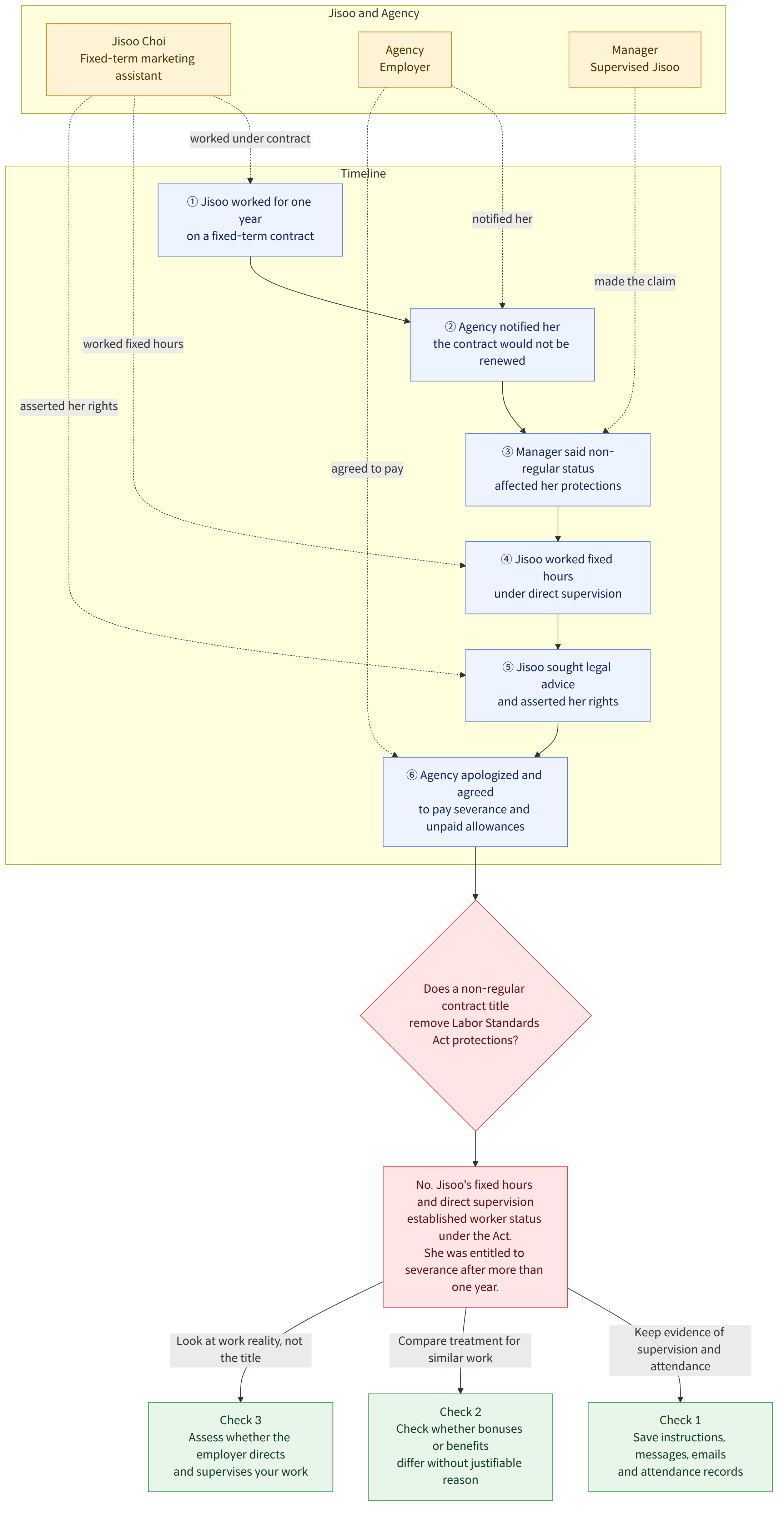
Jisoo Choi, a marketing assistant who had been working at an agency on a one-year fixed-term contract, recently received devastating news. Citing management difficulties, the company notified her that her contract would not be renewed. Although Jisoo had worked overtime and dedicated herself just like the regular employees for the past year, her manager pushed her to pack up quickly, saying, "Since you're not a regular employee, the standards for severance pay or dismissal notice don't apply to you in the same way."
Jisoo felt it was unfair. She arrived at work at a fixed time, followed her supervisor's direct orders, and used company equipment to perform her duties. She wondered why her "contract worker" status should place her in a legal blind spot. Does a mere expiration date on a piece of paper erase the entire value of her labor?
2. The Core Legal Question
The central question raised by Jisoo’s situation is: Does the protection of the Labor Standards Act (LSA) in Korea apply only to regular (permanent) employees? In other words, can non-regular workers, such as contract or dispatched employees, claim the same legal protections as their regular counterparts?
3. What Korean Law Says About Workers
Korean labor law does not discriminate based on the form of employment. The Labor Standards Act defines a "worker" quite broadly:
Labor Standards Act, Article 2 (Definitions)The term "worker" means a person, regardless of the type of occupation, who offers labor to a business or workplace for the purpose of earning wages.
According to this definition, it doesn't matter whether your contract is permanent, fixed-term, or dispatched. Furthermore, specific laws have been enacted to provide extra layers of protection for non-regular workers:
- Act on the Protection, etc. of Fixed-term and Part-time Employees: Prohibits discriminatory treatment without justifiable reasons and includes provisions regarding the transition to indefinite contracts after two years of service.
- Act on the Protection, etc. of Dispatched Workers: Regulates the working conditions and duration for dispatched employees to prevent exploitation.
4. How Korean Courts Approach This: Substance Over Form
When determining whether someone is a "worker" entitled to legal protection, Korean courts prioritize "substantive subordination" over the formal title of the contract (e.g., freelancer, independent contractor, or fixed-term worker). The courts typically look at the following criteria:
- Does the employer determine the specific contents of the work and exercise significant command and supervision?
- Are the working hours and the place of work fixed and binding for the individual?
- Does the employer provide the equipment, raw materials, or tools necessary for the work?
- Can the individual hire third parties to perform the work on their behalf?
If these factors indicate a relationship of subordination, the court recognizes the individual as a protected worker under the LSA, regardless of what the contract is called.
5. Applying the Law to Jisoo’s Case
Let’s look at Jisoo Choi’s situation. Despite her title as a "one-year contract worker," she was under the direct supervision of her manager and worked fixed hours at the office. This clearly establishes her status as a "worker" under the Labor Standards Act.
Therefore, like any regular employee, Jisoo is entitled to severance pay if she has worked for more than one year. If the company refuses to renew her contract without a justifiable reason, she may have grounds to file for remedy for unfair dismissal. Additionally, if she was denied bonuses or benefits given to regular employees doing similar work, she can seek a "correction of discrimination."
6. Conclusion: Justice for Jisoo and Advice for You
Ultimately, after seeking professional legal advice, Jisoo Choi asserted her rights as a legal worker. Recognizing that they would likely lose in a legal battle, the company apologized and agreed to pay her the full severance pay and unpaid allowances she was owed.
Never assume you lack rights just because you are a non-regular worker. Here are three practical tips for those in similar situations:
- Keep a record of your work: Save evidence of direct supervision, such as messenger logs, emails with instructions, and records of your attendance.
- Check for discrimination: If you are treated differently from regular employees performing the same or similar tasks, you may seek legal protection under the Fixed-term Worker Protection Act.
- Don't be fooled by contract titles: Even if your contract says "Freelancer" or "Service Agreement," if the reality of your job involves subordination to an employer, the law is on your side.
Your labor has value, and the law exists to protect that value regardless of the label on your contract.