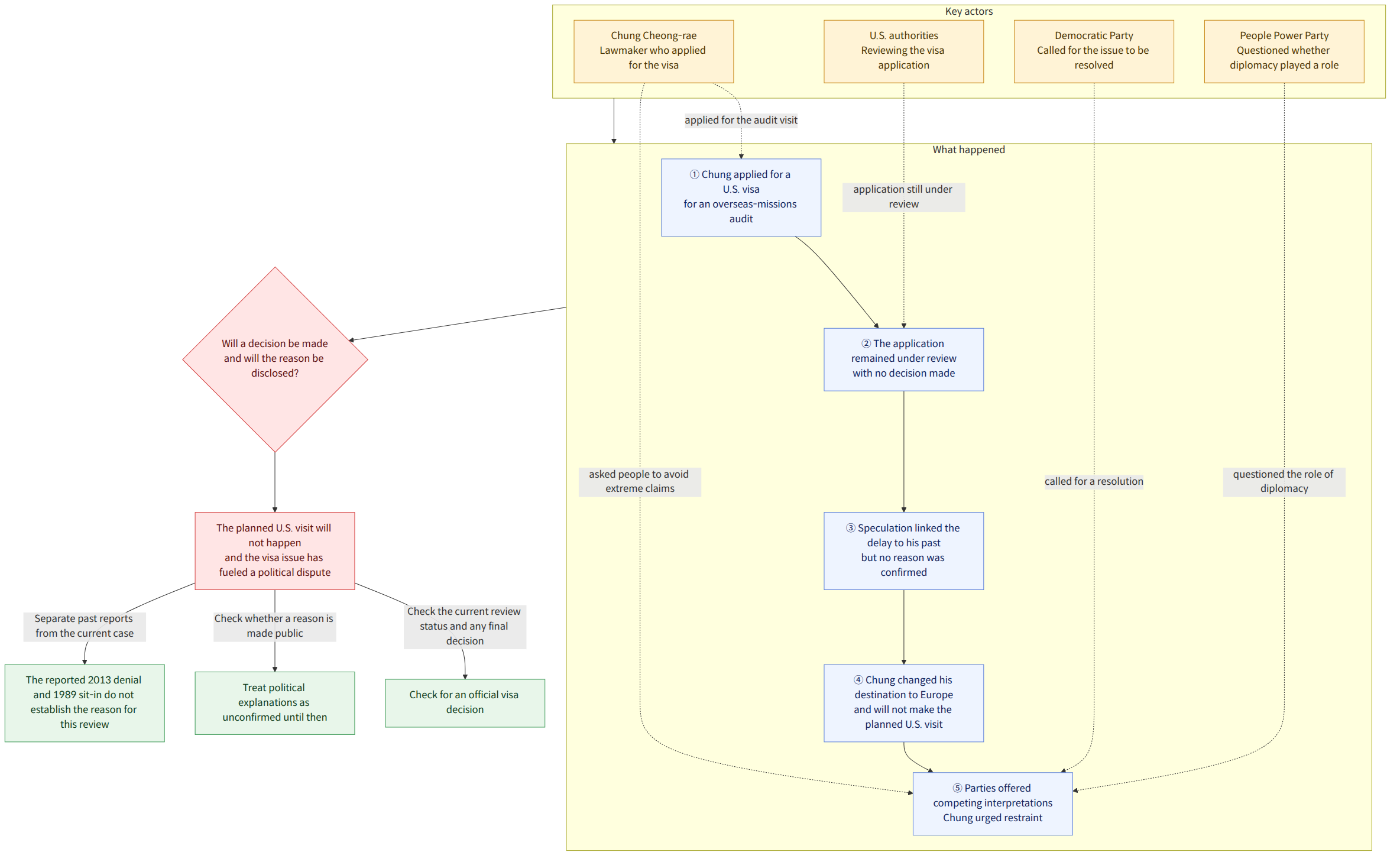
The suspension of the U.S. visa process for Rep. Chung Cheong-rae of the Democratic Party of Korea (더불어민주당) has sparked an ongoing political dispute over South Korea–U.S. relations and the government’s diplomacy with the United States. Chung applied for a visa to conduct the National Assembly’s audit of overseas missions (국정감사) for the Foreign Affairs and Unification Committee (외교통일위원회), but said the official status is currently “under review” and no decision has been made. He moved from the committee’s Americas division to its Europe division and changed his destination from the United States to Europe.
In a Facebook post on the 9th, Chung asked people to refrain from extreme claims about the visa issue and remarks that could harm the South Korea–U.S. alliance, saying they would not serve the national interests of either country. He also said he had already visited the United States twice for official activities and intended to continue contributing to South Korea–U.S. friendship.
Background and context
The visa application was for the Foreign Affairs and Unification Committee’s audit of overseas missions. Chung said he changed his destination to Europe in consideration of public holidays in South Korea and flight reservations. What is currently confirmed, therefore, is that the U.S. visa review has not been completed and he will not be able to make his planned visit to the United States—not that U.S. authorities have made a final decision to deny him a visa.
After the visa delay became known, speculation emerged that it might be linked to Chung’s past. As a university student in 1989, he took part in a sit-in occupation of the U.S. ambassador’s residence. However, it has not been confirmed whether that history affected the review, and Chung said he did not know the reason for it.
Chung cited his past visits to the United States as evidence of his legislative and diplomatic work. He said he conducted the Foreign Affairs and Unification Committee’s audit in the United States in 2012 and, in 2014, discussed issues concerning the Korean Peninsula with U.S. senators and representatives and met with former U.S. Ambassador to South Korea Donald Gregg. Meanwhile, another report said that his U.S. visa had been denied during a 2013 audit, prompting him to change the audit’s location. That past case does not explain the reason for the current review.
What this news means
The issue has drawn attention because political interpretations of the reason have emerged before the visa review has concluded. Park Sung-joon, the Democratic Party’s chief spokesperson, and party leader Kim Min-seok expressed regret over the delay and called on the diplomatic authorities of South Korea and the United States to resolve the issue quickly. Democratic Party lawmakers emphasized that legitimate legislative activity had been obstructed and also criticized the situation, arguing that it would be difficult to accept if Chung’s past participation in the democracy movement had become an obstacle.
By contrast, Choi Eun-seok, chief deputy floor leader of the People Power Party, questioned whether the government and ruling party’s failure in diplomacy with the United States, or a breakdown of trust in the South Korea–U.S. alliance, had played a role in addition to Chung’s past activities. Rep. Na Kyung-won and Rep. Ahn Cheol-soo also framed the matter as an issue concerning South Korea–U.S. relations, rather than simply an individual’s visa problem. These are claims by opposition politicians; they do not mean the reason for the visa delay has been confirmed.
This distinction matters to readers as well. The status of a visa review and the political interpretations placed on it are separate matters. For example, even if the review eventually results in a visa being issued, if the specific reason for the delay is not made public, it may still be impossible to know which, if any, of the political interpretations now being advanced is correct.
Differences in how reports have described the issue
Reports have described the current situation as a “suspension” or “delay” in visa issuance, while some political figures have used stronger terms such as “denial of entry.” Chung, however, said the application is officially under review and no decision has been made. Stronger political descriptions should therefore not be taken to mean that U.S. authorities have made a confirmed final decision to deny the visa.
One report also mentioned Chung’s 2013 visa denial while covering the change to his current travel plans. Other reports focused mainly on the status of the current review and the responses from the ruling and opposition parties. The existence of a past case mentioned in a report and the reason for the current review are separate issues.
What is confirmed and what remains unknown
Confirmed facts
- Chung applied for a U.S. visa to conduct the Foreign Affairs and Unification Committee’s audit and said its official status is “under review.”
- He moved from the committee’s Americas division to its Europe division and changed his destination from the United States to Europe.
- Chung took part in a sit-in occupation of the U.S. ambassador’s residence in 1989, and speculation has emerged that this history may have affected the review.
- The Democratic Party expressed regret and called on the diplomatic authorities of South Korea and the United States to resolve the issue, while People Power Party figures raised questions about the government’s diplomacy with the United States and South Korea–U.S. relations.
What remains unknown
- What is the exact reason the U.S. visa application remains under review?
- When will U.S. authorities conclude the review, and what decision will they make?
- Did Chung’s participation in the 1989 sit-in occupation of the U.S. ambassador’s residence actually affect the review?
What readers should watch for
- Follow-up reports should be checked for whether the visa status changes from “under review” to approved, denied, or another status.
- If further explanations are issued by Chung or the diplomatic authorities of South Korea and the United States, distinguish the confirmed circumstances of the review from political interpretations.
- Follow-up reports should also clarify how the change of destination affects the audit schedule and Chung’s participation.
References
- Other coverage consulted: chosun.com
- Other coverage consulted: chosun.com