Why the cases are being compared
Allegations involving seven current and former Cornell University students have drawn comparisons with South Korea’s Burning Sun scandal, one of the country’s most widely discussed controversies involving sexual misconduct and abuse of power. The comparison has gained attention in Korean and Korean American online communities, in part because one of the students named in the lawsuit, Winston Lee, has ties to Korea.
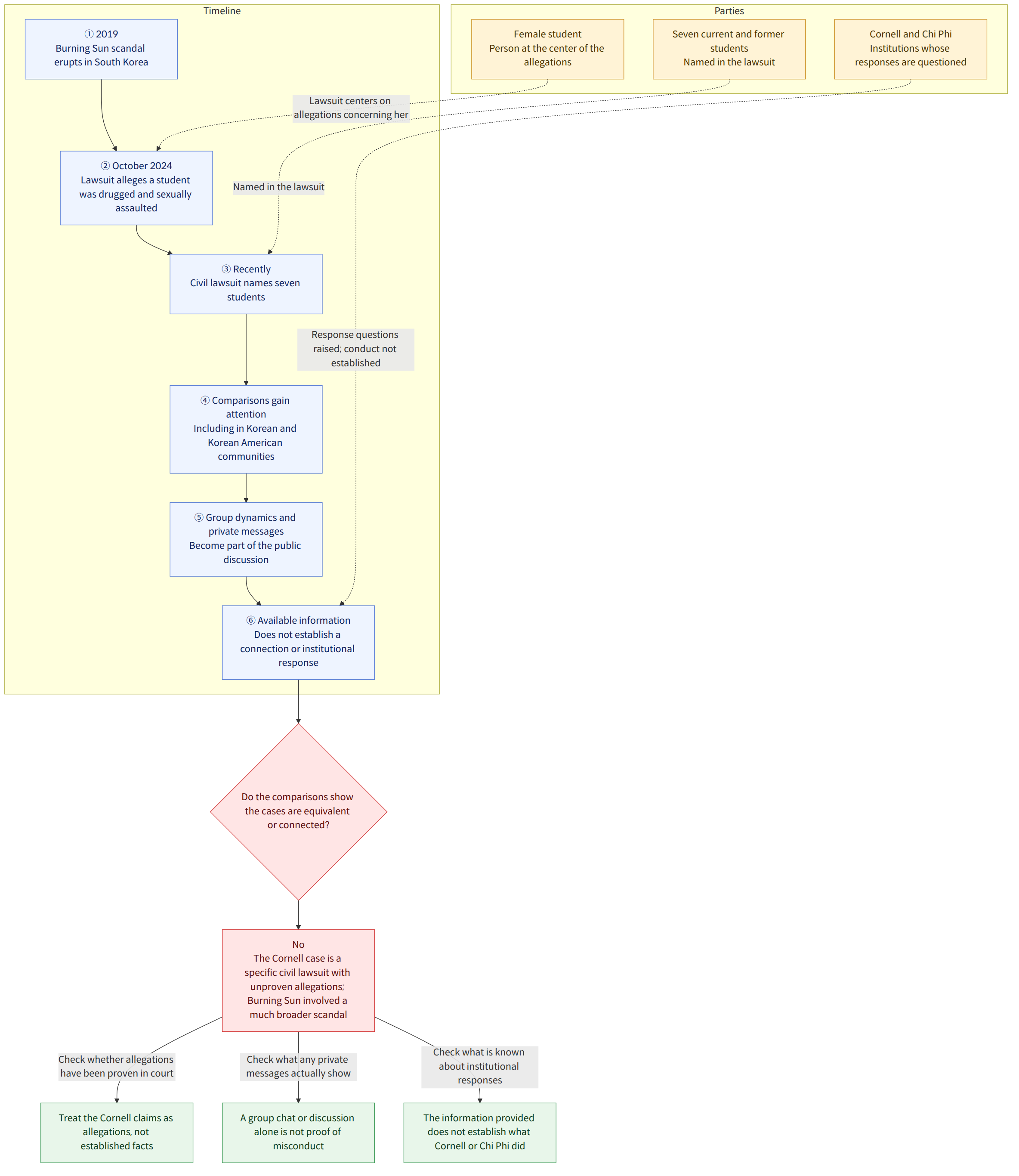
The two cases are not the same, and the available information does not establish that they are connected. Rather, the comparisons focus on broader questions: how groups of men may encourage or conceal harmful behavior, how private communications can become relevant to allegations, and whether institutions respond adequately when serious accusations arise.
The similarities being discussed concern themes and questions of accountability—not proof that the Cornell allegations match the events or scale of Burning Sun.
What the Cornell lawsuit alleges
A civil lawsuit filed recently names seven current and former students. It centers on allegations that, in October 2024, a female student was drugged and sexually assaulted by multiple members of the Chi Phi fraternity. These are allegations in a lawsuit; they have not been established as facts through a court judgment.
A civil case is a legal process in which a person seeks a remedy—such as financial compensation or other relief—from those they accuse of causing harm. It is different from a criminal prosecution, in which the government brings charges and must prove them under the applicable criminal standard. The existence of a lawsuit, by itself, does not determine whether the claims are true or establish the responsibility of any person named in it.
The allegations have also raised questions about how universities and student organizations handle reports of serious misconduct. Those questions can involve how a complaint is received, whether students are protected from further harm, and what steps an institution takes to investigate. The information provided so far does not establish what Cornell or the fraternity did in response, so conclusions about their conduct would be premature.
Why private group chats matter
Private messaging groups can become significant in cases involving alleged group misconduct. They may contain conversations about events, relationships or other behavior, and investigators or lawyers may seek relevant messages as evidence. But the mere existence of a group chat—or discussion among friends—is not proof that its members committed or concealed a crime.
The broader concern is how a group’s norms can shape individual choices. In everyday terms, a person may feel pressure to go along with friends, stay silent, or treat harmful conduct as acceptable. That possibility is one reason observers often ask whether peers challenged behavior or whether a social environment made it easier to ignore warning signs.
What happened in the Burning Sun scandal
The Burning Sun scandal erupted in South Korea in 2019, initially around allegations connected to a Seoul nightclub. The controversy grew into a sprawling public scandal that included allegations and investigations involving prostitution, sexual violence, illegally filmed and shared sexual videos, gambling, and possible police corruption.
The scandal drew intense attention because it was not limited to a single allegation or venue. It became a wider debate about sexual exploitation, the circulation of intimate images without consent, the influence of celebrities and businesses, and whether powerful people could avoid consequences. The issues were discussed across Korean society, in news coverage, public debate and online communities.
That history helps explain why Burning Sun is frequently used as a reference point in conversations about sexual misconduct and groups of men. It has become shorthand for a much broader set of fears about abuse, complicity and institutional failure. However, shorthand can obscure important differences: the Burning Sun affair involved multiple strands of allegations and investigations, while the Cornell case described here concerns a specific civil lawsuit and a particular alleged incident.
Where the comparisons overlap—and where they do not
The most visible overlap is the role of group dynamics. Both discussions raise questions about how people behave within a social group, whether members reinforce or challenge one another, and what happens when someone reports alleged harm. Private communications also feature in the public conversation, although their significance must be assessed based on actual evidence rather than assumption.
A second point of comparison is institutional accountability—the question of whether an organization responds appropriately when serious concerns are raised. In a university setting, that may involve student safety, disciplinary procedures and cooperation with law enforcement where applicable. In a wider scandal involving a nightclub and numerous allegations, accountability can involve businesses, public officials and other institutions.
- Shared themes: alleged sexual misconduct, group behavior, private communications and questions about responses to reports.
- Different scope: Burning Sun developed into a broad, multi-part scandal; the Cornell matter described here is a civil lawsuit concerning an alleged incident.
- Different legal questions: each case has its own evidence, procedures and people involved.
- Important limit: similarity in public discussion does not prove identical conduct, motive or responsibility.
Why the distinction matters
Comparisons can help people recognize recurring concerns, such as the role of peer pressure or the need for credible investigations. But they can also mislead if they make an unresolved allegation seem proven or suggest that two cases are equivalent simply because they share a theme. Careful reporting distinguishes between what a lawsuit claims, what investigators establish and what a court ultimately decides.
The role of online communities and identity
The attention surrounding Winston Lee’s ties to Korea has helped bring the Cornell case into Korean and Korean American online discussions. For people following both societies, the comparison may offer a familiar frame for discussing sexual violence and accountability. At the same time, a person’s national or cultural ties do not establish the truth of allegations or make an individual representative of a whole community.
Online discussion can bring attention to cases that might otherwise receive less public scrutiny, and it can give people space to express concerns about institutional responses. It can also spread incomplete claims quickly. In a case still unfolding, readers should separate verified information from speculation and avoid treating social-media reactions as evidence.
What to watch as the case develops
The next important developments will depend on the legal process and any reliable information made public by the parties or authorities. Relevant questions may include how the claims are contested, what evidence is presented, and whether the case proceeds to further court action. Until those details are established, the allegations should be described as allegations.
The case may also prompt broader discussion about how universities and student organizations prevent misconduct and respond to reports. Useful safeguards can include clear reporting procedures, access to support, fair investigations and protections against retaliation. These measures do not decide the outcome of a particular case, but they can help ensure that concerns are addressed responsibly.
The comparison with Burning Sun is therefore best understood as a debate about patterns and accountability, not a verdict. The Cornell lawsuit must be assessed on its own evidence, while the history of Burning Sun explains why references to group behavior, sexual violence and institutional response resonate so strongly with many observers.