
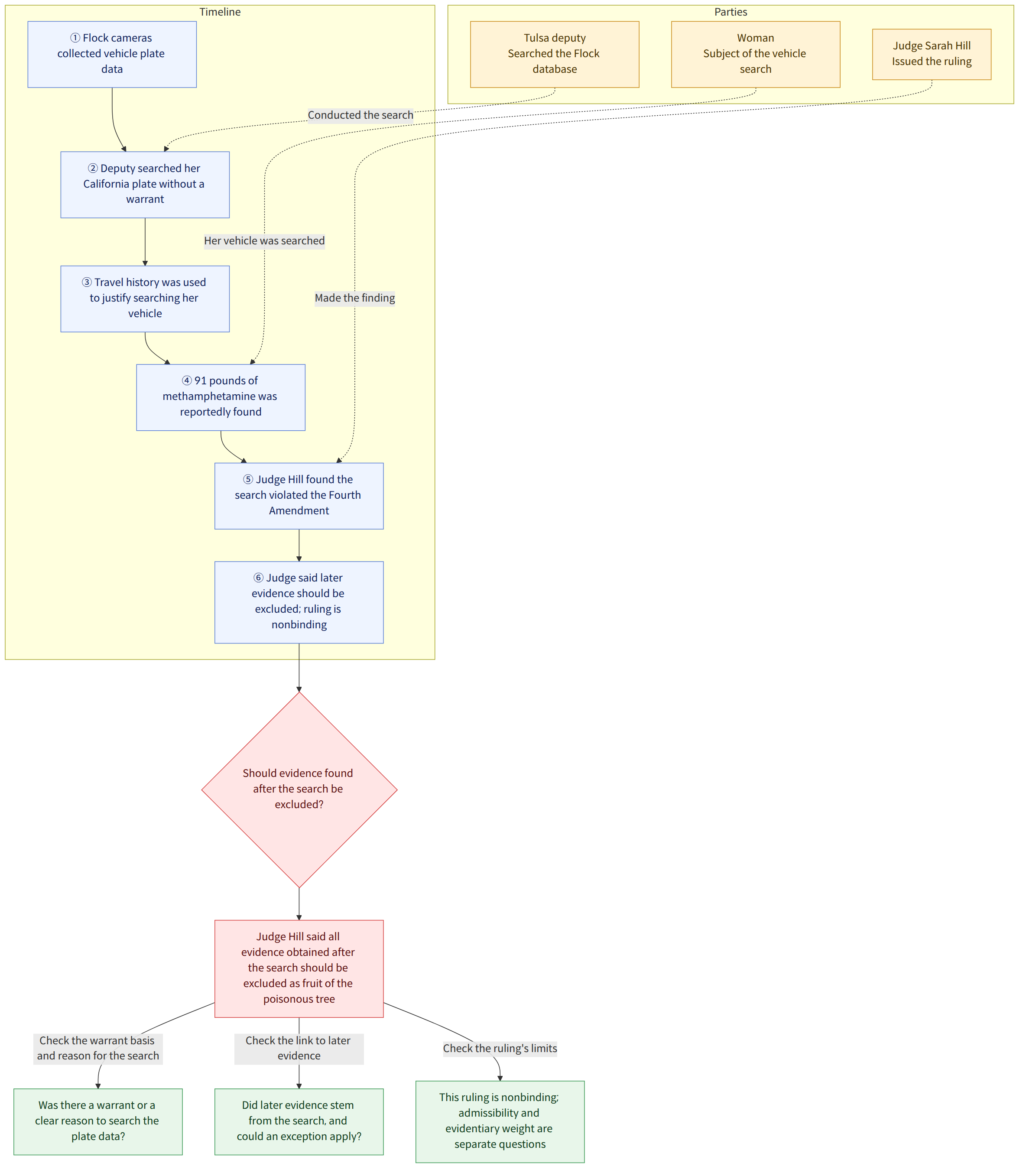
This week, U.S. federal judge Sarah Hill ruled that a deputy at the Tulsa Sheriff’s Office violated a woman’s rights under the Fourth Amendment to the U.S. Constitution by searching her license plate in the Flock Safety database without a warrant. Judge Hill wrote that all evidence obtained after the search should also be excluded as “fruit of the poisonous tree” (evidence derived from illegally obtained evidence). The ruling does not establish binding precedent, but it was reported to be among the first cases in which a federal judge found a Flock search unconstitutional.
Background and context
Flock is a system that collects vehicle license plate information through networked cameras. Judge Hill found that the deputy should have obtained a warrant before searching the database. In the judge’s view, the deputy had no clear reason to conduct the search other than that the vehicle had California license plates.
The deputy used the woman’s travel history found through Flock to justify searching her vehicle. Methamphetamine weighing 91 pounds was reportedly found in the vehicle, but Judge Hill wrote that evidence obtained after the Flock search should be excluded. The focus of the ruling, therefore, is not only the quantity of drugs found, but also the procedures used to obtain the location data used in the investigation and the evidence that followed.
The judge said that indiscriminately and passively recording people’s locations over long periods, then using that information for any purpose whenever needed, could raise constitutional concerns. She described Flock not as a tool targeting only specific individuals, but as a “mass surveillance” tool that continuously collects information on every vehicle passing networked cameras and provides it in response to police requests.
What this news means
The ruling takes aim not at the existence of license plate recognition technology itself, but at the scope of warrantless searches of information and the subsequent use of search results as a basis for investigations. It means that even records of travel in public places can raise questions about privacy and the limits of constitutional rights if they are accumulated over time and used whenever needed. However, the ruling is not binding precedent, so the same conclusion cannot be assumed to apply automatically in other cases.
Investigative agencies may face greater pressure to consider the necessity and procedures for searching information, while organizations that operate or use license plate databases may have to explain the scope of their collection, searches and use of the data. At the same time, it is important for affected individuals to know that an illegal search of information does not always automatically result in the exclusion of all evidence obtained afterward. The connection between the evidence and the possibility of exceptions may be considered separately.
For example, if investigators in a case search vehicle travel records without a warrant and then obtain other evidence based on those records, the person involved could challenge not only the legality of the search but also whether the later evidence stemmed from it. This is a hypothetical example for explanatory purposes; the actual outcome may vary depending on the applicable law and the specific circumstances of the case.
Relevant laws and support information
An internal legal guide explains that under Article 308-2 of Korea’s Criminal Procedure Act (형사소송법), evidence collected through illegal procedures and secondary evidence obtained based on that evidence generally cannot be used as evidence of guilt. However, an exception may be considered after taking into account the nature and degree of the illegality and whether the causal link to the evidence collection has been severed, among other factors. The conclusion in the U.S. ruling does not apply as is to cases in Korea; this guide is for reference in understanding Korean criminal procedure.
Whether evidence may be admitted and whether it is sufficient on its own to establish guilt are also separate questions. The credibility and probative value of evidence are assessed separately. Accordingly, anyone challenging an allegedly illegal search should examine the search procedure separately from the circumstances in which subsequent evidence was obtained.
What is confirmed and what remains unknown
Confirmed facts
- Judge Hill ruled that a Tulsa Sheriff’s Office deputy’s warrantless Flock search violated the woman’s Fourth Amendment rights.
- The judge found that the deputy had no clear reason to conduct the search and wrote that evidence obtained afterward should be excluded.
- The ruling does not establish binding precedent, but it was described as one of the early federal rulings finding a Flock search unconstitutional.
- Multiple local and state governments, including Florida and Texas, reportedly said they would stop using Flock technology. Senator Bernie Sanders introduced a bill to prohibit federal agencies from using automated license plate readers.
What remains unknown
- News reports did not say exactly when the deputy’s Flock search and the vehicle search took place.
- It has not been confirmed whether an appeal was filed against the ruling.
- News reports do not say how congressional consideration of the Block Flock Act has proceeded since it was introduced.
What readers should check
- If you are involved in a similar case, you can check when and under what procedures information was searched and how the results were used in subsequent investigations.
- In Korean criminal procedure, the connection between illegally obtained evidence and subsequent evidence, any exceptional circumstances, admissibility, and probative value should be considered separately. For a specific dispute, it is advisable to consult a legal professional based on the case record.
- When assessing the scope of this ruling, keep in mind both that it is not binding precedent and that the status of any appeal and the consideration of related legislation have not yet been confirmed.