A court rejects the university’s request
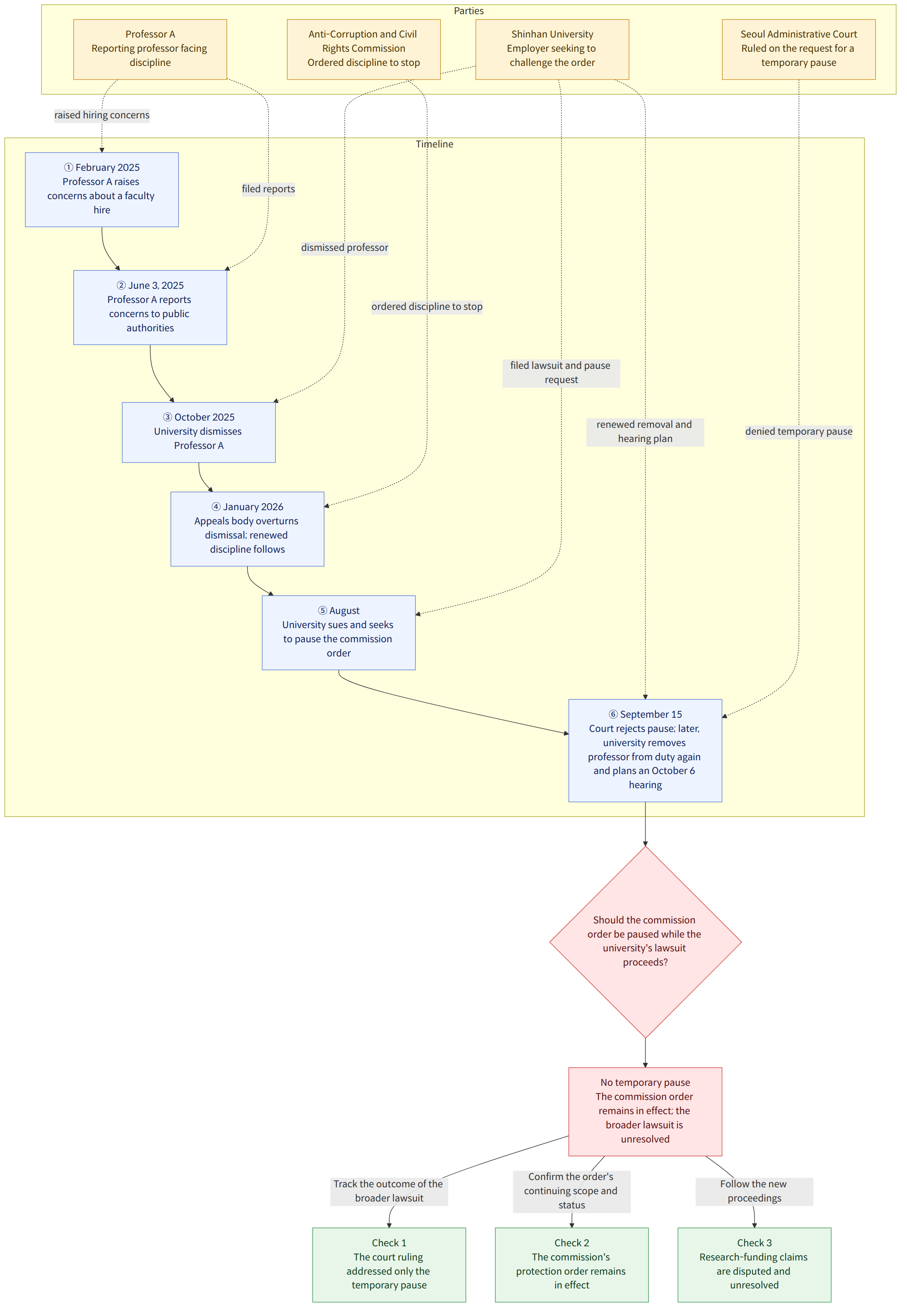
A South Korean court has refused Shinhan University’s request to put on hold a government order protecting a professor who reported alleged irregularities in a faculty hiring process. The Anti-Corruption and Civil Rights Commission had told the university to stop disciplinary proceedings against the professor, identified in the case as Professor A.
The university filed a lawsuit in August seeking to overturn the commission’s decision. It also asked for an injunction (a temporary court order that pauses an action while a case is being heard), arguing that the commission’s order should not take effect until the lawsuit is decided.
On September 15, the Seoul Administrative Court rejected that request. It said the university had not shown that following the commission’s order would cause harm that could not later be repaired, or that there was an urgent need to suspend the order. The court’s decision concerns the request for a temporary pause; it does not, by itself, settle the university’s broader lawsuit over the commission’s ruling.
The commission’s protection order remains in effect while the university challenges it in court.
The professor’s report concerned a faculty hire
Professor A teaches in the Department of Performing Arts at Shinhan University, in Uijeongbu, north of Seoul. In February 2025, the professor took part in a faculty hiring review in which an aide from the university president’s office was among the applicants.
Professor A alleged that the university changed the job requirements to suit the aide and that the president and an academic affairs official directed reviewers to give the candidate high scores. The candidate was hired and later faced questions about the quality of teaching in the first semester. These are allegations, not established findings; police are investigating the suspected hiring irregularities.
The professor says the concerns were first raised internally with the university in April 2025. After seeing no improvement, Professor A filed reports with the commission and the Ministry of Education on June 3 that year. The university disputed the professor’s account, arguing that the complaint followed a disagreement over who should be hired.
A first dismissal was overturned
In October 2025, the university dismissed Professor A after investigating student complaints that included alleged verbal abuse and demands that students handle personal tasks. The dismissal came about four months after the professor’s reports to public authorities.
The dismissal was later overturned by the national faculty appeals commission, a body that reviews disputes over disciplinary decisions against teachers. In January 2026, it found that the university’s disciplinary panel did not meet the required gender-balance rules. The university then sought to discipline the professor again on the same grounds.
The Anti-Corruption and Civil Rights Commission viewed that renewed effort as a possible disadvantage imposed because of whistleblowing (punishment or unfair treatment for reporting suspected wrongdoing). It said some aspects of the professor’s supervision may have been excessive, but also found that some of the university’s stated grounds for discipline lacked sufficient evidence. It considered dismissal especially severe given that the university had not issued a prior warning and had not used dismissal in similar cases.
- The commission did not find that every university action was improper.
- It accepted that the university could investigate student complaints and temporarily remove some duties in response to them.
- Its central concern was whether renewed discipline was being used to penalize the professor for reporting suspected misconduct.
New allegations and another removal from duty
Professor A has not taught classes since May 2025, more than a year before the latest developments. On September 22, 2026, the university again notified the professor of a suspension from duties (removal from work responsibilities while retaining formal employment status), this time citing concerns about past research-funding payments.
The university has also filed a police complaint over alleged improper receipt of research funds and alleged misuse of performance-support money. It says a new disciplinary committee will meet on October 6 to consider the matters. Professor A denies wrongdoing, saying the money in question was payment for actual performances and was donated to support the department.
The competing claims have not been resolved in the information available. The new proceedings therefore raise two separate questions: whether the financial allegations are supported by evidence, and whether the timing and handling of the case amount to retaliation for the professor’s earlier reports.
University and professor offer sharply different accounts
The university denies that it is acting in retaliation. It says separating Professor A from students is necessary to protect them and argues that students’ rights must also be considered alongside the professor’s rights.
Professor A says the university is continuing to find new grounds for action despite the commission’s protection order and the court’s refusal to suspend it. The professor argues that whistleblowing is meant to help organizations correct internal problems, and that withholding classes or imposing unfair treatment could discourage others from speaking up.
“If people are treated unfairly and denied teaching work for reporting problems inside an organization, who will speak up?” Professor A said.
A professors’ labor union focused on democratizing private universities has also described the renewed disciplinary effort as retaliation. It called on Shinhan University not to hold the October 6 hearing, saying the case risks undermining the purpose of whistleblower protections.
Why the case matters beyond one campus
Whistleblower protections are designed to make it safer for people to report suspected misconduct, especially when they work inside the organization being reported. The same person may also face a difficult balance: an institution must be able to investigate genuine complaints and protect students, while ensuring that those steps are not used as a pretext to punish someone for reporting suspected wrongdoing.
That distinction can be hard to assess from timing alone. A new investigation after a whistleblower’s report does not automatically prove retaliation, just as a university’s stated concern for students does not by itself establish that its actions are fair. Evidence, the consistency of disciplinary procedures, and whether similar cases were treated alike can all matter.
The court’s refusal to pause the commission’s order is significant because it leaves the protection in place while the legal challenge proceeds. But the final outcome will depend on the courts’ review of the commission’s decision and on the evidence behind the university’s new allegations. For now, the October 6 hearing is the next immediate test of how the university will handle the dispute.
What happens next
- October 6: Shinhan University says its disciplinary committee will consider the new allegations.
- Ongoing: Police are investigating the suspected hiring irregularities and the university’s complaints concerning funds.
- In court: The university’s lawsuit challenging the commission’s protection decision remains separate from the rejected request to pause that decision.
The case will test whether a university can pursue new disciplinary grounds while a whistleblower-protection order is in force—and what safeguards are needed to distinguish a legitimate investigation from retaliation.