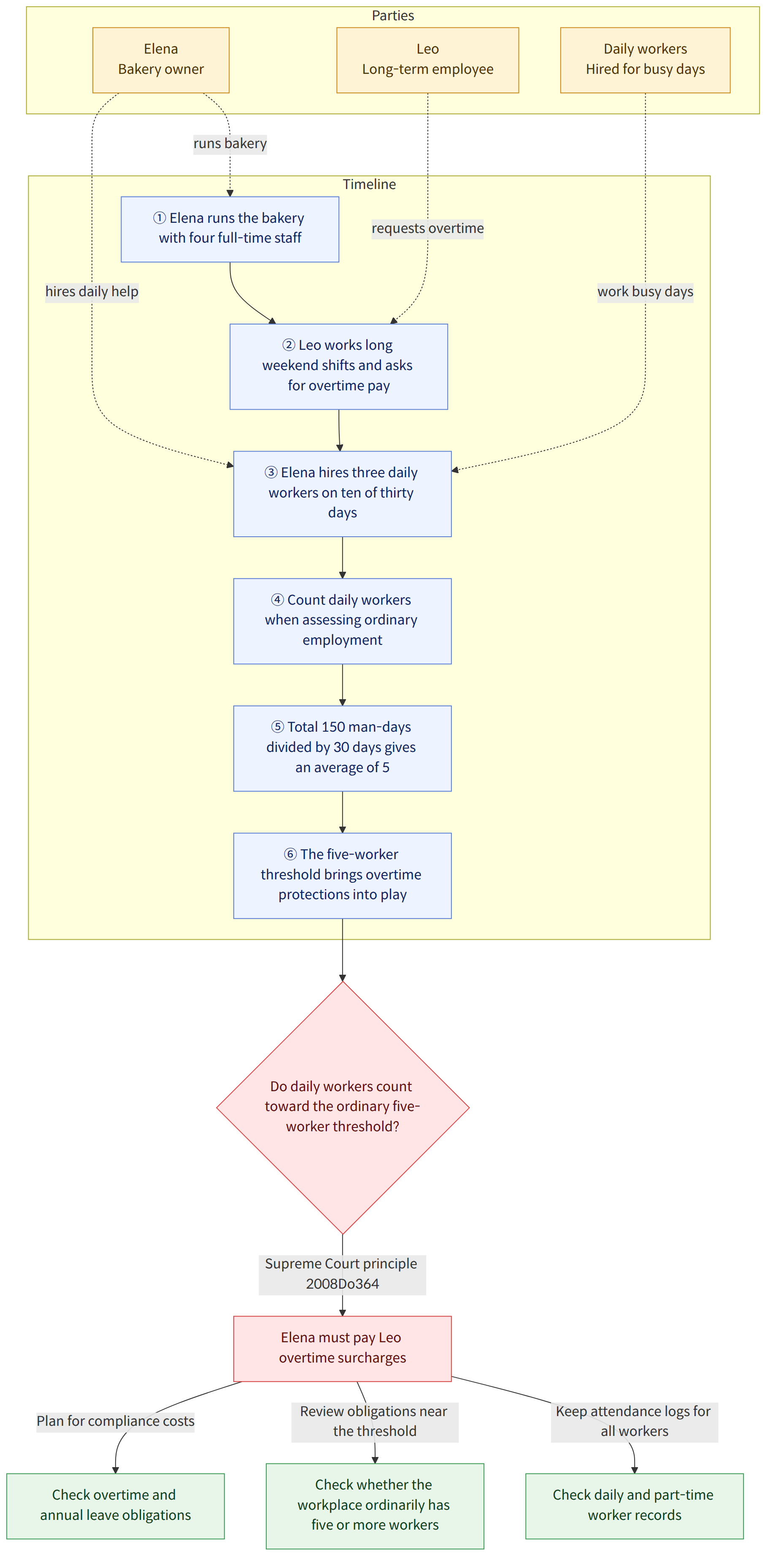
1. A Baker's Dilemma: The Busy Season Surprise
Elena, the owner of a trendy Seoul bakery called "Bread & Bloom," always considered her business a "micro-enterprise." She employs four dedicated full-time staff members. However, during the peak holiday season or busy weekends, she frequently hires two or three daily workers—college students looking for extra cash—to handle the overflow of orders.
One evening, Leo, one of her long-term employees who had been working long weekend shifts, asked for overtime pay. Elena was taken aback. "Leo, we only have four employees. According to what I've heard, the rules for overtime pay don't apply to businesses with fewer than five workers." She assumed the temporary helpers didn't count toward the official tally.
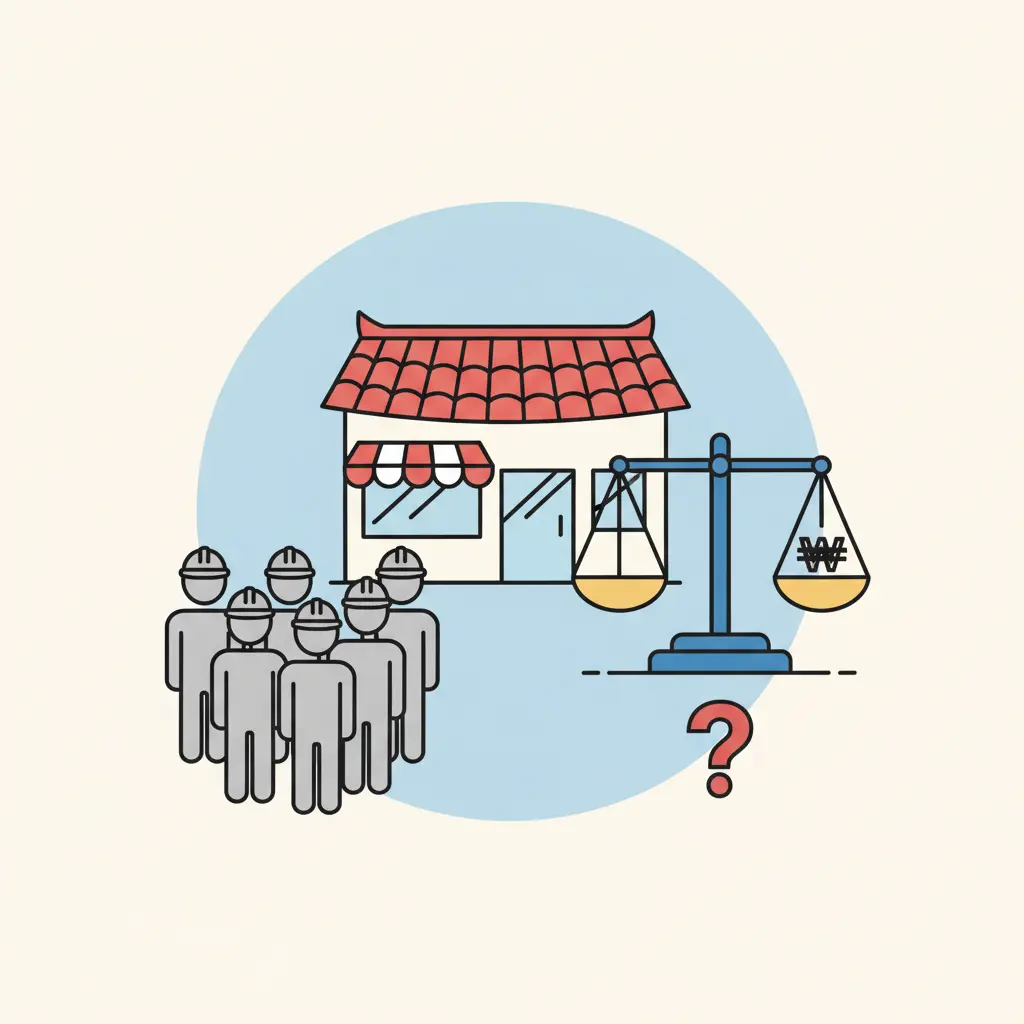
2. The Legal Question: Do Temporary Workers Tip the Scales?
The core of the conflict lies in the Labor Standards Act (LSA). In Korea, several key protections—such as overtime surcharges, annual paid leave, and restrictions on unfair dismissal—apply only to workplaces that "ordinarily employ five or more workers." The question is: Does Elena's habit of hiring daily workers push her bakery into this high-stakes category?
3. What Korean Law Says: Defining 'Ordinarily Employed'
Korean law uses the term "Sang-si" (상시), which translates to "ordinarily" or "as a matter of status." It does not mean that five people must be physically present every second the doors are open.
Supreme Court Principle (2008Do364):"Ordinarily employing five or more workers" refers to the general state of the workplace. Even if the number of workers occasionally falls below five, the business is still considered a 5+ workplace if the 'status' of the operation involves five or more people. Crucially, this count must include not only permanent staff but also daily workers (daily laborers) hired according to the needs of the moment.
In short, the law looks at the reality of the labor usage, not just the names on the permanent payroll.
4. How Korean Courts Approach the Calculation
To determine if a business meets the threshold, courts and the Ministry of Employment and Labor use a specific formula during a "calculation period" (usually one month prior to a legal event):
- Total Man-Days: Sum the total number of workers present for each day the business operated.
- Average Calculation: Divide the Total Man-Days by the number of operating days.
- The 'Half-Day' Rule: Even if the average is slightly below 5, if the number of days where 5 or more workers were employed exceeds 50% of the total operating days, the law considers it a 5+ workplace.
5. Applying the Law to Elena's Bakery
Let’s look at Elena’s bakery for the last month (30 days). For 20 weekdays, she had 4 employees. For 10 weekend/holiday days, she hired 3 daily workers, making a total of 7 people on those days.
- (4 workers × 20 days) + (7 workers × 10 days) = 80 + 70 = 150 total man-days.
- 150 ÷ 30 days = 5.0
In this scenario, Elena’s average is exactly 5. Even though her "core team" is only four, the consistent use of daily workers on weekends brings her entire business under the full jurisdiction of the Labor Standards Act. Leo is indeed entitled to overtime pay.
6. Conclusion: What Happened, and What Should You Do?
Because Elena’s bakery hit the average of five workers due to the inclusion of daily help, she is legally required to pay Leo his overtime surcharges (typically an additional 50% of the hourly wage). Failure to do so could result in labor complaints and penalties.
Practical Tips for Business Owners:
- Keep Precise Attendance Logs: Track every person who walks in to work, including part-timers and daily help. This data is your primary defense or your primary liability.
- Understand the Threshold: If your business hovers around 4 or 5 employees, consult a legal professional to understand your obligations before a dispute arises.
- Budget for Compliance: If your business is growing, it is safer to assume you will hit the 5-worker threshold and budget for overtime and annual leave accordingly, rather than risking a legal battle later.