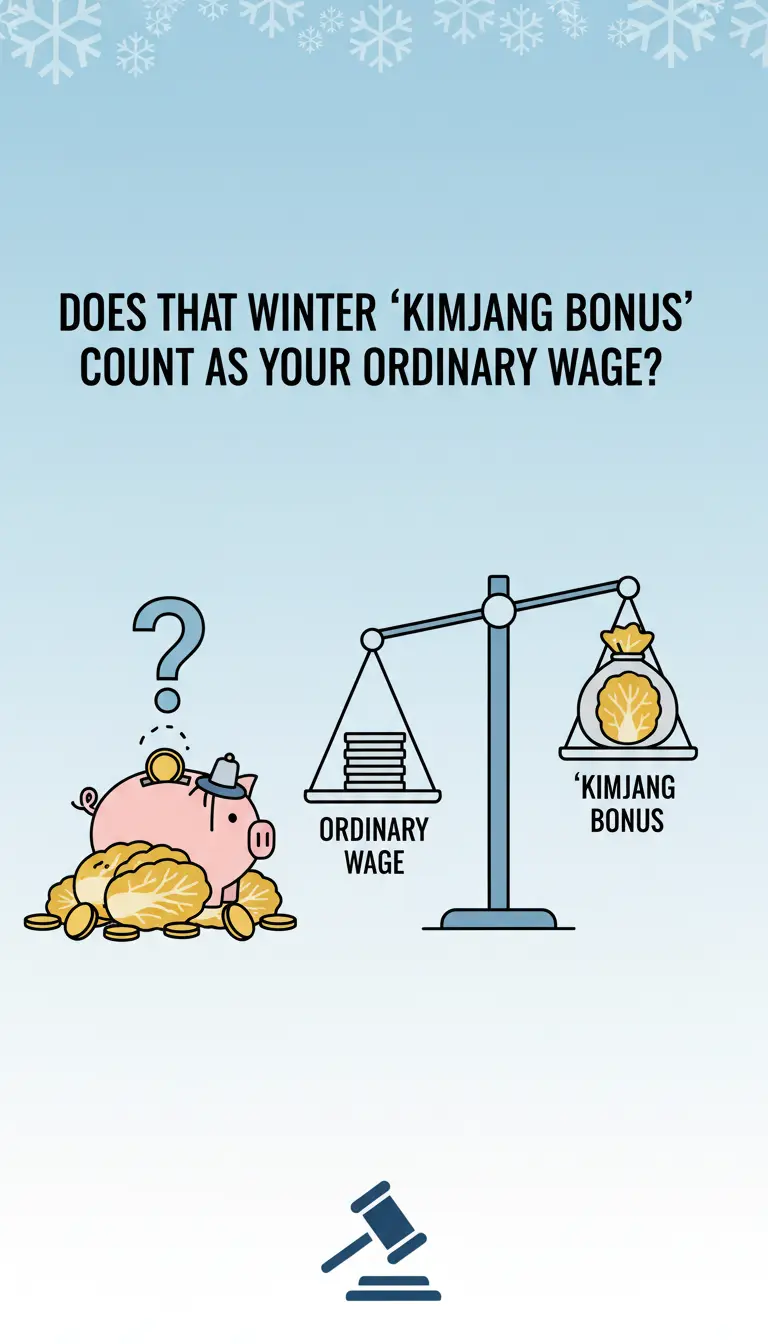
1. A Warm Gift in the Cold Winter
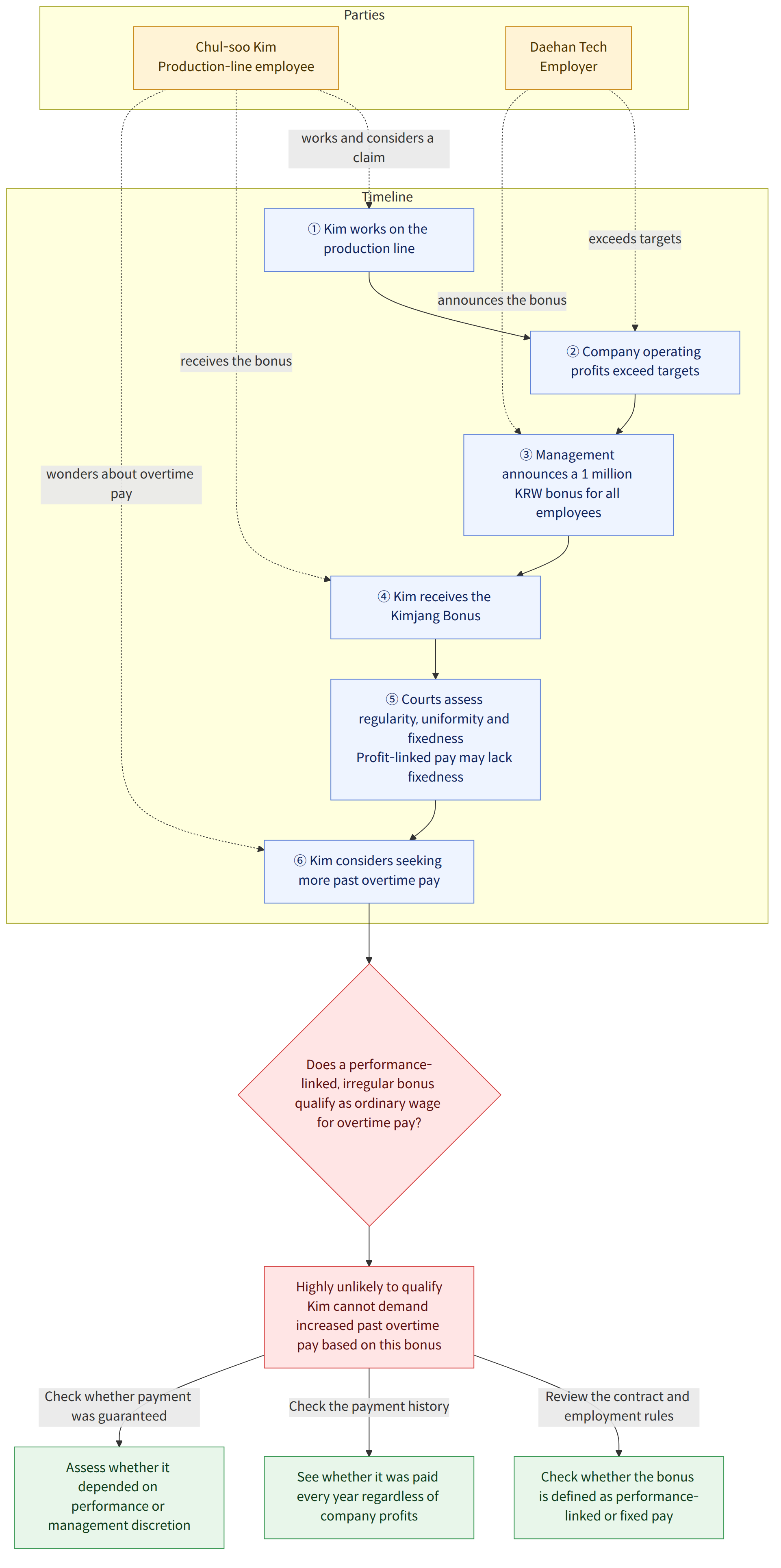
Chul-soo Kim, who has been working on the production line at Daehan Tech for five years, recently received some heartwarming news. As the company's operating profits exceeded targets this year, the management announced a 1 million KRW "Kimjang Bonus" (traditionally for making winter kimchi) for all employees. Chul-soo and his colleagues were thrilled by the unexpected cash and celebrated with a round of drinks after work.
However, a few days later, Chul-soo began to wonder. A friend working in the same industry mentioned that if various bonuses or allowances are classified as "Ordinary Wage" (Tong-sang-im-geum), the rates for overtime, night, and holiday work would also increase. Since Chul-soo had worked a lot of overtime this year, he hoped that this Kimjang Bonus would lead to a retroactive increase in his overtime pay.
2. The Core Legal Question
Can a so-called "Kimjang Bonus" or performance incentive, paid irregularly only when the company performs well, meet the definition of "Ordinary Wage" under the Labor Standards Act and be included in the base amount used to calculate overtime pay?
3. What Korean Law Says About Ordinary Wage
In the Korean Labor Standards Act, Ordinary Wage is a crucial benchmark for calculating various statutory allowances. According to the landmark Supreme Court En Banc ruling, three key criteria must be met for a payment to be considered Ordinary Wage:
The Three Criteria of Ordinary Wage1. Regularity: It must be paid consistently at regular intervals.2. Uniformity: It must be paid to all employees or all employees who meet certain objective criteria.3. Fixedness: It must be predetermined and guaranteed in exchange for labor, regardless of additional conditions like performance or achievements.
"Fixedness" is often the most contentious criterion. The payment must be guaranteed at the time the labor is provided, and if it depends on uncertain future events like company profits, it is generally considered to lack fixedness.
4. How Korean Courts Approach This
Korean courts look at the actual nature of the payment rather than its name. Even if something is called a "bonus," if it has been paid to all employees on a fixed schedule every year without exception, the court is likely to recognize it as Ordinary Wage.
Conversely, if a payment is contingent on conditions such as "only in years with good performance" or "subject to management's discretion," the courts typically deny its status as Ordinary Wage. In such cases, the payment is viewed as a discretionary or one-time incentive rather than a fixed exchange for labor.
5. Applying the Law: Chul-soo's Case
Let's analyze Chul-soo Kim's situation through this legal lens. The Kimjang Bonus at Daehan Tech likely fails to qualify as Ordinary Wage for two main reasons.
First, the lack of Fixedness. This bonus is conditional on the company having a "good year." If performance drops next year, Chul-soo will not receive it. Therefore, at the time he provided his labor, the payment was not guaranteed.
Second, the issue of Regularity. Because it is only paid when performance targets are met, it is not necessarily a recurring payment made at regular intervals. Even though it was paid to everyone this year, the fact that it depends on an uncertain future outcome prevents it from becoming part of the base Ordinary Wage.
6. Conclusion: What Happened and What Should You Do?
In conclusion, Chul-soo Kim's Kimjang Bonus is highly unlikely to be recognized as Ordinary Wage. Consequently, he cannot legally demand an increase in his past overtime pay based on this bonus. While it is a welcome financial boost, it is legally categorized as a "lucky incentive" rather than "guaranteed pay."
If you find yourself in a similar situation, here are two practical tips:
- Check Your Employment Rules: Review your contract or the company’s Rules of Employment to see if bonuses are defined as "performance-linked" or "fixed payments for all active employees."
- Look for Long-term Custom: Investigate if the bonus has been paid every single year regardless of profit levels. If a payment becomes an established custom over many years, it might be argued that it has gained the nature of a fixed wage.
This column provides general legal information. Actual cases may vary depending on specific facts and the details of individual employment contracts.