
A French Agency in Gangnam and Min-su Kim’s Dilemma
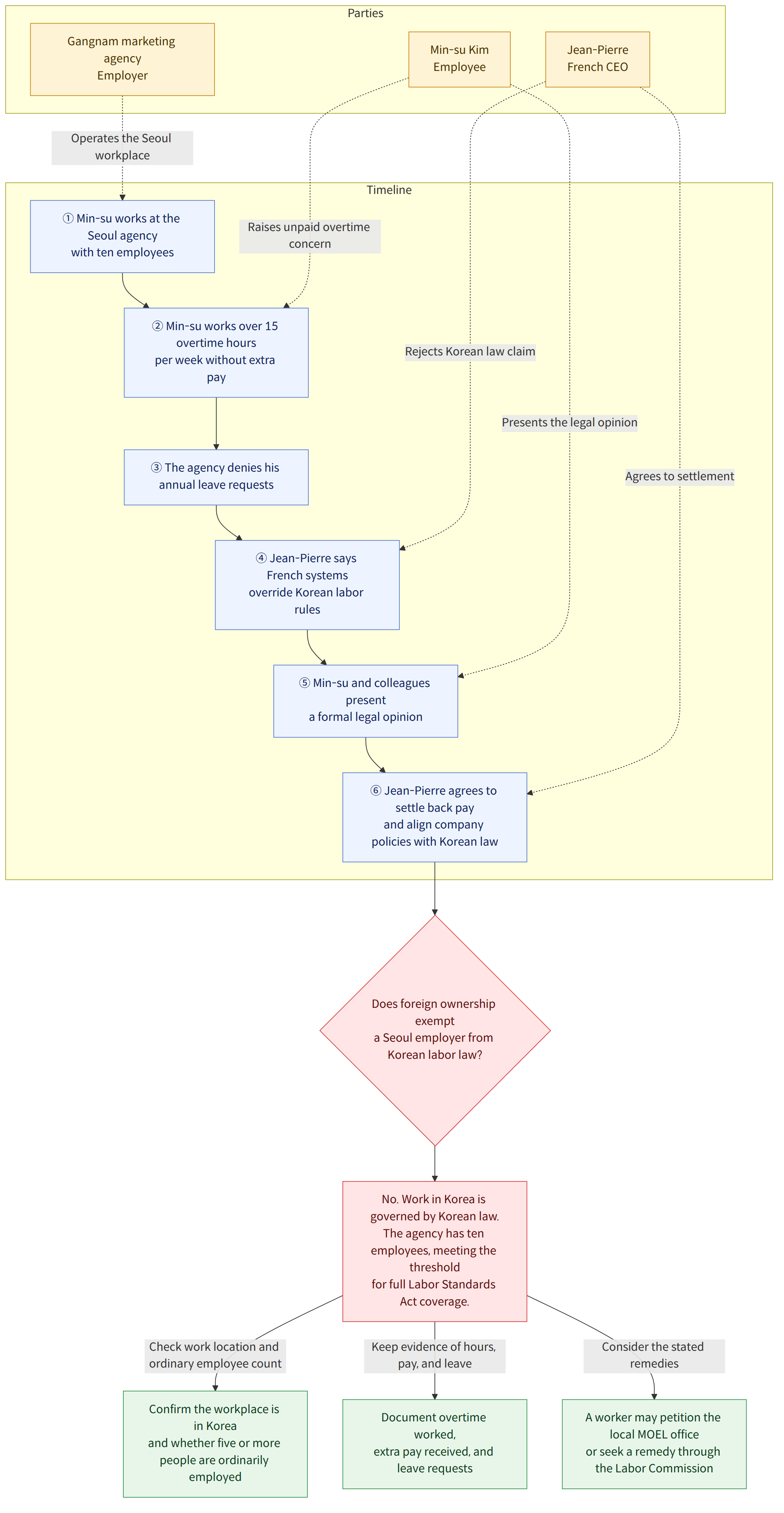
In a sleek co-working space in Gangnam, Seoul, Min-su Kim found himself losing sleep over his job at a boutique marketing agency. The company, owned and operated by a French national named Jean-Pierre, was a small but successful team of ten. However, the work environment was far from ideal. Jean-Pierre often claimed, "We follow the systems of our French headquarters. Korean labor laws are mere suggestions for an international entity like ours."
Over the past few months, Min-su had consistently worked over 15 hours of overtime each week without receiving a single won in extra pay. When Min-su brought this up, Jean-Pierre dismissed it as "European-style flexible culture." Even requests for annual leave were denied on the grounds that "Korean-style vacation rules aren't in our global contracts." Min-su began to wonder: Is it true that a foreign-owned company is exempt from Korean laws simply because the boss is an expat?
The Legal Question: Does Nationality Grant Immunity?
The core legal question in this scenario is whether the nationality of the employer or the company’s origin excuses them from complying with the Korean Labor Standards Act (LSA).
What Korean Law Says: The Territorial Principle
Labor law in the Republic of Korea operates on the Territorial Principle (Lex Loci). This means that any labor relationship performed within Korean territory is governed by Korean law, regardless of who owns the business.
Labor Standards Act, Article 11 (Scope of Application)This Act shall apply to all businesses or workplaces in which five or more employees are ordinarily employed.
The term "all businesses" is interpreted broadly. It includes state and local governments, public corporations, non-profits, and crucially, businesses owned by foreigners or local branches of foreign legal entities. Key criteria include:
- Jurisdiction over Foreign Entities: As long as a foreign company hires workers in Korea and acts as an employer, it must fulfill all obligations under the LSA.
- Employee Threshold: If a workplace employs five or more people on average, the full weight of the LSA—including protections against unfair dismissal, overtime pay requirements, and mandatory annual leave—applies.
- Exceptions: The law does not apply to businesses employing only cohabiting relatives or to domestic helpers (housekeepers/nannies), as state intervention in private domestic life is limited.
How Korean Courts Approach Foreign Employers
Korean courts and the Ministry of Employment and Labor (MOEL) maintain a strict and consistent stance: Location of work is paramount. Courts have ruled that the LSA is a set of mandatory provisions (jus cogens) that cannot be bypassed by private agreements.
Even if an employment contract states that the laws of the foreign headquarters' country will apply, such clauses are generally void if they provide less protection than the Korean LSA. In determining the "five or more employees" rule, the Supreme Court has clarified that this includes not just permanent staff but also temporary or daily workers who are employed as needed.
Applying the Law to Min-su’s Case
Applying these principles to Min-su Kim’s situation, the conclusion is clear. Since the agency is located in Gangnam, it is a domestic workplace subject to Korean jurisdiction. With ten employees, it meets the threshold for full LSA application.
Jean-Pierre’s claim that "French systems" override Korean law is legally invalid. Under the LSA, Min-su is entitled to:
- Overtime Pay: A 50% premium on top of his base hourly wage for every hour worked beyond the legal limit.
- Annual Paid Leave: At least 15 days of paid leave per year if he has worked at least 80% of the time.
- Protection from Unfair Treatment: Any disciplinary action or denial of leave must follow Korean statutory procedures.
Min-su has the right to file a petition with the local MOEL office or seek a remedy through the Labor Commission. Failure to comply can lead to criminal penalties for the employer, regardless of their nationality.
Conclusion: What Happened, and What Should You Do?
Realizing he had the law on his side, Min-su Kim and his colleagues presented a formal legal opinion to Jean-Pierre. Confronted with the reality that he could face criminal charges and labor inspections in Korea, the CEO's attitude shifted. Jean-Pierre agreed to settle the back pay and align the company's policies with Korean law. Min-su successfully secured his rights without having to leave the company.
If you find yourself in a similar situation at a foreign-owned firm, keep these tips in mind:
- Location is Law: If your feet are on Korean soil when you work, you are protected by Korean law. Don't let an employer's "global policy" intimidate you.
- Document Everything: Keep logs of your working hours, copies of your contract, and any emails where leave or overtime pay was discussed. Documentation is your strongest weapon.
- Seek Professional Advice: If there is a language barrier, contact the Global Center or a local labor attorney. Many resources are available specifically to help international and local staff navigate these cross-cultural legal issues.
This column is for informational purposes only and does not constitute legal advice. Please consult with a qualified legal professional for specific cases.