
1. A Fixed Salary with a Hidden Flaw
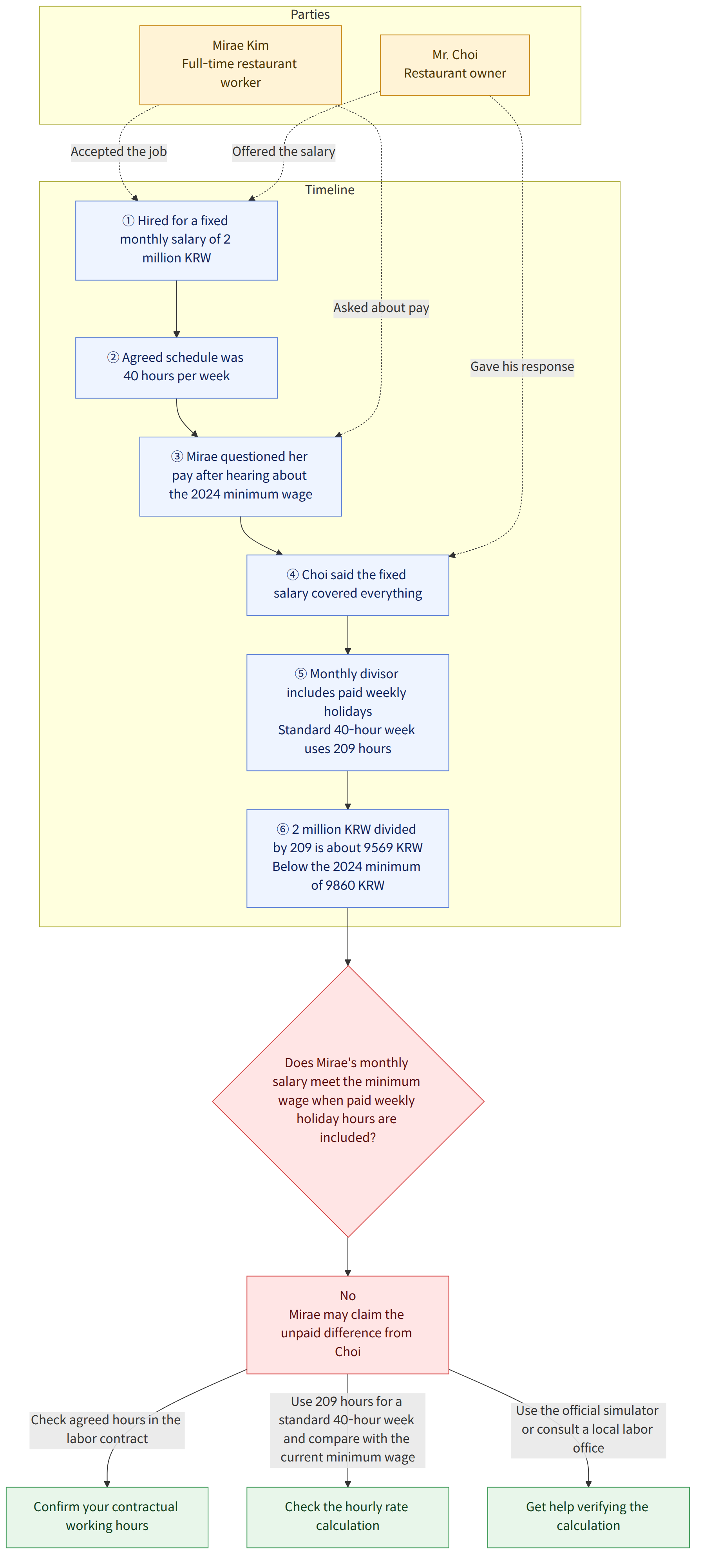
Mirae Kim, a university student, works full-time at a popular Italian restaurant in Hongdae, Seoul. When she was hired, the owner, Mr. Choi, told her, "We pay a clean monthly salary of 2 million KRW for a standard 40-hour week, 5 days a week." Mirae was initially satisfied, thinking 2 million KRW was a decent sum to see in her bank account every month.
However, after hearing news about the recent hike in the national minimum wage, Mirae began to wonder. When she asked Mr. Choi about it, he simply replied, "Isn't 2 million KRW enough? It's a fixed salary, so it covers everything." Mirae felt uneasy. Was she actually earning less than the legal minimum, despite working hard every day?
2. The Legal Question
How should a worker receiving a fixed monthly or weekly salary determine if their pay complies with the Minimum Wage Act? Specifically, how do you calculate the hourly rate when 'Paid Weekly Holidays' (Juhyu-sudang) must be factored into the equation?
3. What Korean Law Says: Converting Pay to Hourly Rates
Under the Korean Minimum Wage Act, regardless of how your wages are structured—whether daily, weekly, or monthly—they must be converted into an hourly wage to be compared against the government-announced minimum wage for that year.
Conversion Methods under the Minimum Wage Act Enforcement Decree: >1. Daily Wages: Divide the daily amount by the contractual working hours per day.2. Weekly Wages: Divide the weekly amount by the contractual working hours per week (including paid weekly holiday hours).3. Monthly Wages: Divide the monthly amount by the contractual working hours per month (including paid weekly holiday hours).
The key term here is "Contractual Working Hours." This refers to the hours agreed upon between the employer and the employee within legal limits. For monthly workers, this must include the hours for holidays that are paid even though no work is performed.
4. How Korean Courts Approach This: The Significance of 209 Hours
Korean courts and the Ministry of Employment and Labor (MOEL) apply a strict standard for monthly wage earners. They rule that the divisor used to calculate the hourly rate must include both the actual hours worked and the mandatory 'Paid Weekly Holiday' hours.
For a typical employee working 40 hours a week (8 hours a day, 5 days a week), the benchmark used by the courts is 209 hours per month. This figure is derived as follows:
- [(40 contractual hours + 8 paid holiday hours) × 52 weeks + 8 hours for the extra day] ÷ 12 months ≈ 209 hours.
If your monthly salary divided by 209 is lower than the legal minimum hourly wage, it constitutes a clear violation of the law.
5. Applying the Law: Is Mirae Being Underpaid?
Let's break down Mirae's situation using the 2024 standards.
- Determining Monthly Hours: Since Mirae works 40 hours a week, her monthly divisor is 209 hours.
- Calculating the Hourly Rate: 2,000,000 KRW ÷ 209 hours = approx. 9,569 KRW.
- Comparison with Minimum Wage: In 2024, the legal minimum wage in Korea is 9,860 KRW per hour.
Clearly, Mirae’s calculated rate of 9,569 KRW falls short of the 9,860 KRW requirement. She is essentially being underpaid by about 291 KRW for every hour worked, totaling roughly 60,000 KRW per month.
6. Conclusion: Reclaiming Rights and Advice for Readers
Ultimately, Mirae has the legal right to claim the unpaid difference from Mr. Choi. Even if the employer did not intend to break the law, violating the Minimum Wage Act is a serious matter that can lead to criminal penalties. Mirae can request back pay for the months she was underpaid.
If you find yourself in a similar situation, follow these three practical tips:
- Check Your Labor Contract: The starting point for any calculation is knowing your officially agreed-upon 'contractual working hours.'
- Remember the Number '209': If you work a standard 40-hour week, divide your monthly base pay by 209. If the result is lower than the current year's minimum wage, you are likely being underpaid.
- Use Official Tools: Use the 'Minimum Wage Simulator' on the Ministry of Employment and Labor website or consult a local labor office if the math feels overwhelming.
This column provides general legal information and does not constitute specific legal advice for individual cases.