1. A Human Story — A Warehouse, a Deadline, and a Prosecution
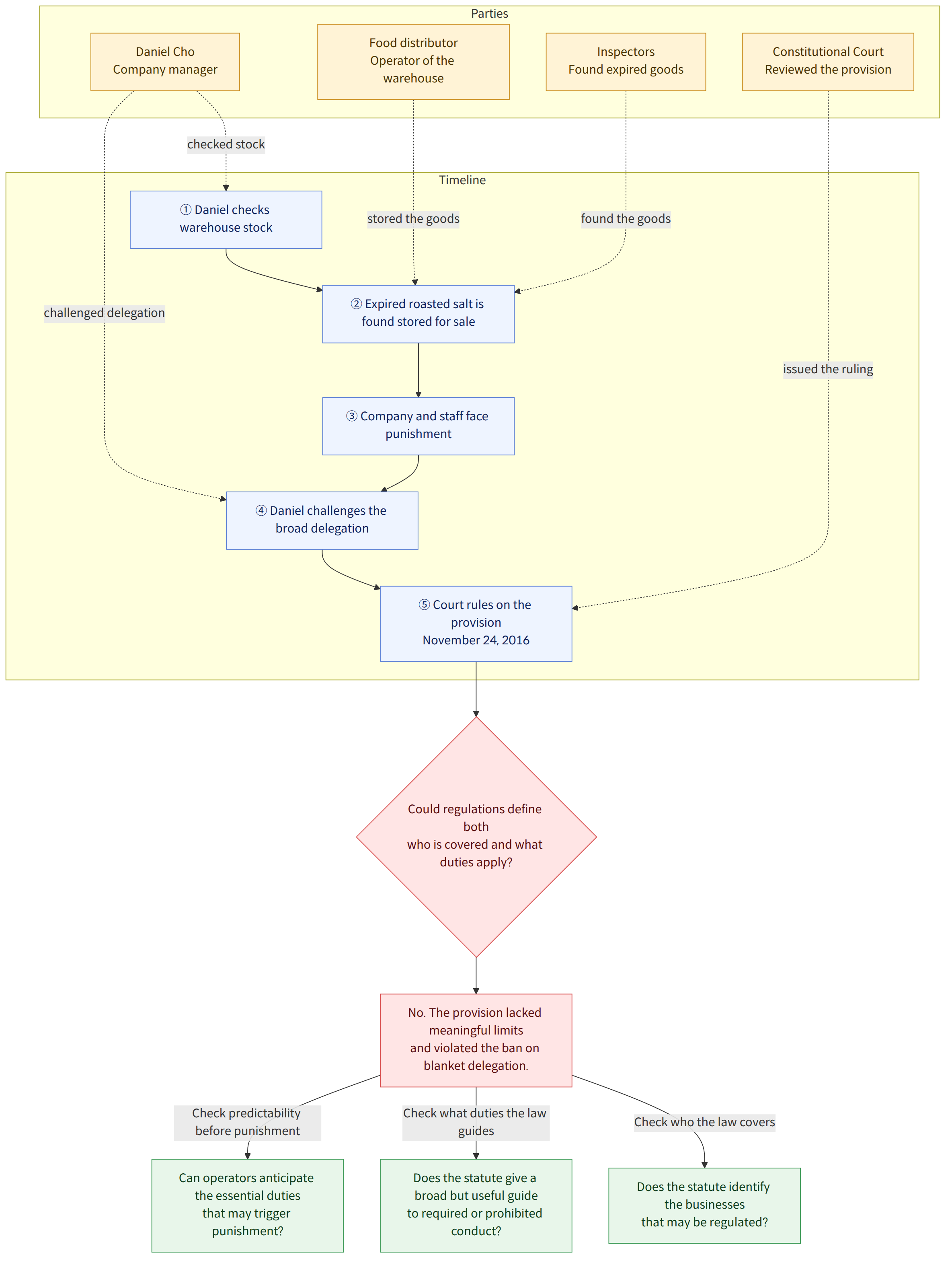
In the spring of 2013, Daniel Cho, a manager at a regional food-distribution company, was checking stock in the firm’s materials warehouse. Among the goods were bags of roasted salt and other food items or ingredients whose use-by dates had passed. They had not been sold, but inspectors found them stored with the intention of selling them.
The discovery led to punishment. Daniel’s company and its staff faced consequences under a rule requiring certain food businesses and their employees to follow hygiene and order-related requirements set out in subordinate regulations. Daniel did not argue that the dates on the goods were wrong. Instead, he asked a more basic question: could a person be punished under a rule that left both the identity of the regulated businesses and the conduct they had to avoid largely to later regulations?
2. The Legal Question
The central question was whether the Korean legislature could leave two essential matters to subordinate rules: which businesses were subject to the duties and what those duties required. Or did that broad delegation violate the constitutional principle that lawmakers must define the boundaries of rules that can expose people to punishment?
3. What Korean Law Says
Korean law permits the National Assembly to authorize the executive branch to fill in technical details. That flexibility can be important in food regulation, where businesses and practices change and where the appropriate safeguards may differ between types of operation.
But delegation has limits. A law must give people enough direction to understand, at least in broad terms, who will be regulated and what kind of conduct the rules may require. The executive branch may complete the details; it should not be left to decide the whole substance of the obligation without a meaningful guide from the legislature.
The challenged provision stated, in substance:
Food-service operators and other business operators designated by Presidential Decree, together with their employees, must comply with matters prescribed by Prime Ministerial Ordinance for the hygienic management and orderly operation of their businesses and the promotion of public health.
The constitutional difficulty was not simply that the provision referred to lower-level rules. It was that it referred out both the regulated parties and the required conduct, while offering little concrete direction about either.
The relevant principles can be put simply:
- Delegation may be necessary. Food businesses vary, and requirements suited to one kind of operation may not fit another. Industry practices and public-health needs can also change.
- The law must still set boundaries. It should give people a reasonable basis to anticipate which businesses may be covered and the general nature of the duties they may face.
- General purposes are not the same as conduct rules. Phrases such as hygiene management, order, and public-health promotion describe goals, but do not by themselves tell an operator what specific acts are required or prohibited.
- The more consequential the rule, the more important clarity becomes. When a breach can lead to punishment, people must not be left to guess at the essential elements of the obligation.
4. How Korean Courts Approach This
Korean constitutional review recognizes that not every detail must appear in an Act of the National Assembly. The legislature may leave technical or changing matters to regulations, particularly where different business models call for different standards. The question is whether the statute provides a workable framework within which those regulations must operate.
The Constitutional Court has also treated predictability as central to the ban on blanket delegation. A person should be able to look at the statute and understand, in broad outline, who may be regulated and what sort of obligations may follow. Sometimes detailed duties can help make a broad description of regulated businesses predictable. But that reasoning does not work when the duties themselves are described only through broad aspirations.
In its decision of November 24, 2016, the Court concluded that the provision at issue failed this test. It supplied no meaningful criteria for determining which non-food-service businesses would be covered, and its references to hygiene, order, and public health did not allow operators to predict what specific requirements would be imposed. The Court held that the provision violated the constitutional prohibition on blanket delegation.
The legislature may leave details to regulations, but it cannot leave both the people bound by a rule and the substance of their obligations so undefined that neither can reasonably be anticipated.
5. Applying the Law to Daniel’s Case
Daniel’s situation brings the two parts of the problem into focus.
- Was the regulated group defined with adequate guidance? The provision expressly referred to food-service businesses, but also swept in other operators to be selected by Presidential Decree. It did not set out criteria that would tell a business like Daniel’s distributor whether it belonged in that wider group.
- Could the required conduct be predicted? The provision directed operators to follow requirements established for hygiene, business order, and public health. Those aims matter, but they did not tell Daniel that storing expired roasted salt or other expired food materials for sale would trigger a particular duty under this provision. The aims were too broad to supply a practical standard.
- Could one part compensate for the other? A statute with a broad description of covered businesses might still give fair notice if it set out concrete duties. Conversely, a clear list of duties might help identify the relevant businesses. Here, however, both sides were left open: the scope of the regulated class and the content of its obligations.
- Did the need for flexible food regulation save the rule? No. The Court accepted that the food sector changes and that different businesses may need different requirements. But the need for flexibility did not excuse the absence of legislative boundaries. The legislature could delegate details while still specifying the criteria and general limits that regulations had to follow.
The ruling addressed the constitutionality of this particular delegation. It did not establish that expired food is safe to store or sell, nor that every punishment involving expired goods is automatically invalid. Other clearly written food-safety requirements may apply, and the practical effect of a constitutional ruling on an individual penalty can depend on the procedural posture of that case.
6. Conclusion — What Happened, and What Should You Do?
Daniel’s constitutional challenge exposed a real defect in the rule used against him: it gave too little guidance about both who could be bound and what they had to do. The Constitutional Court held that this was an unconstitutional blanket delegation. That conclusion resolved the constitutional question, although it should not be mistaken for a blanket license to sell expired food or as an automatic ruling on every individual penalty.
For businesses facing a similar issue, three practical steps matter:
- Keep expired goods clearly identified and segregated. Record when they were removed from sale, where they are stored, and what will happen to them. This reduces public-health risk and helps establish the facts.
- Ask for the exact legal basis in writing. Identify the statutory provision and the regulation said to apply, and check whether the obligation was in force at the relevant time and clearly covered your business.
- Get prompt legal advice before accepting a penalty as final. A constitutional ruling may matter, but its effect depends on the specific charge, the legal provision used, and the stage of the proceedings.
Daniel’s story is a reminder that public-health rules can be essential and still have to be written within constitutional limits. Effective regulation protects consumers; clear regulation also lets businesses know where the law draws the line.