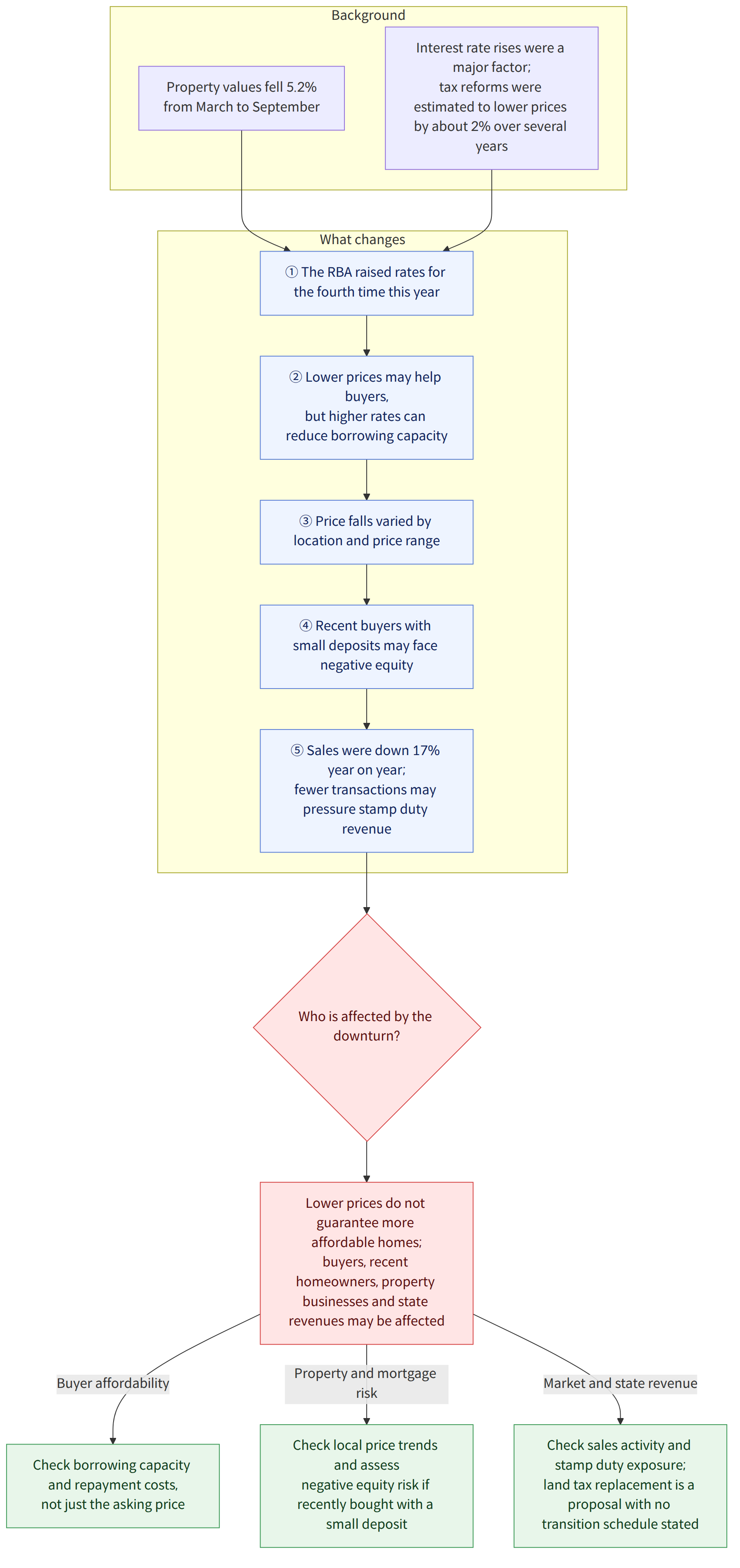
Property values across Australia fell 5.2% from their March peak to September. Prices declined for six consecutive months and, based on Domain’s price data, typical home prices fell to around the level of a year earlier. However, it is not yet certain whether the decline will deepen.
Background and context
The decline has become a point of debate in connection with tax reforms announced in the May federal budget. However, in most parts of Australia, the market downturn was already underway before the budget announcement: prices peaked in March and fell after the first official interest-rate rise.
Treasury (재무부) experts estimated that the budget measures tightening negative gearing (네거티브 기어링), the tax treatment that allows losses on rental properties to be offset against other income, and capital gains tax rules would lower prices by about 2% over several years. It is important to distinguish this estimate from the main causes of this year’s decline. The article says that, since falling interest rates were a major driver of house-price growth over the past 30 years, this year’s interest-rate rises have played a central role in the price decline.
The Reserve Bank of Australia (호주중앙은행) raised interest rates last week for the fourth time this year. Financial markets expect at least one further increase, in November or in 2027. Against this backdrop, Tim Lawless, Cotality’s head of research, said that a 10–15% fall in overall home prices is a reasonable estimate. This is a forecast, not a certainty.
A 15% fall would be larger than the typical declines of 5–10% in previous downturns. However, the national median property price, combining houses and apartments, on the SQM Research index has risen 78% since 2020. Even after a 15% fall, prices would still be at around their level in early 2024.
What this means
Falling prices may give some buyers a better chance to purchase a home, but they do not automatically make buying more affordable. When interest rates rise, the amount buyers can borrow falls as well as house prices. First-home buyers, in particular, need to consider both their borrowing capacity and repayment costs, rather than looking only at the price tag.
The extent of price declines has also varied by property type and price range. According to Cotality’s analysis, in Sydney, the decline for homes in the top quartile was 5.3 percentage points greater than for those in the bottom quartile; in Melbourne, the difference was 6.6 percentage points. So even if prices fall, it does not follow that lower-priced homes will become cheaper by the same amount.
Some households that bought recently may face risks, by contrast. Negative equity—a situation in which the outstanding mortgage is greater than the value of the home—could be a particular problem for first-home buyers who purchased homes in 2025 with small deposits. For example, if someone buys a home with a small deposit and prices then fall until the mortgage balance exceeds the home’s value, that buyer could be in negative equity. The article does not say that this risk applies equally to all homeowners.
Falling house prices could give first-home buyers a chance to enter the market, but higher interest rates may reduce their borrowing capacity and leave some buyers at risk of negative equity.
The effects of the downturn extend beyond people buying and selling homes. Westpac reported that the number of home sales was down 17% from the same period a year earlier. When falling prices coincide with fewer transactions, activity in the real estate industry may contract, and stamp duty revenue, which is tied to property transactions, may also come under pressure.
Relevant policies and support information
The tax reforms mentioned in this article tighten negative gearing and capital gains tax rules. Treasury experts estimated their effect on prices at about 2% over several years. This provides context for why the policy alone is unlikely to explain the entire housing-market downturn. The article says that prices had already started falling in most areas before the May budget announcement, and that this year’s interest-rate rises are a major factor.
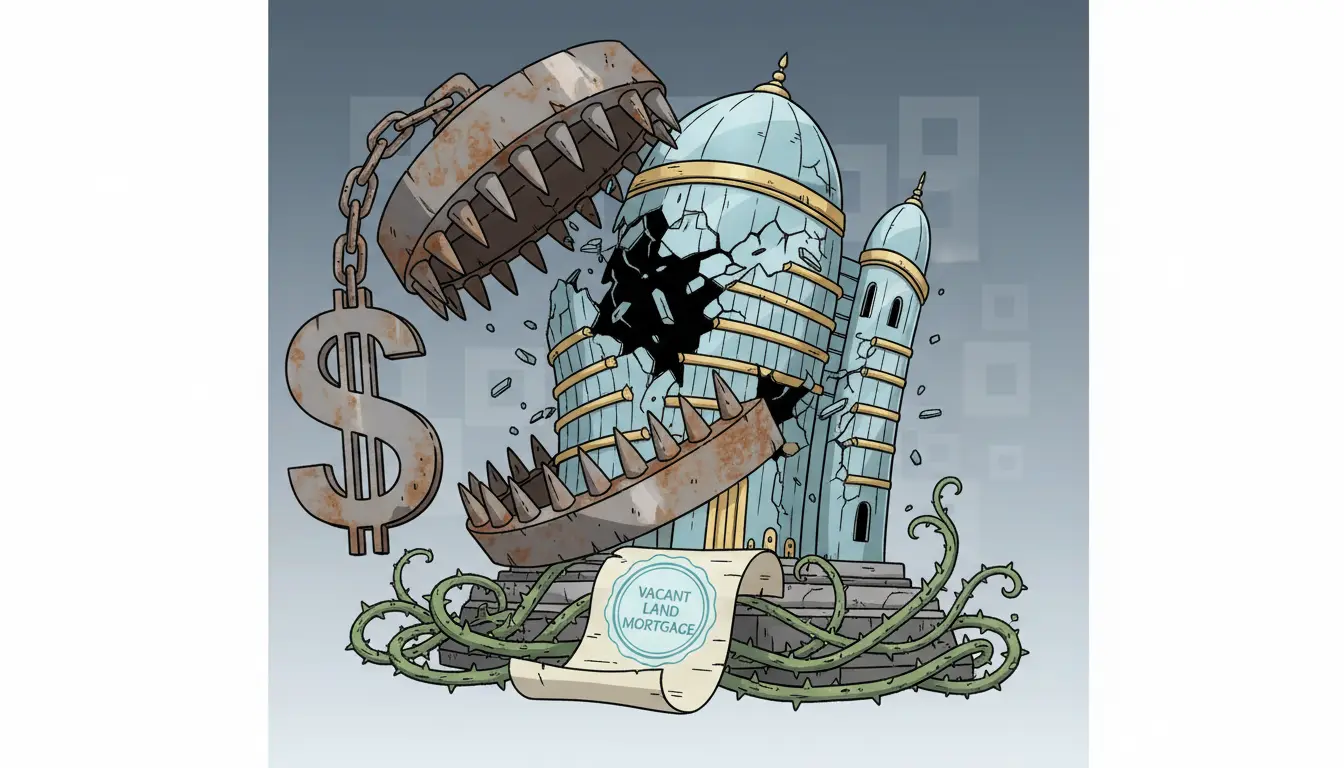
In terms of state finances, stamp duty accounted for 18.5–22.5% of revenue collected within New South Wales and Victoria in 2022–23. The article argues that replacing stamp duty with a broad-based land tax could make revenue for state and territory governments more stable and help reduce volatility in the housing market. This is a policy proposal made in the article; it does not set out how the transition would work or give a specific implementation schedule.
What is confirmed and what is not yet known
Confirmed facts
- Property values nationwide fell 5.2% from their March peak to September, declining for six consecutive months.
- Treasury experts estimated that tightening negative gearing and capital gains tax rules would lower prices by about 2% over several years.
- Cotality’s head of research put forward a 10–15% decline in overall prices as a reasonable estimate, but this is not a certain outcome.
- Westpac reported that the number of home sales fell 17% from the same period a year earlier.
- In New South Wales and Victoria, stamp duty accounted for 18.5–22.5% of revenue collected within each state in 2022–23.
What is not yet known
- It is not certain whether house prices will actually fall by as much as 10–15%.
- The article does not provide the specific figures or calculation methods for the chart included in it.
- The article does not make clear how changes in interest rates and transaction volumes will affect house prices in different regions and price ranges going forward.
What readers can check
- If you bought a home recently, you can compare its current value with your remaining mortgage balance to see whether you may be at risk of negative equity.
- If you are considering buying your first home, do not assume that falling prices alone will improve affordability. Also consider how rising interest rates may affect the amount you can borrow.
- When reviewing housing policy, consider not only price trends but also transaction volumes, the share of state revenue accounted for by stamp duty, and whether the proposal to replace stamp duty with land tax is moving forward.