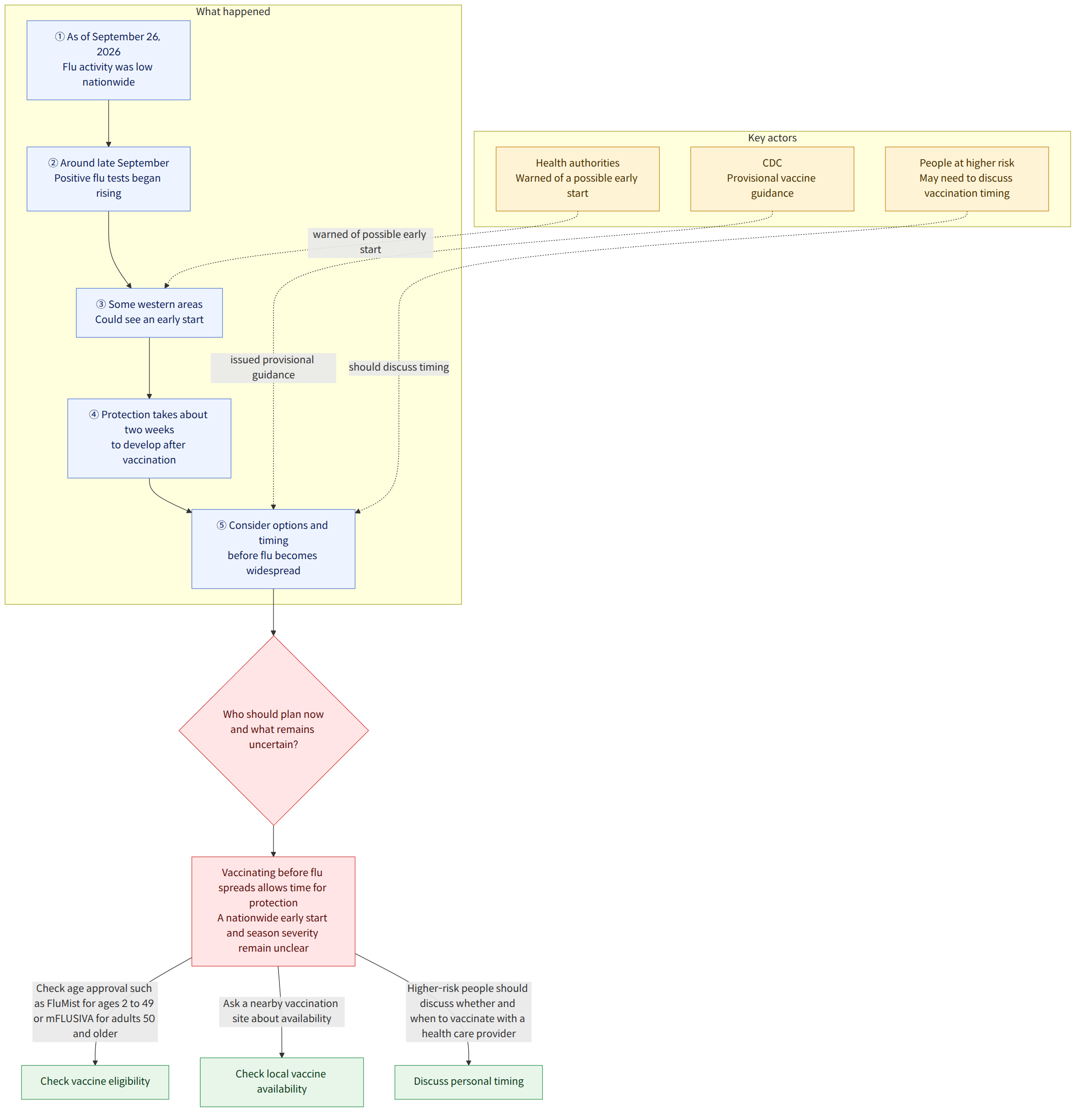
The number of flu cases is beginning to rise in the United States. As of September 26, 2026, seasonal flu activity was low nationwide, but the share of patients with respiratory infections who tested positive for flu began to increase around the end of September. Health authorities warned that the 2026–2027 flu season could start early in some parts of the western United States.
However, it is too early to conclude from the current data that the flu season has started early across the country or to predict how severe this season will be. Since several types of flu vaccines are available depending on age and how they are administered, it is important to check your options before flu becomes widespread.
Background and context
In the United States, flu viruses generally begin to spread in the fall, and activity typically peaks between December and February. As of September 26, 2026, wastewater surveillance also showed very low or low flu activity in most states. Low activity nationwide and the possibility of an early start in some areas are information that should be considered together.
The scale of last season offers useful context when considering when to get vaccinated. The U.S. Centers for Disease Control and Prevention (미 질병통제예방센터, CDC) classified the 2025–2026 flu season as moderately severe. There were more than 32 million flu cases, 390,000 hospitalizations, and up to 81,000 deaths.
The composition of flu vaccines is adjusted each year to target the viruses expected to circulate. All three components of the 2026–2027 vaccine have been updated to better match the viruses expected to circulate. However, vaccine effectiveness can vary from year to year, and the information provided does not indicate how effective the vaccine will be this season.
What this means
Timing your vaccination is not something to consider only after flu activity has picked up in earnest. It takes about two weeks for protection to develop after vaccination, so getting vaccinated before flu activity becomes widespread can give you time to prepare for when the risk of exposure increases. Health authorities have often recommended getting vaccinated by the end of October, but in practice, you should consider both your personal circumstances and vaccine availability.
Vaccine choices can vary depending on age and preference. The CDC’s provisional guidance for this season recommends flu vaccination for children aged 6 months and older and most adults. For adults aged 65 and older, enhanced vaccines are available as shots, including high-dose vaccines, cell-based vaccines, and vaccines containing an ingredient that boosts the immune response.
For people who want to avoid shots, the nasal spray FluMist may be an option. It is approved for people aged 2 through 49. Flucelvax, which is made using mammalian cells, is approved for people aged 6 months and older. People with egg allergies may receive any flu vaccine, including vaccines produced using eggs.
Another option is mFLUSIVA. Approved by the U.S. Food and Drug Administration (FDA) in August 2026, it is the first mRNA-based flu vaccine and is approved for adults aged 50 and older. However, as a newly introduced vaccine, its availability may vary by vaccination location.
For example, an adult in their 50s who wants an mRNA vaccine should check not only that they meet the age requirement but also whether the vaccine is available at a nearby vaccination site. Conversely, someone aged 2–49 who does not want a shot could ask whether FluMist is available. These are hypothetical examples to explain the options; they do not indicate actual stock or availability.
Groups at higher risk of serious flu complications include adults aged 65 and older, children, pregnant people, people with chronic conditions, and people with weakened immune systems. It may be particularly important for them to discuss whether and when to get vaccinated with a health care provider.
What is known and what remains unclear
What is known
- As of September 26, 2026, seasonal flu activity was low nationwide in the United States, and wastewater surveillance levels were very low or low in most states.
- The number of patients with respiratory infections who tested positive for flu began to rise around the end of September.
- The CDC classified the 2025–2026 season as moderately severe, with more than 32 million cases, 390,000 hospitalizations, and up to 81,000 deaths.
- All three components of the 2026–2027 flu vaccine have been updated to better match the viruses expected to circulate.
- It takes about two weeks for protection to develop after vaccination.
What remains unclear
- It is not yet possible to determine whether flu activity will actually start early across the United States this season or how severe it will be.
- The information provided does not say how effective the 2026–2027 flu vaccine will be.
- It has not been established which vaccination sites will offer each vaccine or how availability will vary by location.
What readers can check
- Ask a health care provider or vaccination site which vaccine is appropriate for your or your family members’ ages and health conditions. In particular, people aged 65 and older, those who are pregnant, and those with chronic conditions or weakened immune systems can discuss their vaccination options.
- If you want a specific type, such as mFLUSIVA or FluMist, check the age requirements and availability at a nearby pharmacy or health care facility before visiting.
- Consider when to get vaccinated, keeping in mind that it takes about two weeks for protection to develop after vaccination.