
A Career Leap with a Hidden Risk
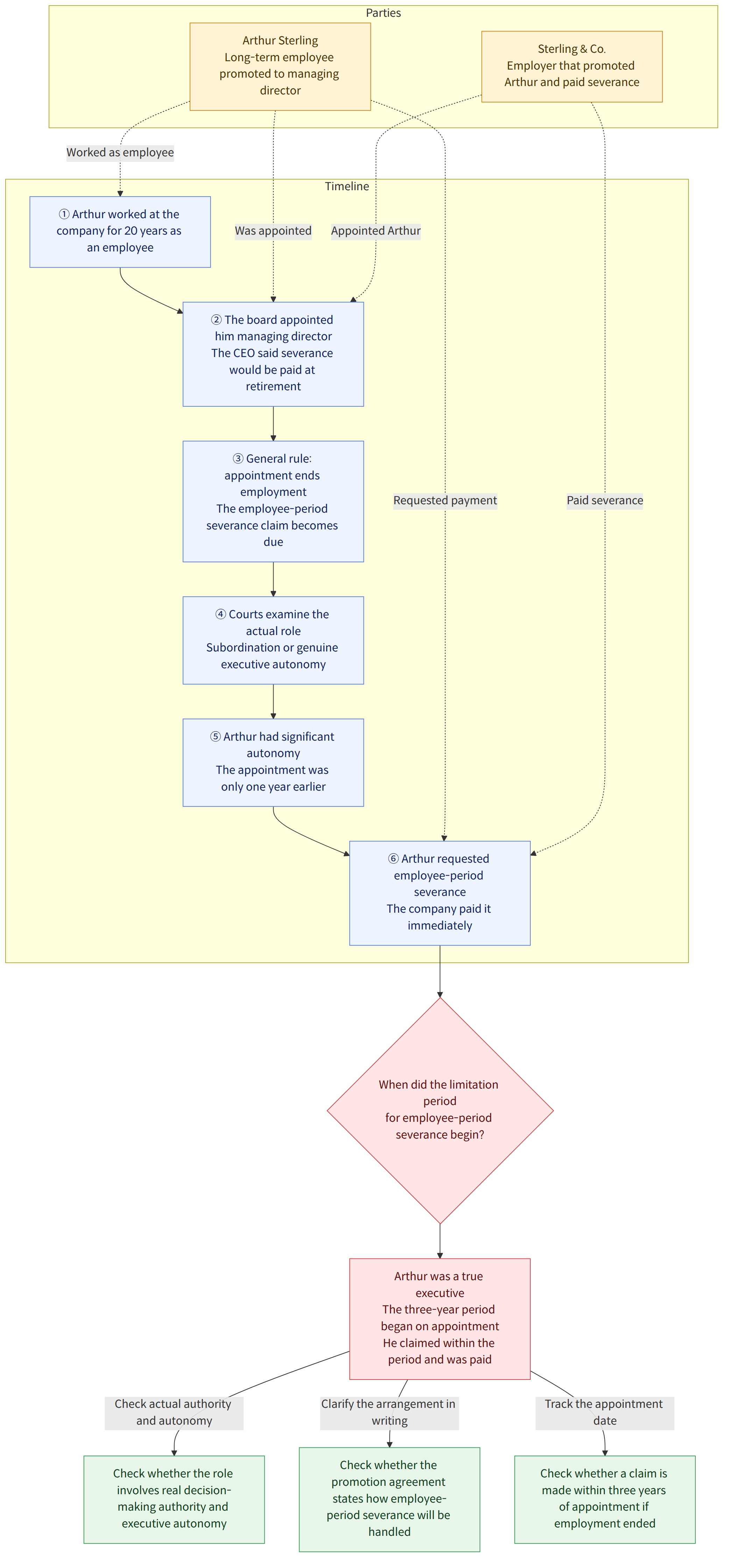
Arthur Sterling had dedicated twenty years of his life to Sterling & Co., a mid-sized logistics firm. He had risen through the ranks from a junior clerk to a senior manager, becoming the backbone of the operations department. His loyalty and expertise did not go unnoticed, and last year, the board of directors appointed him as a Managing Director.
During the promotion meeting, the CEO patted him on the back and said, "Arthur, you've earned this. Don't worry about your accumulated severance pay from your twenty years as a staff member; we'll settle the entire amount once you eventually retire from your executive position."
Trusting his employer, Arthur stepped into his new office. However, a year later, while consulting with a friend who is a lawyer, he discovered a worrying fact: severance pay claims in Korea have a relatively short statute of limitations. He began to panic. Had the clock already started ticking the day he became a Director, or was his money safe until his final retirement?
The Legal Question
When an employee is promoted to an executive (director) without any break in service, does the statute of limitations for the severance pay earned during the employee period begin at the moment of appointment, or does it only start when the person finally leaves the company entirely?
What Korean Law Says
In the Korean legal framework, there is a fundamental distinction between a worker (employee) and an employer (executive/director). Severance pay is a right guaranteed to workers under the Labor Standards Act and the Employee Retirement Benefit Security Act.
The statute of limitations for claims regarding wages, including severance pay, is three years. If a claim is not exercised within this window, the right to receive the payment expires.
When an employee becomes an executive, the law generally views this as the termination of the employment relationship and the start of a mandate relationship. Consequently:
- The Separation Principle: The moment a worker is appointed as a director, they are no longer a 'worker.'
- Triggering the Clock: Because the employment relationship has ended, the right to severance pay for the employee period is triggered on the date of appointment.
- The Limitation Period: The three-year countdown to claim that money begins exactly on the day the appointment as a director takes effect.
How Korean Courts Approach This
Korean courts emphasize the substance of the relationship over the title of the position. While the general rule is that appointment as a director triggers the statute of limitations, the courts look for "subordinate status."
If a person is called a "Director" but continues to work under the direct supervision and command of the employer—without actual decision-making authority or executive autonomy—the court may rule that the person is still, in fact, a worker.
In such cases, the court treats the transition as a mere change in title, not a change in legal status. Therefore, the employment relationship is seen as continuing uninterrupted until the person finally leaves the firm.
Applying the Law to the Case
To determine Arthur's fate, we must analyze his daily reality as a Managing Director at Sterling & Co.
Scenario A: Arthur is a True Executive. If Arthur now attends board meetings, votes on corporate strategy, manages his own budget, and is not subject to the daily clock-in/clock-out supervision of the CEO, he has transitioned from a worker to an employer. In this case, his employment relationship ended the day he was appointed. The three-year statute of limitations began that day. If he waits until he retires in ten years to claim his employee-period severance, that right will have long since expired.
Scenario B: Arthur is a 'Director' in Name Only. If Arthur still reports to the CEO for every minor task, follows a strict employee handbook, and has no real authority to make corporate decisions, he remains a "worker" under the law. In this scenario, the clock has not started ticking yet. His right to severance pay will only be triggered on the day he finally leaves the company.
Conclusion: What Happened, and What Should You Do?
Upon reviewing his role, it became clear that Arthur was a true executive with significant autonomy. Unfortunately, this meant the clock had already started. Because he was promoted only a year ago, he is still within the three-year window. To avoid losing his hard-earned money, Arthur formally requested the payment of his severance pay for his 20-year employee tenure, which the company paid out immediately.
For those navigating a similar transition, here are three practical tips:
- Clarify the Status in Writing: When being promoted to an executive, sign an agreement that explicitly states whether the employee-period severance pay is being settled immediately or if the company acknowledges a deferred payment date.
- Request Immediate Payout: The safest route is to receive the severance pay for the employee period the moment you transition to an executive role.
- Document Your Authority: If you believe you are a "director in name only," keep records of your daily supervision and lack of autonomy, as this will be crucial evidence if you need to prove you are still a "worker" to extend the statute of limitations.