
The Temptation of a Polished Resume: Jun-ho Park's Risky Success
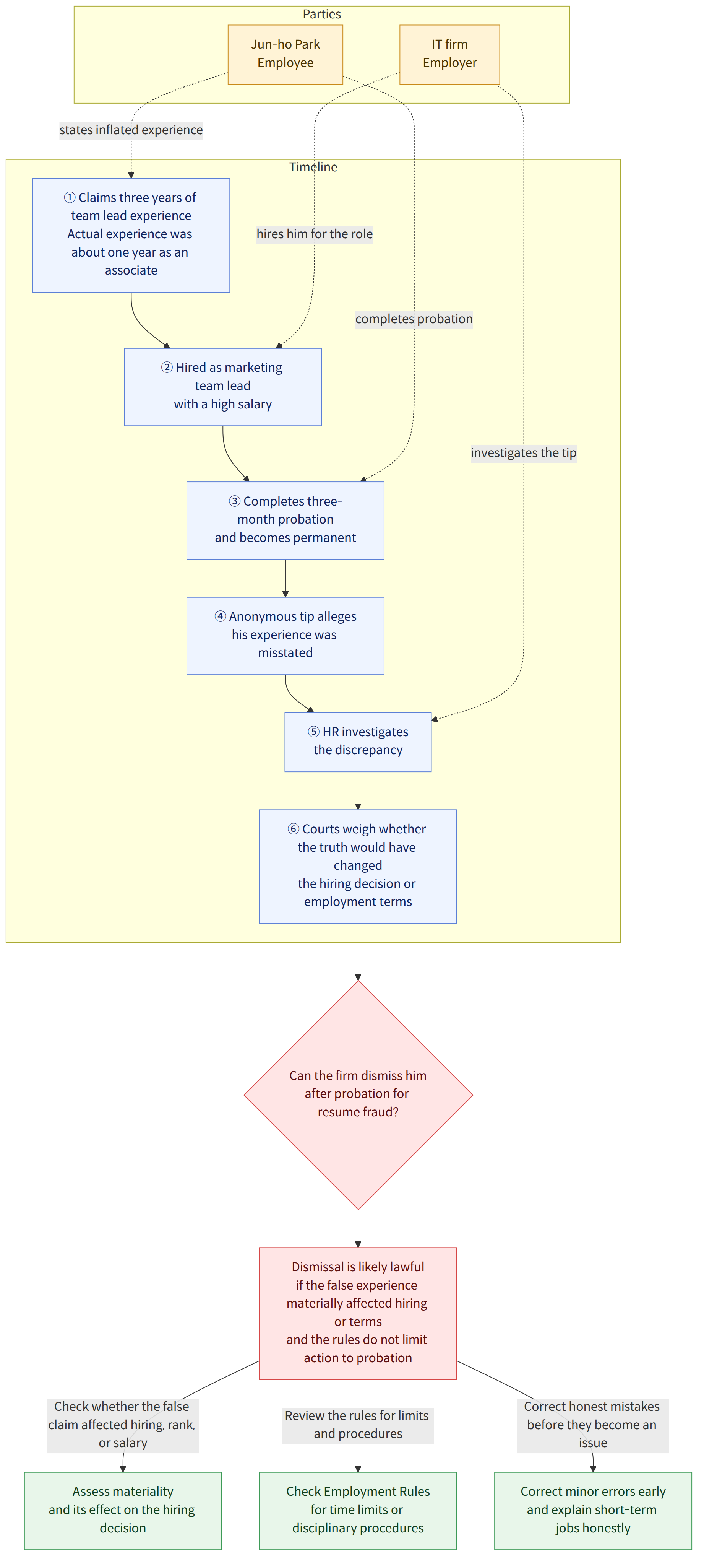
Two years ago, Jun-ho Park landed a coveted role as a marketing team lead at a mid-sized IT firm. In reality, he had only about a year of experience as an associate at his previous job. Desperate for the position, he wrote "3 years of team lead experience" on his resume. Thanks to this inflated career path, he was offered a high salary and successfully completed his three-month probationary period. Today, he is considered a promising permanent employee.
However, the HR department recently received an anonymous tip. A person claiming to be Jun-ho's former colleague pointed out that his actual experience did not match his resume. HR immediately launched an investigation, and Jun-ho hasn't slept a wink since. Since the company's internal rules (Employment Rules) don't explicitly mention resume fraud as a ground for dismissal, Jun-ho is caught between hope and fear, wondering: "I'm already a permanent employee and I do my job well—can they really fire me for this?"
The Core Legal Question
Jun-ho's case raises two critical legal questions: First, can a company use resume falsification as a reason for discipline even if it's not explicitly stated in the employment rules? Second, can an employee be fired for past resume fraud even after the probationary period has ended?
The Weight of a Resume Under Korean Law
Korean Labor Standards Act and Supreme Court precedents view a resume as more than just a list of past jobs. When a company requests a resume, it is seeking data for a "holistic judgment" of the candidate's honesty, integrity, and organizational fit, not just their technical skills.
"The reason a company requires a resume and certificates is to judge the worker's intelligence, experience, honesty, and adaptability to decide whether to hire them. Therefore, as long as it is clear the company would not have hired the worker had they known the truth, dismissing the worker for such falsification is not considered unfair." (Supreme Court Principle)
Key principles include:
- Hypothetical Causality: It must be objectively recognized that the company would not have hired the person, or at least not under the same conditions (rank, salary), if they had known the truth.
- Breach of Good Faith: Employment contracts are built on a strong foundation of trust. Falsifying credentials is seen as betraying that trust from the very start.
How Korean Courts Approach the Issue
Courts do not view every minor error as a valid reason for firing. They weigh the severity of the case based on "social norms."
- Cases where dismissal was justified: Hiding a university degree to apply for a position requiring only a high school diploma (concealing educational background), or inflating experience by several years.
- Cases where dismissal was unjustified: Omitting a very short period of employment (e.g., 4 months at a bus company) or when the error was a simple mistake that had no bearing on the actual job performance.
Applying the Law to Jun-ho's Case
In Jun-ho's case, it is difficult to see this as a simple mistake. Fabricating "3 years of team lead experience" when he was only an associate was likely a decisive factor in the company's decision to hire him and offer him a leadership role and higher pay.
Furthermore, the fact that he passed his probation does not serve as a shield. The Supreme Court has ruled that employers have the right to trust that a resume is truthful. Unless the employment rules specifically state that disciplinary action for resume fraud can only be taken during probation, the company can take action even after the employee becomes permanent. Ultimately, Jun-ho's actions fundamentally damaged the relationship of trust, making his dismissal likely legal.
Conclusion: Why Honesty Remains the Best Policy
In the end, Jun-ho Park will likely face severe disciplinary action, including potential dismissal. Even if his current performance is excellent, the fact that the employment contract began with "deception" is a significant legal disadvantage.
For those in similar situations, here are a few practical tips:
- Correct minor errors early: If you realize there is a non-intentional mistake on your record, it is better to inform HR and correct it voluntarily before it becomes an issue. This can help rebuild trust.
- Honesty is better than omission: Rather than hiding short-term jobs, explain honestly what you learned during that time. This prevents future legal risks.
- Check your Employment Rules: While general court principles are strict, individual company rules might have specific statutes of limitations or procedures for disciplinary actions. Consulting a legal expert is always advisable.
A single line on a resume may be short, but its consequences can follow you until the day you retire.