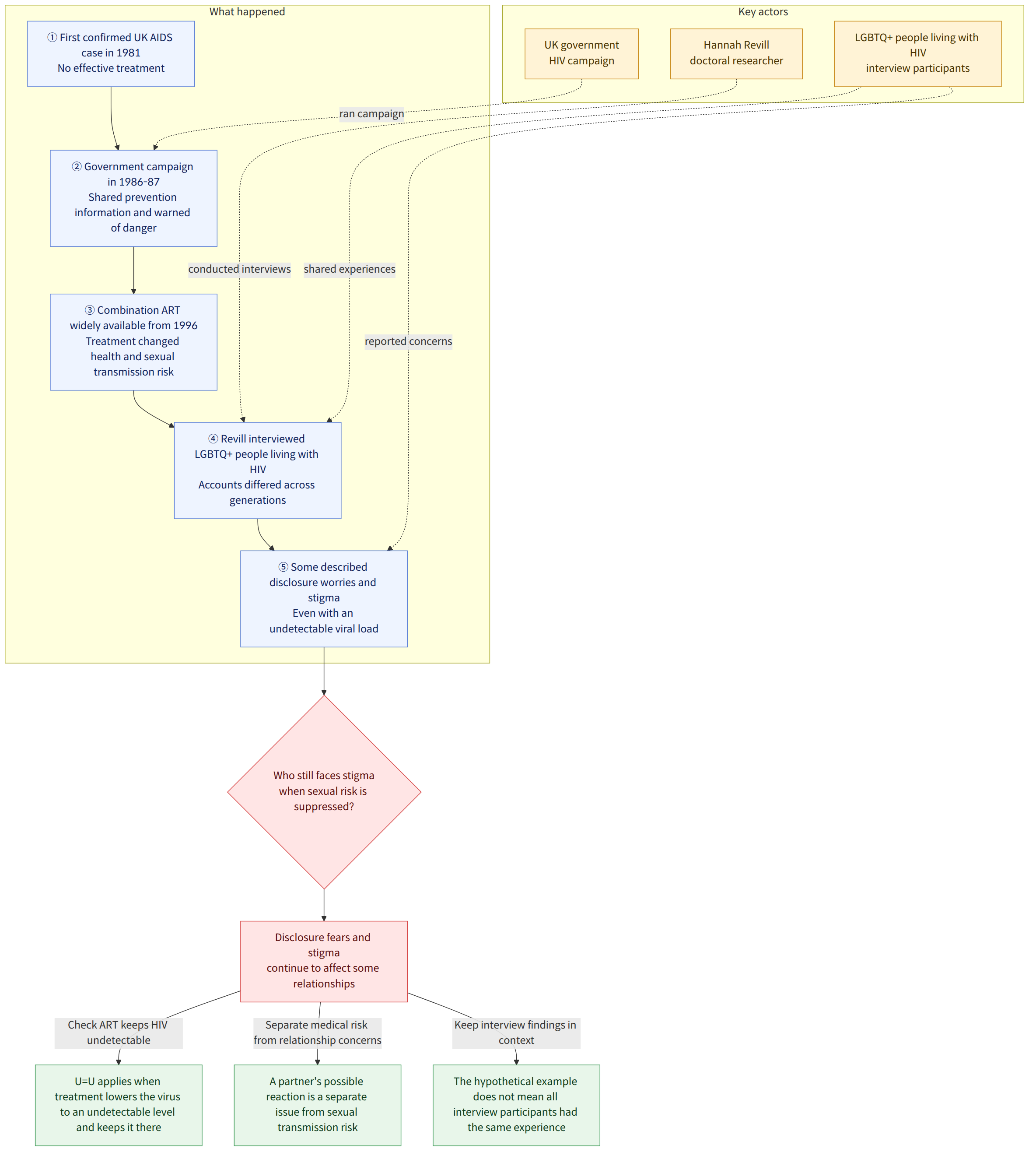
The first officially confirmed case of AIDS in the UK was in December 1981. At first, there was no effective treatment, and many people diagnosed with AIDS became seriously ill or died. HIV was associated with gay and bisexual men and people who inject drugs, groups that already faced prejudice. Treatment has since greatly changed the health outlook for people living with HIV and the risk of transmission, but the stigma shaped by fear in the past has not disappeared.
Background and context
As part of her doctoral research, Hannah Revill interviewed LGBTQ+ people living with HIV about their everyday experiences. The interviews showed that people who lived through the early epidemic and those diagnosed after effective treatments became available talked about HIV in different ways. This illustrates how the medical realities transformed by treatment can coexist with memories and feelings shaped in the past.
Effective combination antiretroviral therapy became widely available in the UK from 1996. Antiretroviral therapy (ART) is drug treatment that suppresses the replication of HIV in the body. People who are diagnosed and receive treatment can generally live long, healthy lives.
Treatment has also changed the risk of transmission through sex. When ART lowers the amount of virus in the blood to an undetectable level on standard tests, and keeps it there, there is no risk of HIV transmission through sex. This is known as U=U, meaning “undetectable equals untransmittable.”
Popular culture and public messaging have also influenced how people understand HIV. The film Philadelphia brought AIDS and discrimination to mainstream cinema, while the British drama Queer as Folk, first broadcast in 1999, did not put HIV at the center of its story. The article reports that orders for HIV tests rose sharply while It's a Sin, a series about the AIDS crisis of the 1980s, was being broadcast.
The actions of public figures and government campaigns offer further examples of the climate at the time. In 1987, Diana, Princess of Wales, opened England's first specialist AIDS ward and met patients, holding their hands. At a time when the misconception that HIV could be transmitted through everyday contact was widespread, this act challenged those fears. Freddie Mercury died of an AIDS-related illness in November 1991, and his death focused public attention on the epidemic.
The UK government's “Don’t Die of Ignorance” campaign (무지로 죽지 마십시오) provided information about HIV transmission and encouraged safer behavior in 1986–87. Using images of gravestones, icebergs and death, the campaign strongly warned of the danger, while it may also have left people with an association between HIV, fear and death. This suggests that the messaging at the time could both communicate information about preventing infection and reinforce fear.
What this news means
Advances in treatment have changed the health outlook for people living with HIV and eliminated the risk of sexual transmission when the virus is suppressed. But changes in medical facts do not automatically change other people's attitudes or the feelings people living with HIV have built up over time. Research on HIV stigma in the UK has found that, although overt discrimination declined after effective treatment became available, fear of rejection, shame and stigma continue to affect some people living with HIV.
Some of Revill's interview participants worried about disclosing their HIV status when dating or starting a new relationship. Some also said they had experienced stigma in LGBTQ+ social and dating spaces despite having an undetectable viral load. So even with the medical information conveyed by U=U, it cannot be assumed that the burden of revealing one's status in real-life relationships has disappeared.
For example, a person receiving HIV treatment and maintaining an undetectable viral load might be unsure whether to tell a new partner about their status. In that situation, the medical facts about the risk of sexual transmission and concerns about the other person's reaction may both come into play as separate issues. This hypothetical example is intended to explain the potential burden that disclosing one's status can have on personal relationships and emotions; it does not mean that all interview participants had the same experience.
What is confirmed and what remains unknown
What is confirmed
- The first officially confirmed case of AIDS in the UK was in December 1981, and there was no effective treatment at the time.
- Effective combination antiretroviral therapy became widely available in the UK from 1996.
- When ART keeps the virus suppressed, there is no risk of HIV transmission through sex. This is known as U=U.
- Some interview participants worried about disclosing their status when dating or starting new relationships, and some experienced stigma in LGBTQ+ social and dating spaces.
What remains unknown
- The article does not say how many people Revill interviewed or how they were recruited.
- The distribution of participants by time of diagnosis and background is also not given.
- These materials alone cannot establish how representative the interviewees' experiences are of the experiences of all people living with HIV.
What readers should check
- When seeking information about HIV and its treatment, it is important to check the conditions under which the virus remains suppressed and to understand what U=U means.
- If you have concerns about disclosing your status or relationships, it may help to discuss medical information relevant to your situation with a healthcare professional.
- Do not assume the risk of sexual transmission based on HIV status alone; also consider the facts about treatment and viral suppression.