
Understanding Fraudulent Acts in Property Law
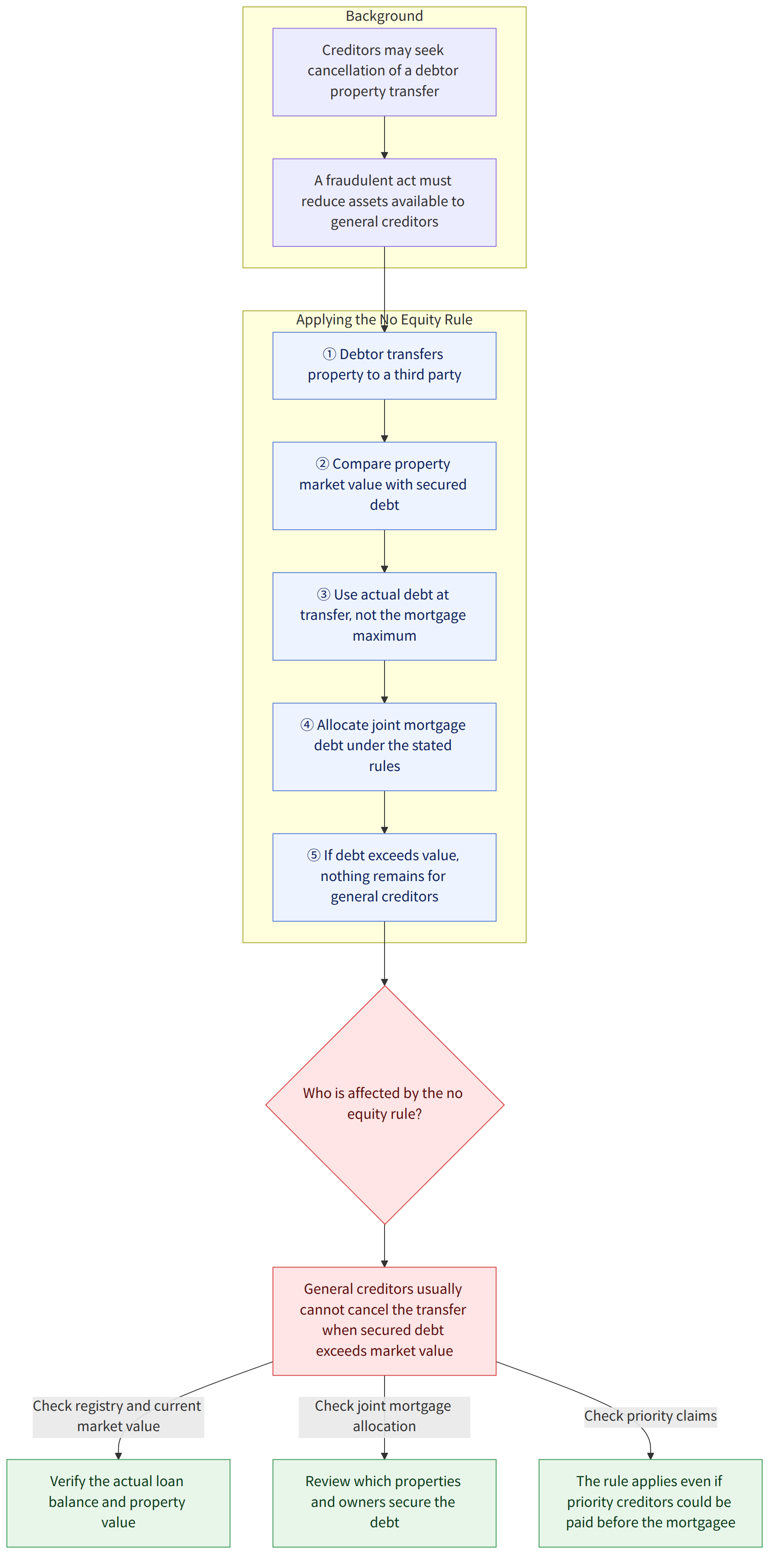
In South Korea, when a debtor transfers their property to a third party (such as a spouse or relative) to avoid paying back their debts, creditors have the right to request the court to cancel that transfer. This is legally known as a Fraudulent Transfer Cancellation (사해행위취소).
However, a specific legal question often arises: What happens if the property is already mortgaged for more than it is worth?
The "No Equity" Rule
According to the Supreme Court of Korea, a fraudulent act only exists if the transfer actually reduces the assets available to general creditors. If a property is sold or transferred, the law looks at the remaining value after subtracting the secured debt (mortgage).
- Market Value (시가): The actual current price of the property.
- Secured Debt (피담보채권액): The actual amount currently owed to the bank or mortgagee.
Important: If the secured debt is higher than the market value, the property essentially has no remaining value for other general creditors. Therefore, transferring such a property is not considered a fraudulent act, and creditors cannot sue to cancel the transfer.
Key Details to Note
- Actual Debt vs. Maximum Limit: For a collateral mortgage (근저당권), the law considers the actual amount owed at the time of transfer, not the maximum bond amount (채권최고액) written on the registry.
- Joint Mortgages: If multiple properties are tied to one mortgage, the debt is usually distributed proportionally. However, if one property belongs to the debtor and others to a guarantor, the full debt is often calculated against the debtor's property first.
- Priority Creditors: This rule applies even if there are creditors with priority (like employees with unpaid wages) who could have been paid before the mortgagee in an auction.
Legal Advice for Foreigners
If you are a creditor trying to recover money and find that the debtor has transferred their only property, you must first check the Real Estate Registry (Deunggi-bu). If the actual loans on the property were already greater than the property's market value, a lawsuit for fraudulent transfer is unlikely to succeed.
--- Disclaimer: This information is for educational purposes and should not replace professional legal advice. For your specific case, always consult with a qualified legal professional in Korea.