
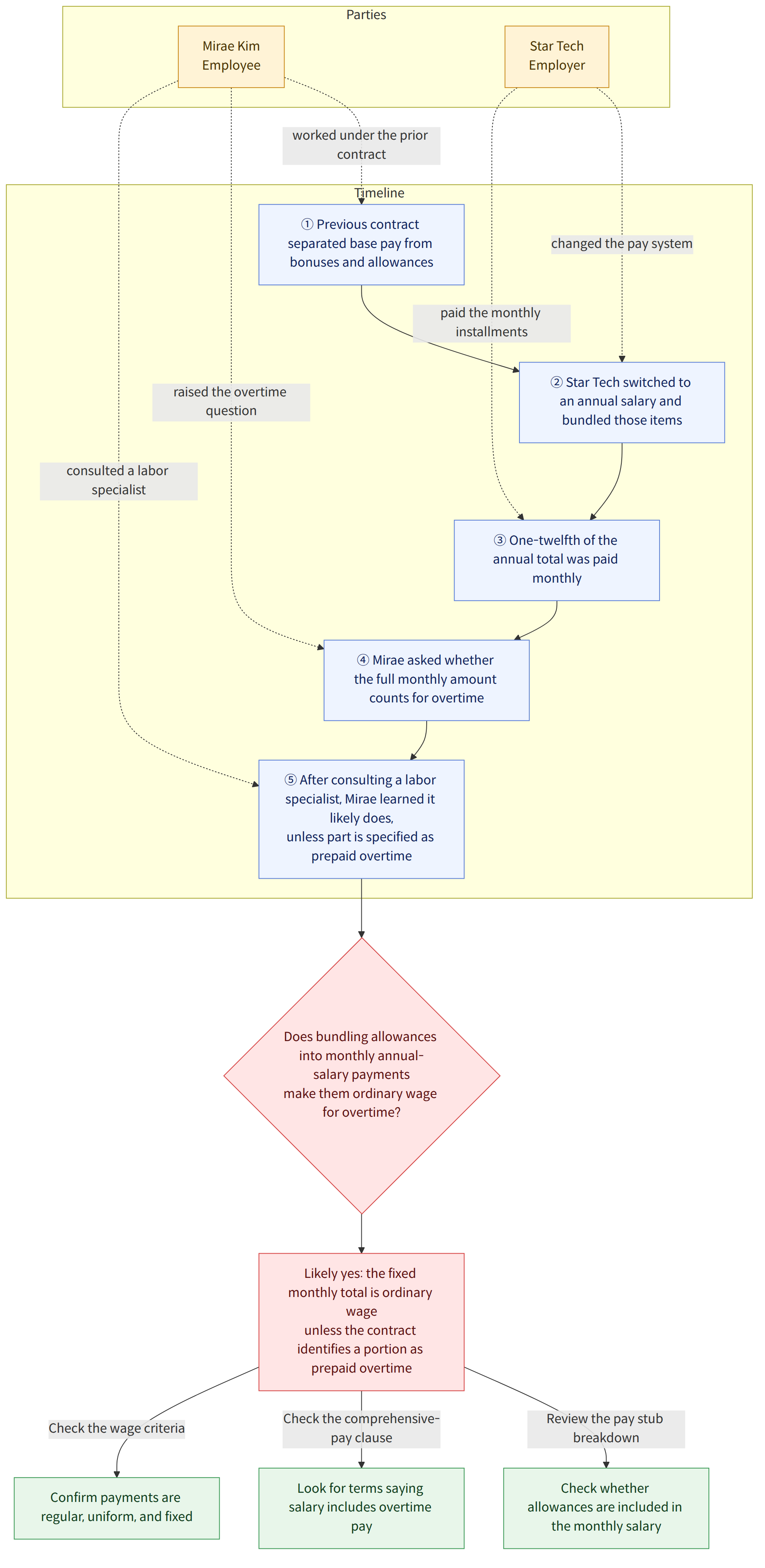
1. Mirae Kim’s Transition to an Annual Salary System
Mirae Kim, a five-year veteran at 'Star Tech,' a mid-sized IT firm, recently faced a significant change in her compensation. The company decided to switch from a traditional seniority-based pay scale to an Annual Salary System. In her previous contract, her base pay was separate from specific bonuses and allowances like family support and holiday bonuses, which were paid at different times of the year.
Under the new contract, all these items were consolidated into a single 'Annual Total.' The company explained that one-twelfth of this total would be paid to her on the monthly payday. While Mirae was happy to see a higher monthly deposit, she became curious: "When I work late and need to calculate my overtime pay, is the basis for that calculation—the 'Ordinary Wage'—this new entire monthly amount, or just the portion that used to be my base pay?"
2. The Legal Question: Does Integration Equal Ordinary Wage?
The core legal issue here is whether various allowances (family support, long-service pay, fixed bonuses), once integrated into a total annual salary and distributed in 12 equal monthly installments, qualify as Ordinary Wage under Korean law.
3. Understanding 'Ordinary Wage' in Korea
In the Korean Labor Standards Act, Ordinary Wage refers to the hourly, daily, weekly, or monthly amount determined to be paid to a worker for their prescribed labor. To be legally recognized as an Ordinary Wage, the payment must satisfy three strict criteria established by the Supreme Court:
The Three Pillars of Ordinary Wage1. Regularity: The payment must be made consistently at fixed intervals.2. Uniformity: The payment must be made to all employees or all employees who meet certain objective conditions.3. Fixedness: The payment must be guaranteed to the worker regardless of their performance or additional achievements, provided they perform their labor.
In Mirae’s case, since the annual total is fixed and paid out regularly every month, it strongly aligns with these criteria.
4. How Korean Courts Approach the Issue
Korean courts prioritize substance over labels. Even if a payment is still called a "holiday bonus" or "family allowance," if it is integrated into the annual salary and paid out automatically every month as part of the 1/12th installment, the court views it as a fixed, regular wage.
Legal precedents and the Ministry of Employment and Labor state that if a wage system is changed to an annual salary system where various allowances are bundled, the 1/12th portion paid monthly should be regarded as the Ordinary Wage. This is significant because the Ordinary Wage is the denominator used to calculate overtime, night shift, and holiday work premiums (usually 1.5x the hourly rate).
5. Applying the Law to Mirae’s Case
For Mirae Kim, her new monthly salary—one-twelfth of her total annual package—is likely her new Ordinary Wage. Because items like the family support and long-service pay were moved into the fixed annual total, they have lost their "contingent" nature and have become part of her guaranteed labor compensation.
However, there is one critical exception: The Comprehensive Salary System (포괄임금제).
- If Mirae’s contract specifies that a certain portion of her annual salary is actually pre-paid overtime pay for a set number of hours per month, that specific portion is excluded from the Ordinary Wage.
- If there is no such clause, and the total is simply a bundle of base pay and previous fixed allowances, the entire amount serves as the Ordinary Wage.
6. Conclusion: A Win for Mirae and Advice for You
After consulting with a labor specialist, Mirae Kim realized that her Ordinary Wage had effectively increased. Because her overtime pay is now calculated based on this higher integrated amount, her hourly rate for late-night work is higher than it was under the old system. The company's attempt to simplify the payroll actually increased the cost of her overtime hours.
If you find yourself in a similar situation, here are two practical tips:
- Review Your Pay Stub Breakdown: Check if your annual salary is clearly categorized. If bonuses and allowances are integrated into a single monthly payment without being labeled as "overtime," your Ordinary Wage might be higher than you think.
- Check for Comprehensive Pay Clauses: Look for language that says "inclusive of overtime pay." This clause is the primary way employers legally lower the Ordinary Wage used for additional calculations.
Understanding your wage structure is not just about the total amount in your bank account; it’s about ensuring every hour of extra work is valued correctly under the law.
** *This column is provided for general informational purposes only and does not constitute specific legal advice. For individual cases, please consult with a legal professional.