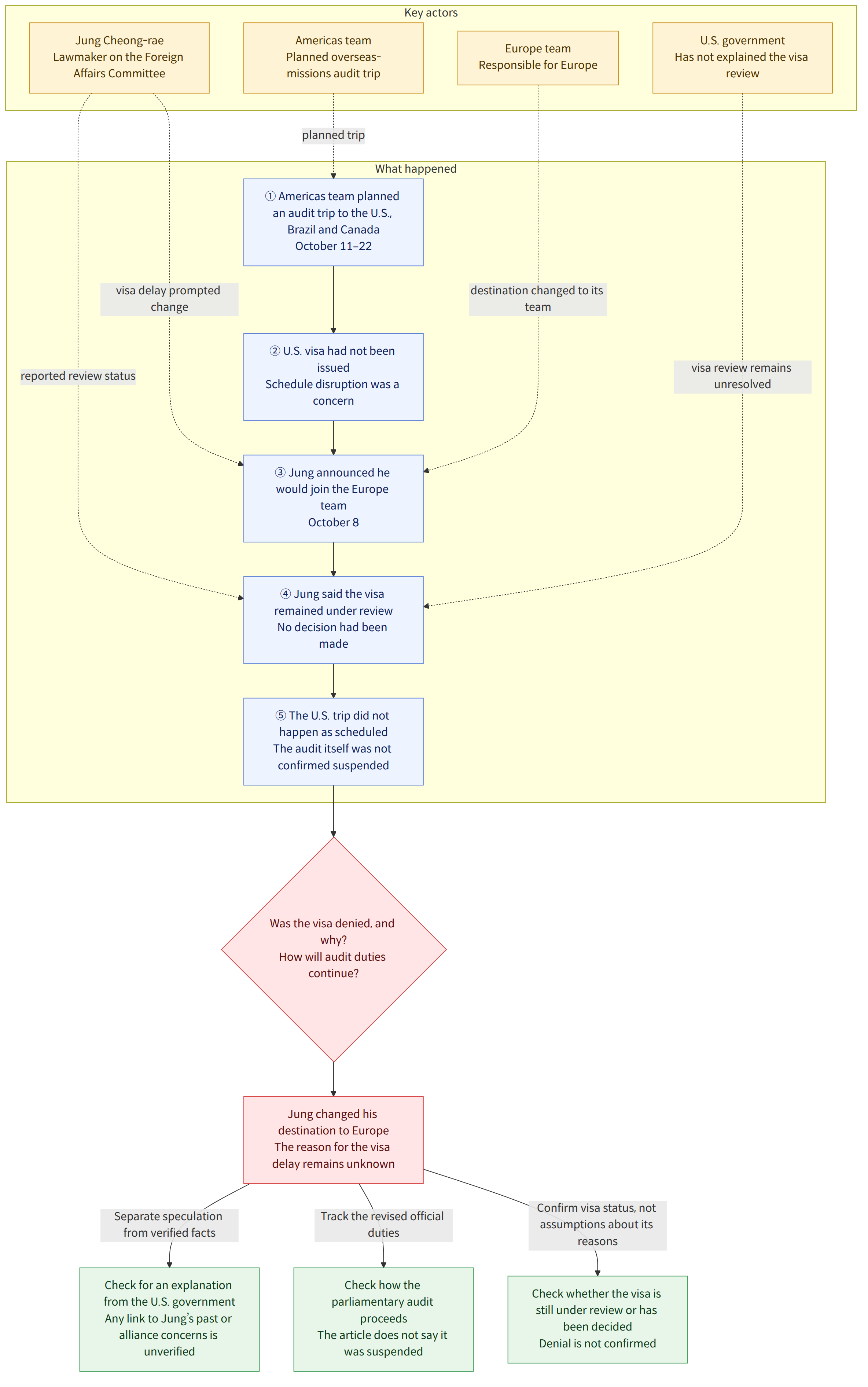
Jung Cheong-rae, a lawmaker from the Democratic Party of Korea (더불어민주당) who serves on the National Assembly Foreign Affairs and Unification Committee (국회 외교통일위원회), changed his planned trip to the United States for a parliamentary audit of overseas missions because of a delay in the issuance of his visa. The committee’s Americas team (미주반) had originally planned to visit the United States, Brazil and Canada, among other countries, for 12 days and 9 nights from October 11 to 22. Concerned that the schedule could be disrupted because his U.S. visa had not been issued, Jung said on Facebook on October 8 that he had changed his destination to the Europe team (구주반), which is responsible for Europe.
However, it has not been confirmed that his visa was ultimately denied. The following day, Jung explained that his U.S. visa was officially “under review” and that no decision had yet been made. The available public information does not reveal why the visa issuance was delayed.
Background and context
Jung’s past was repeatedly brought up in the controversy. In 1989, as a member of the National Council of Student Representatives (전국대학생대표자협의회), he led a sit-in occupation of the U.S. ambassador’s residence in Seoul’s Jeong-dong district and was sentenced to two years in prison. Some speculated that this was connected to the visa review, but without an explanation from the U.S. government, it is difficult to confirm whether it actually affected the review.
This is not the first time a schedule change of this kind has occurred. During the National Assembly’s 2013 audit, Jung also switched from the Americas team to the Europe team because of a delay in obtaining a U.S. visa. In contrast, he visited the United States on a single-entry visa for the 2012 audit, and in 2014, in his capacity as a secretary of the National Assembly Intelligence Committee (국회 정보위원회), he met in the United States with local members of the House and Senate and former U.S. Ambassador to South Korea Donald Gregg.
These past cases do not establish the reason for the current delay. Rather, the fact that there have been both occasions when he was able to visit the United States and occasions when he changed his itinerary shows that the outcome of the current review cannot be inferred solely from his past student activism. An editorial said it was possible to infer that his past record and remarks related to the United States may have affected the review, but it also made clear that this was speculation whose truth could not be verified without an explanation from the U.S. government.
Political interpretations diverged. The People Power Party (국민의힘) linked the visa delay to the Lee Jae-myung government’s failure in diplomacy with the United States and the possibility of a breakdown in trust in the South Korea-U.S. alliance. Some in the ruling camp also wondered whether this was an attempt at political intimidation. As the controversy grew, Jung urged restraint, saying that extreme claims or remarks harmful to the South Korea-U.S. alliance would not serve the interests of either country.
What this news means
The case has drawn attention because an individual’s overseas travel coincided with the schedule of official legislative duties. Had the U.S. trip gone ahead as planned, it could have been included in the Americas team’s schedule for the parliamentary audit of overseas missions, but Jung changed his destination after the visa issuance was delayed. What has therefore been confirmed is that the U.S. trip did not take place as scheduled; it cannot be concluded that the parliamentary audit itself was suspended.
When the reasons for a visa review are not disclosed, the same event can also be interpreted in different ways. One side may speculate about an individual’s past or the visa decision, while another raises concerns about the government’s diplomatic capabilities or trust in the alliance. Since such claims have not been confirmed as fact, it is important to distinguish the status of the review from its reasons rather than jumping to conclusions about political responsibility or retaliation, which could intensify the controversy.
For example, if another lawmaker were waiting for a visa for an official trip and changed their itinerary, it would first be necessary to establish separately whether the visa had been finally denied or the review was still in progress, and how the official duties assigned to that person would continue under the revised schedule. In this case, too, the visa-processing status and the progress of the parliamentary audit after the itinerary change are separate matters that need to be verified.
What reports described differently
Reports differed in how they described the visa status. One said that the U.S. government had delayed issuing the visa without a clear explanation, while in another, Jung said that the visa was officially “under review” and that no decision had yet been made. Therefore, based on the information currently available, it is more accurate to say that the issuance was delayed and Jung said the review was ongoing than to say that the visa had been denied.
There is also additional information about why he changed his destination. An editorial reported that he switched to Europe because the U.S. visa had not been issued and there were concerns that the parliamentary audit schedule would be disrupted. Jung added that he changed his plans because of holidays in South Korea and the availability of flight reservations. Both explanations were reported, but neither disclosed the specific reason for the visa delay.
What is confirmed and what remains unknown
Confirmed facts
- Jung was scheduled to visit the United States, Brazil and Canada, among other countries, as part of the Americas team’s trip for the parliamentary audit of overseas missions.
- The planned trip was for 12 days and 9 nights, from October 11 to 22.
- Jung said he changed his destination to the Europe team after the issuance of his U.S. visa was delayed.
- Jung explained that his U.S. visa was officially under review and that no decision had yet been made.
- Jung visited the United States in 2012 and 2014, and changed his itinerary in 2013 because of a delay in obtaining a visa.
What remains unknown
- What specific reason did the U.S. government have for delaying the visa issuance?
- Did the U.S. government or the State Department issue an official explanation for the delay?
- How did the revised trip schedule and the parliamentary audit of overseas missions proceed afterward?
- Did Jung’s past student activism actually affect the current visa review?
What readers should check
- In any follow-up announcement, it will be necessary to distinguish whether the visa was denied or the review is still ongoing.
- Readers can check whether the U.S. government or the State Department has issued an official explanation and whether the reason for the delay has been established.
- It is also necessary to check how Jung’s parliamentary audit schedule and the audit of overseas missions proceeded after his destination was changed.
References
- Other coverage consulted: hani.co.kr