A Parting Only on Paper
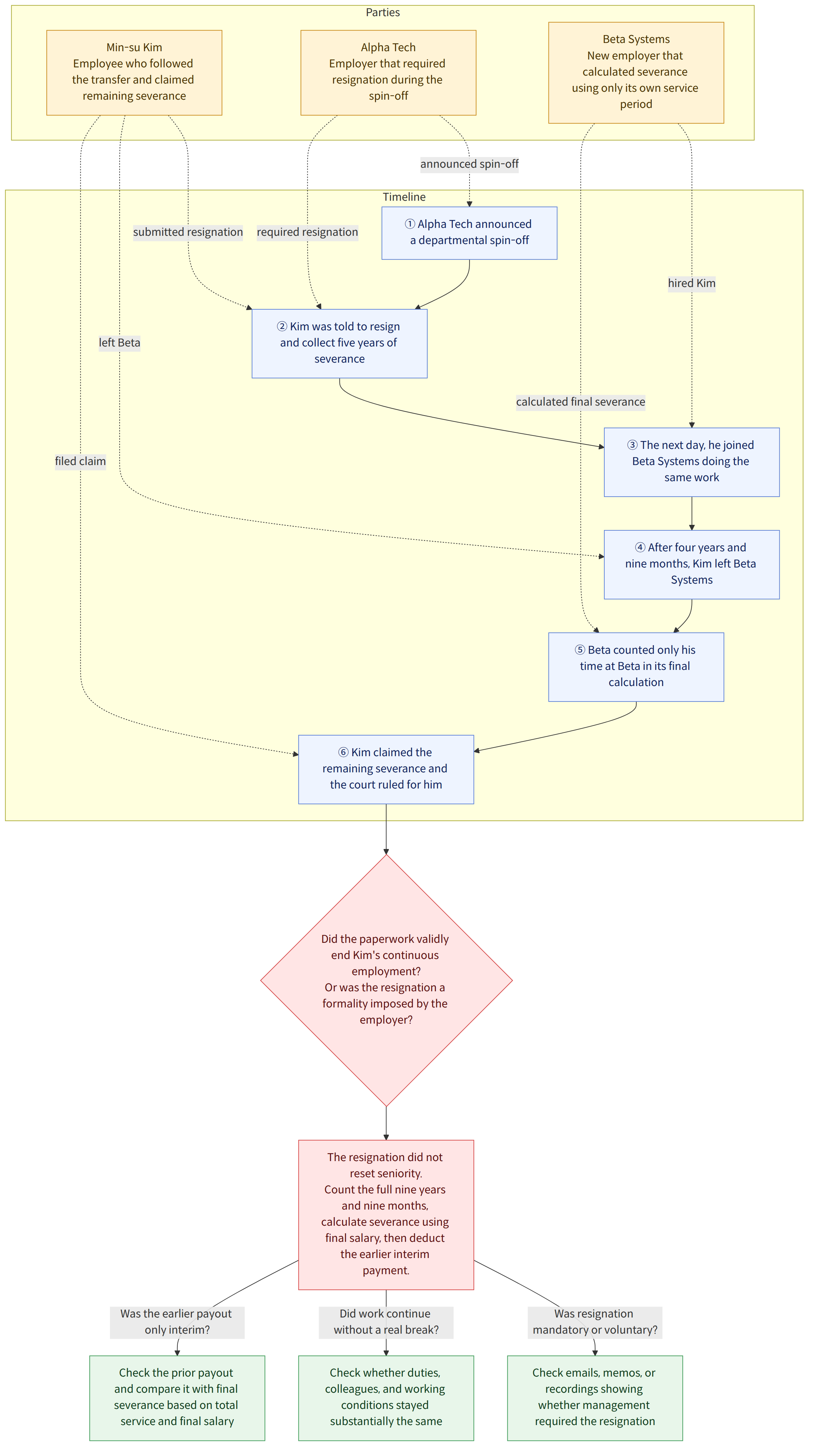
Min-su Kim was a talented engineer who had dedicated five years of his life to 'Alpha Tech,' a mid-sized IT firm in Korea. One day, the company announced a major restructuring: Min-su’s entire department would be spun off into a new independent entity called 'Beta Systems.' The management’s instructions were clear and non-negotiable. "Everyone must officially resign from Alpha Tech today, collect their severance pay, and then sign a new contract with Beta Systems starting tomorrow."
Min-su felt uneasy, but since his desk, his colleagues, and his daily tasks remained exactly the same, he followed the company’s orders. He submitted his resignation, received his 5-year severance check, and started fresh at Beta Systems. Four years and nine months later, Min-su decided to leave Beta Systems for a new opportunity. However, he was shocked when he received his final severance statement. Beta Systems calculated his pay based only on the 4 years and 9 months he spent there, ignoring his previous 5 years at Alpha Tech. This meant he missed out on the 'progressive multiplier' benefit reserved for long-term employees with over 10 years of service.
The Core Legal Question
The central question in this case is whether Min-su Kim’s transition from Alpha Tech to Beta Systems constituted a 'valid severance' of the employment relationship. If the law views it as a clean break, his seniority reset to zero the day he joined Beta. If not, the entire 9 years and 9 months must be counted as one continuous period of service.
What Korean Law Says
Under Korean labor law and established judicial principles, the continuity of employment during corporate mergers, splits, or transfers depends heavily on the 'free will' of the employee.
Supreme Court Principle:If an employee submits a resignation based on their own needs and free will, the employment relationship is legally severed. However, if the resignation was submitted due to the employer’s unilateral management policy or as a mere formality, the continuous employment relationship remains intact.
Key factors for determining this include:
- Was the resignation truly voluntary or a result of company pressure?
- Did the job duties or working conditions change significantly after the move?
- Was the process used by the employer as a tactic to settle severance pay early?
How Korean Courts Approach This
Korean courts prioritize 'substance over form.' Simply having a signed resignation letter and a payout does not automatically mean the legal relationship ended. If an entire department is transferred and employees have no choice but to follow a specific administrative procedure set by the company, judges generally rule that the employment was continuous. This protects workers from losing seniority-based benefits (like higher severance multipliers or long-term leave) due to corporate maneuvering.
Applying the Law to Min-su’s Case
Looking at Min-su Kim’s situation, it is clear that his resignation was not voluntary. It was a mandatory step in a unilateral corporate spin-off. There was no gap in his employment—he was an Alpha employee on Monday and a Beta employee on Tuesday, doing the exact same work.
Therefore, his 'continuous service' period is the full 9 years and 9 months. While Min-su did receive severance pay after the first 5 years, this is legally treated as an 'interim settlement.' When he finally leaves Beta Systems, the company must calculate the total severance pay for the full 9 years and 9 months (based on his final, higher salary) and then deduct the amount he already received five years ago. The difference is what Min-su is legally owed.
Conclusion: What Happened, and What Should You Do?
Ultimately, Min-su Kim sought legal counsel and successfully filed a claim against Beta Systems. The court ruled in his favor, recognizing his full tenure and awarding him the remaining severance pay adjusted for his 10-year seniority level. The company’s attempt to 'reset the clock' through paperwork failed.
If you find yourself in a similar restructuring situation, keep these two tips in mind:
- Document the 'Involuntary' Nature: Save emails, memos, or recordings where management states that the resignation and re-hiring process is a mandatory company policy. This is vital evidence that your resignation wasn't 'voluntary.'
- Don't Assume the Check is the End: Receiving a severance payout mid-career doesn't always mean your seniority has been wiped out. If the process was a formality, you are still entitled to have those years counted for your final retirement package.
Your years of service are a hard-earned asset; do not let administrative technicalities erase the value of your dedication.