1. A Promotion That Felt Like a Trap
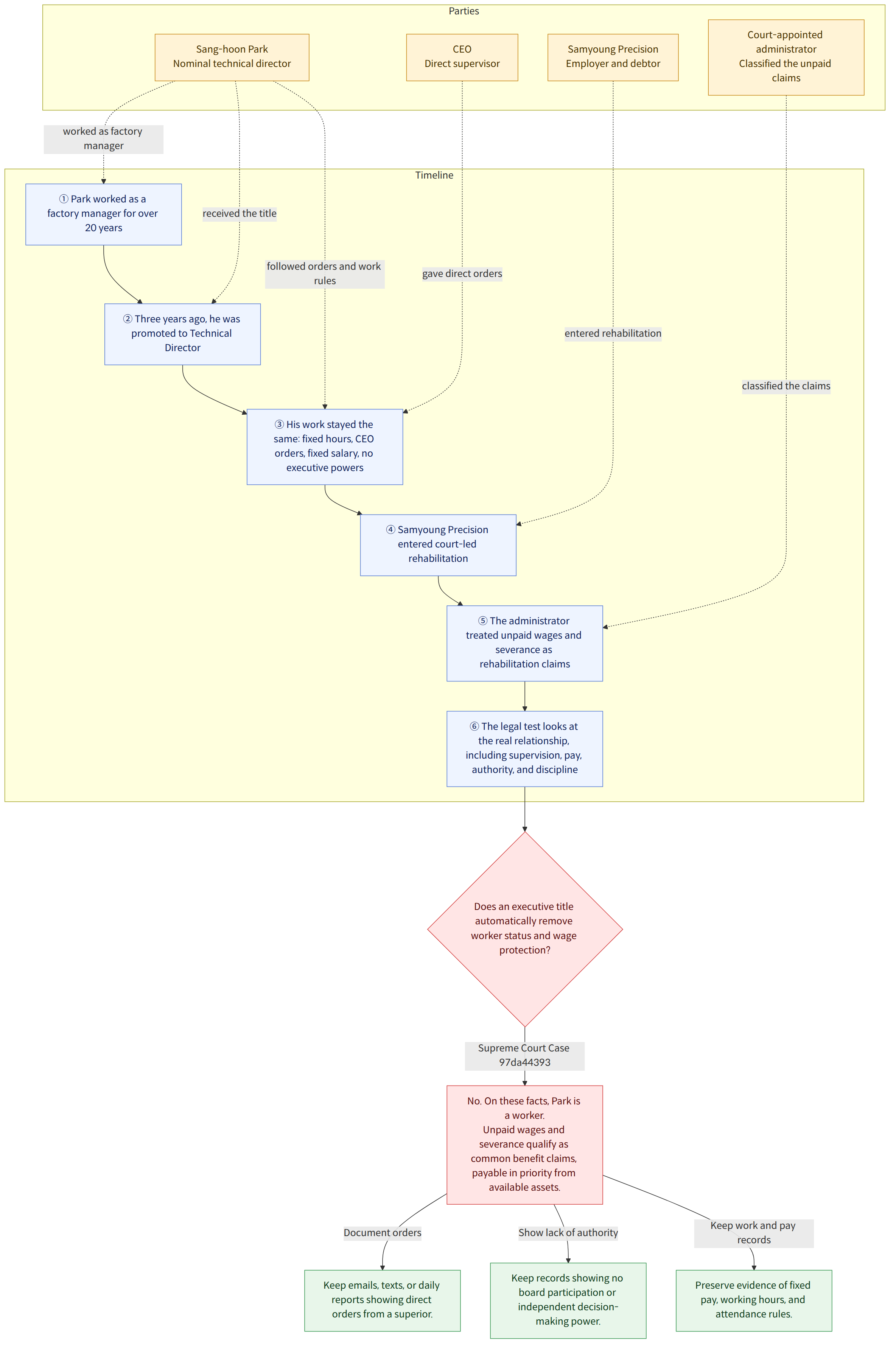
Sang-hoon Park had been a dedicated factory manager at Samyoung Precision for over 20 years. Three years ago, the CEO promoted him to 'Technical Director' as a gesture of appreciation for his loyalty. Sang-hoon was proud, but in reality, nothing changed. He still clocked in at 8:00 AM, managed the production line under the CEO’s direct orders, and received a fixed monthly salary. He had no shares, no seat at the board meetings, and no power to hire or fire.
When Samyoung Precision suddenly filed for court-led rehabilitation due to a financial crisis, Sang-hoon’s world collapsed. The court-appointed administrator told him, "Since you are an executive, your unpaid wages and severance are 'rehabilitation claims.' You will have to wait for the five-year repayment plan to get a portion of it." Sang-hoon was devastated. He had worked as a laborer his entire life; now, a mere title was preventing him from accessing the money he needed for his family's survival.
2. Does a Title Disqualify You from Wage Protection?
In the face of corporate insolvency, the pivotal legal question is: "Does an executive title automatically strip a person of their right to be treated as a worker under the Labor Standards Act during rehabilitation proceedings?"
3. What Korean Law Says About Common Benefit Claims
The 'Debtor Rehabilitation and Bankruptcy Act' of Korea provides special protection for worker's claims to ensure their basic livelihood even when a company is failing.
Article 179 (Claims Constituting Common Benefit Claims)(1) Any of the following claims shall be a common benefit claim:10. Claims for wages, retirement allowances, and disaster compensation for workers of the debtor.
Common benefit claims are powerful. Unlike general rehabilitation claims, which are often slashed or delayed by the court's plan, common benefit claims must be paid in full and in preference to other debts from the company's remaining operating funds.
4. How Korean Courts Approach 'Substance over Form'
The Korean Supreme Court has a long-standing principle: the legal status of a worker is determined by the reality of the relationship, not the title on a business card. (Supreme Court Case 97da44393)
To decide if an executive is actually a worker, the courts look for:
- Subordination: Did the person work under the specific command and supervision of the employer?
- Fixed Remuneration: Was the pay a fixed amount for labor provided, rather than a share of profits?
- Lack of Authority: Did the person lack actual management rights, such as voting on the board or making executive decisions?
- Work Discipline: Was the person subject to the company’s standard rules regarding working hours and attendance?
If an executive’s role was purely formal or nominal, the court treats them as a 'worker under the Labor Standards Act,' granting them the same protections as any blue-collar or white-collar employee.
5. Applying the Law to Sang-hoon Park
Let's analyze Sang-hoon Park’s situation. Despite being called a 'Technical Director,' he had no actual executive power. He followed a strict schedule set by the CEO, performed routine labor management, and received a standard salary. He was a nominal executive.
Under Korean law, Sang-hoon is a worker. Therefore, his unpaid wages and severance pay should be categorized as common benefit claims. He is not required to wait for the five-year rehabilitation plan; he has the legal right to demand immediate payment from the company’s available assets.
6. Conclusion: What Happened to Sang-hoon, and What Should You Do?
In the end, Sang-hoon Park can successfully file a claim against the rehabilitation administrator to receive his wages as a priority. The law recognizes that his 'Director' title was a label of respect, not a description of his legal status.
If you find yourself in a similar position where a corporate title is blocking your worker rights, keep these tips in mind:
- Document Your Subordination: Collect emails, text messages, or daily reports that show you were taking direct orders from a superior. This proves you were in a subordinate relationship.
- Show Your Lack of Executive Power: Keep records showing you did not participate in board meetings or exercise independent decision-making authority over the company's direction or finances.