A Promise Made in the Shadows
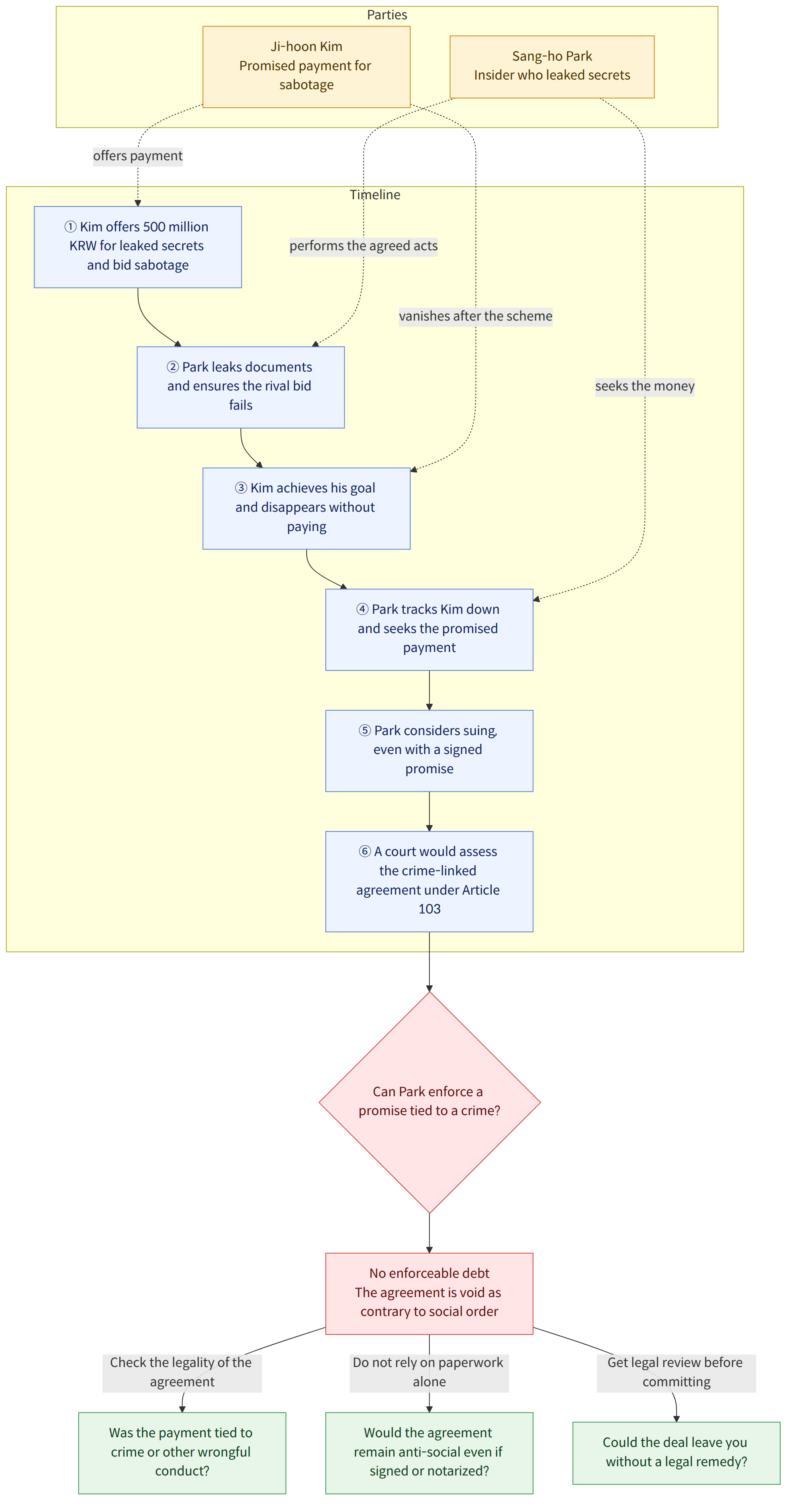
Ji-hoon Kim had a plan to cripple his rival's expansion. To do this, he needed an insider. He approached Sang-ho Park, a senior manager at the competing firm, with a lucrative proposal. In exchange for leaking trade secrets and sabotaging the company's internal bidding process, Ji-hoon promised to pay Sang-ho 500 million KRW—half as 'operational funding' and half as a 'success fee.'
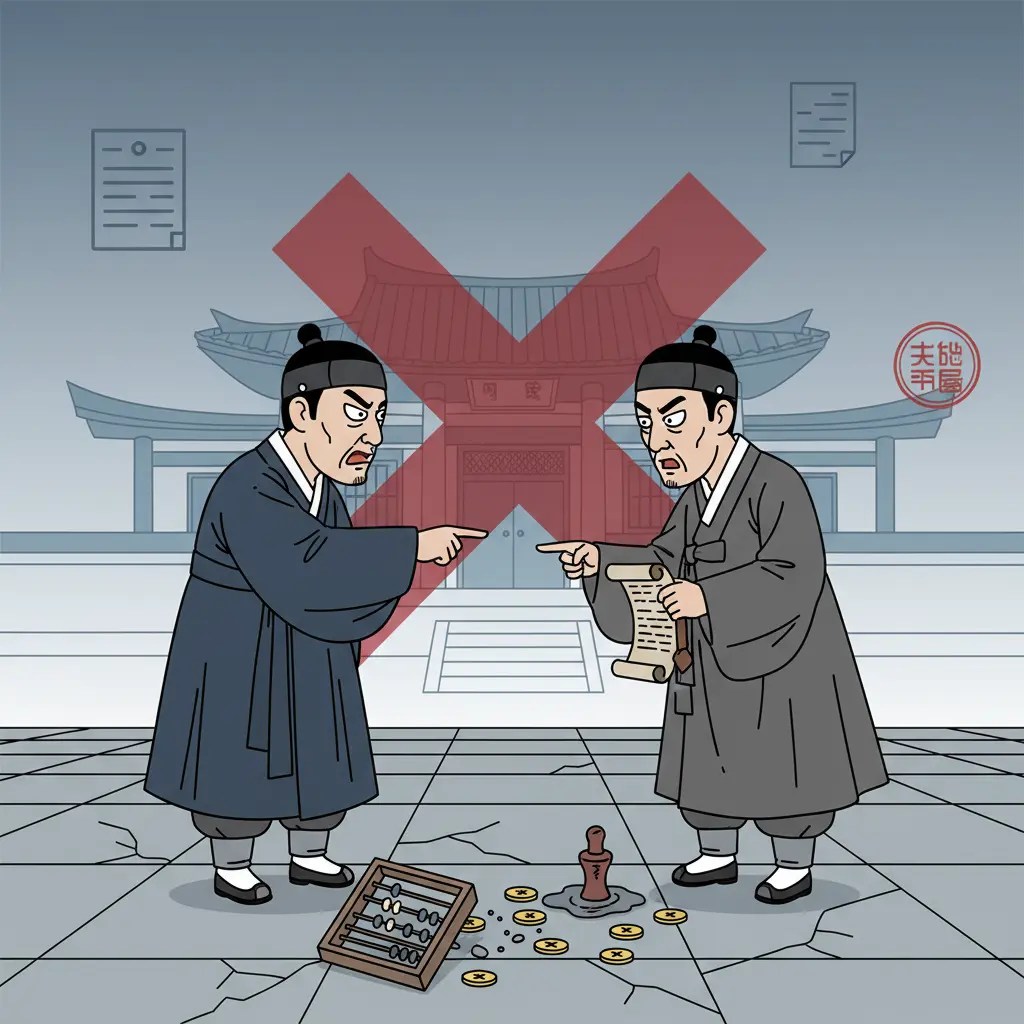
Sang-ho, blinded by the promise of a massive payday, fulfilled his end of the bargain. He leaked the documents and ensured the rival's bid failed. However, once the dust settled and Ji-hoon achieved his goal, he vanished. When Sang-ho finally tracked him down, Ji-hoon simply laughed, knowing that Sang-ho couldn't exactly report him to the police without admitting to his own crimes. Desperate, Sang-ho wondered: "Can I at least sue him for the money he promised me in our contract?"
The Legal Question: Can an Illegal Contract Be Enforced?
This scenario raises a fundamental question in Korean civil law: Is a private agreement between two parties enforceable if the very foundation of that agreement is a criminal act? Specifically, can an accomplice demand the 'funding' or 'reward' promised by their partner in crime through a court of law?
What Korean Law Says: The Principle of Social Order
Under the Korean Civil Act, Article 103, any legal act (such as a contract) that has a content violating "good morals or other social order" is null and void. A contract to commit a crime, or to provide funds for the execution of a crime, is the quintessential example of such an anti-social act.
Supreme Court PrincipleAn agreement between accomplices to provide compensation for funding a crime or to compensate for losses incurred during the criminal process is void as it violates social order. Furthermore, any agreement by a third party to assume or fulfill a debt based on such a void agreement is also null and void.
This means the law does not recognize the existence of a debt if that debt arose from a criminal conspiracy. The law views such 'contracts' as if they never existed in the eyes of the legal system.
How Korean Courts Approach This
Korean courts apply a strict "hands-off" policy regarding illegal transactions. The judiciary is not a tool to be used by criminals to settle disputes over their ill-gotten gains or broken promises. If the court were to enforce such a contract, it would effectively be participating in the criminal enterprise by validating the financial incentives behind it.
Judges look beyond the surface of a document. Even if a contract looks like a standard loan or a consultancy agreement, if the evidence shows it was actually meant to fund a breach of trust (malfeasance) or any other crime, the court will declare it void and dismiss the plaintiff's claim immediately.
Applying the Law to Sang-ho’s Case
If Sang-ho were to file a civil lawsuit against Ji-hoon, the outcome would be a swift defeat. Even if Sang-ho presents a signed document where Ji-hoon promises the 500 million KRW, the court would examine the reason for that payment.
Once it is revealed that the money was a reward for committing a breach of trust (the leakage of corporate secrets), the judge would rule that the agreement violates Article 103 of the Civil Act. Because the contract is void, there is no legal obligation for Ji-hoon to pay. In the eyes of the law, Sang-ho has no "right" to the money, and Ji-hoon has no "debt." Sang-ho would likely leave the courtroom empty-handed and might even catch the attention of prosecutors for his admitted role in the crime.
Conclusion: What Happened, and What Should You Do?
In the end, Sang-ho learned a bitter lesson: there truly is no honor among thieves—at least not any honor that the law will enforce. He lost his job, his reputation, and the 500 million KRW he was promised. Because his "deal" was born out of an illegal conspiracy, it held zero weight in the Korean judicial system.
For readers who might find themselves in complex business disputes or high-stakes negotiations, keep these points in mind:
- Legality is the Foundation of Enforceability: A contract is only as strong as its legality. If any part of your agreement involves circumventing the law or committing a wrongful act, the entire contract could be rendered worthless.
- Illegality Trumps Documentation: Even a notarized document cannot save an agreement that is fundamentally anti-social or criminal in nature.
- Seek Legal Vetting for High-Stakes Deals: Before entering into significant financial commitments, ensure the transaction complies with all Korean regulations. If a deal feels like it's in the 'gray area' of the law, remember that you may have no recourse if the other party decides to walk away.