Working for One, Contracted by Another: The Safety Gap
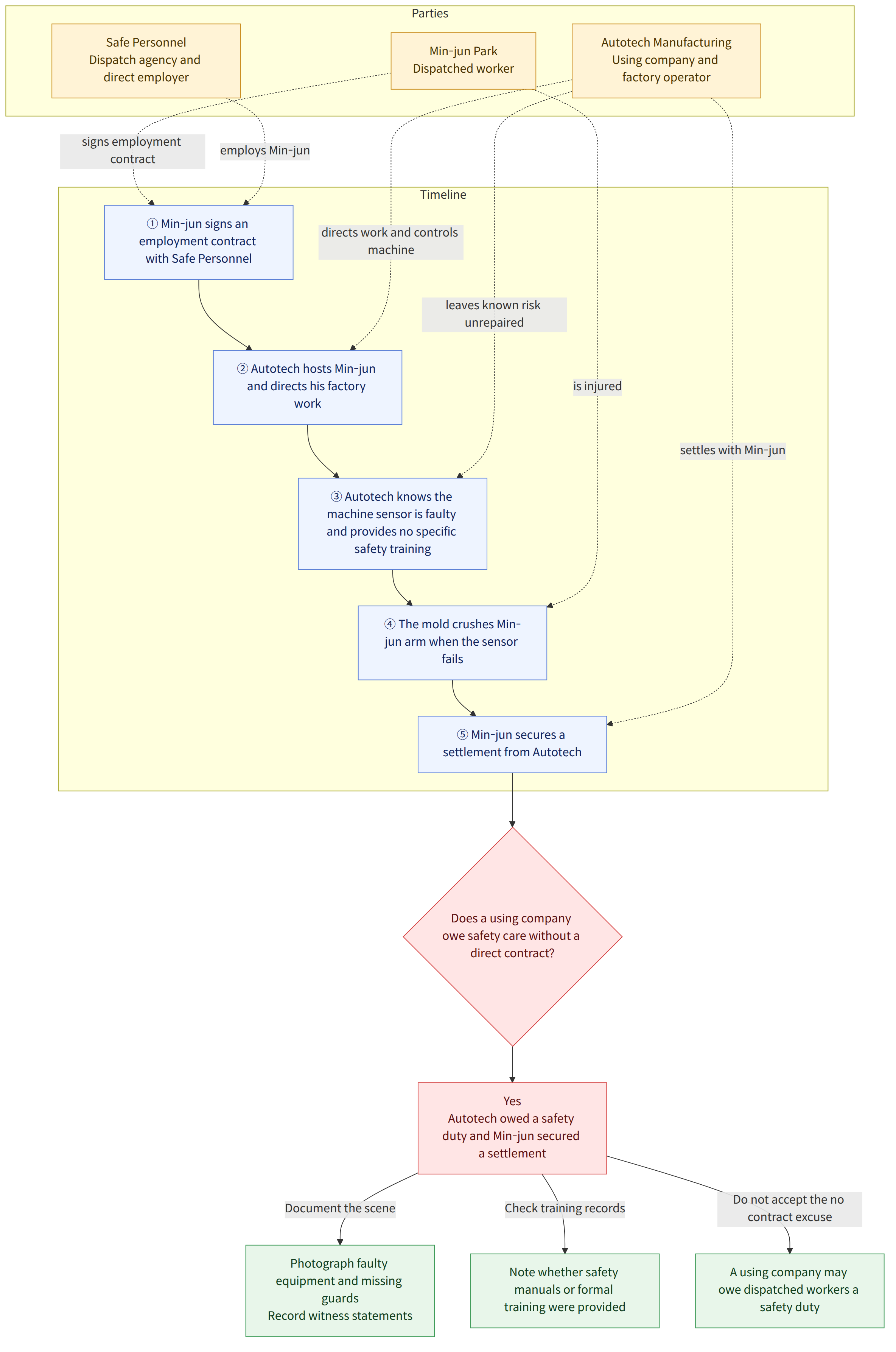
Min-jun Park was eager to start his new job. He had signed an employment contract with 'Safe Personnel,' a dispatch agency. However, his daily workplace was the factory floor of Autotech Manufacturing, a car parts producer. Min-jun commuted on a bus provided by Autotech, followed the instructions of Autotech managers, and operated injection molding machines owned by Autotech. While his paycheck came from the agency, his work life was entirely governed by Autotech.
Disaster struck in an instant. A piece of debris became lodged in the injection molding machine, which used intense heat of over 200°C. Min-jun reached in to clear it, assuming the safety sensors would automatically stop the machine. They didn't. The sensor was faulty, and the heavy mold crushed his right arm, causing multiple fractures. It was later revealed that Autotech had known the sensor was finicky but hadn't fixed it, and they hadn't provided Min-jun—a new recruit—with any specific safety training for handling malfunctions.
As medical bills mounted, Min-jun faced a cold wall of denial from Autotech. "We never signed a contract with you," they claimed. "Take your grievances to the dispatch agency; they are your legal employer." Is Min-jun truly left without recourse against the company that actually controlled his work environment?
The Legal Question: Can a User Company be Held Liable Without a Contract?
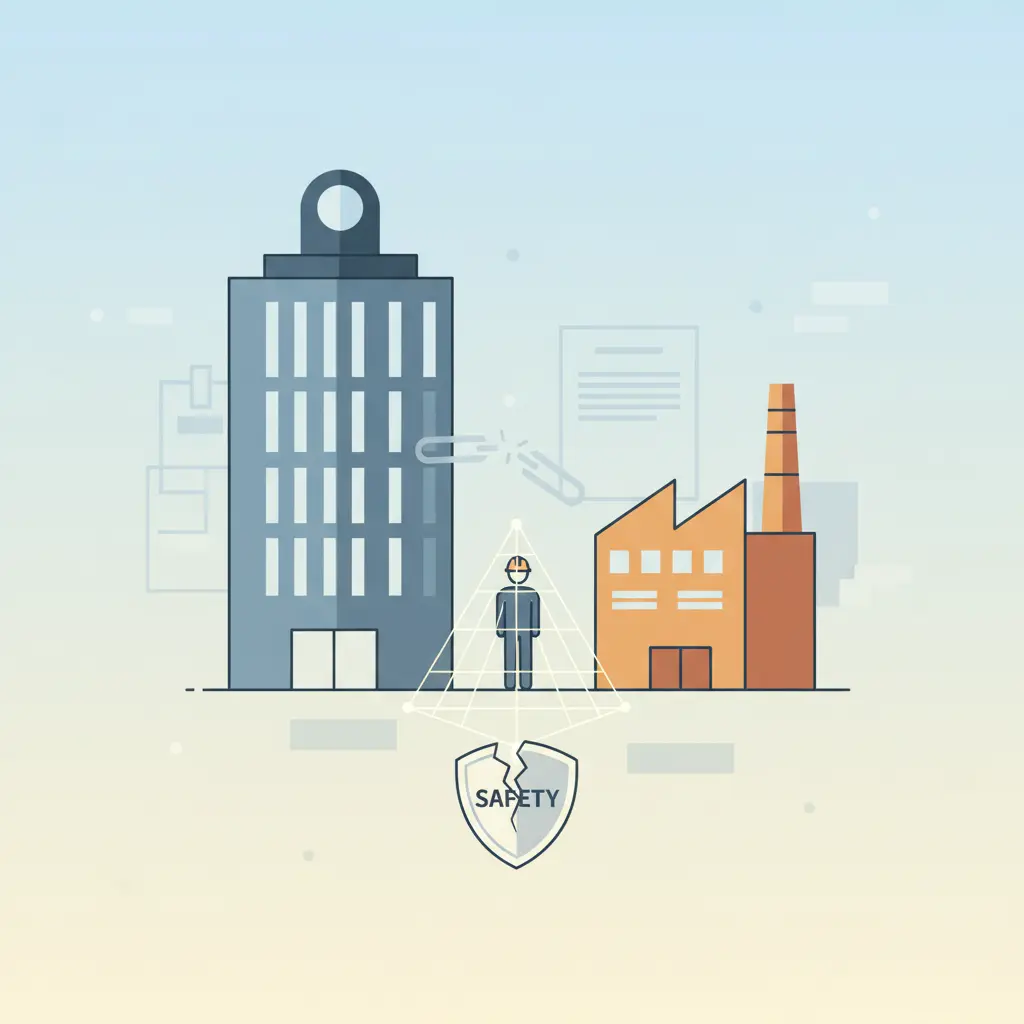
The core issue is whether a 'using employer' (the company where the work is actually performed) owes a 'Duty of Safety Care' (보호의무/안전배려의무) to a dispatched worker, despite the absence of a direct employment contract.
What Korean Law Says: The Duty of Protection
Korean law and Supreme Court precedents prioritize the life and safety of workers, even in complex indirect employment structures like worker dispatch.
"Since a using employer accepts a dispatched worker into their own workplace, directs and supervises them, and has them engage in continuous labor for their benefit, it is reasonable to conclude that the using employer accepts the duty to protect or care for the safety of the dispatched worker."
Korean courts recognize this responsibility based on several principles:
- Implied Mutual Consent: The law assumes that when a dispatch contract is signed, there is an implicit agreement that the company receiving the worker will ensure their safety.
- Actual Control: Because the user company controls the environment, maintains the machinery, and gives the orders, they are in the best position to prevent accidents.
- Principle of Good Faith: A party that benefits from another's labor has a moral and legal obligation to prevent foreseeable risks to that person.
How Korean Courts Approach This
Judiciary practice in Korea looks past the formal paperwork to the 'substantive relationship'. Even if a contract between the agency and the user company claims that "the agency is solely responsible for all accidents," such a clause generally cannot waive the user company's basic duty of care under public policy. In cases like Min-jun's, the failure to maintain safety devices and the omission of essential safety training are viewed as severe negligence on the part of the using employer.
Applying the Law to Min-jun's Case
Applying these principles to Min-jun, Autotech’s liability becomes clear through two main failures:
First, the failure to maintain the injection molding machine's sensor is a direct breach of the duty to provide a safe working environment. As the owner and operator of the facility, Autotech was responsible for ensuring its equipment met safety standards.
Second, the lack of safety training for a new employee is a critical oversight. A worker cannot be expected to know the specific dangers of a proprietary machine without proper instruction.
Therefore, even without a signed contract between Min-jun and Autotech, the law recognizes an 'implied agreement' regarding safety. Min-jun is entitled to sue Autotech directly for damages, including medical costs and compensation for pain and suffering.
Conclusion: Seeking Justice and Practical Advice
Ultimately, Min-jun was able to secure a settlement from Autotech. The court reaffirmed that the complexity of an employment structure should never be a shield for corporate negligence.
If you find yourself in a similar situation as a dispatched worker, keep these three tips in mind:
- Document the Scene Immediately: Take photos or videos of the faulty equipment and the absence of safety guards. Witness statements from colleagues are also vital.
- Check Training Records: Note whether you were ever given a safety manual or formal training. If you were asked to sign a training log without receiving the actual training, document that fact.
- Don't Accept the 'No Contract' Excuse: If a company directs your work and provides your tools, they are legally responsible for your safety. Do not let them brush you off—consult a legal professional to verify your rights.
The law exists to ensure that every worker who enters a factory gate returns home safely, regardless of whose name is on their paycheck.
--- This column provides general legal information and does not constitute specific legal advice. For individual cases, please consult with a qualified legal professional.