A financial crisis puts a public service under scrutiny
The lead operator of Jeonju’s Comprehensive Recycling Town has applied for corporate rehabilitation, a court-supervised process intended to help a financially distressed company reorganize its debts and continue operating if possible. The application has triggered calls from a civic coalition for the city to explain who is currently running the facility and how essential services will be protected.
The complex, located in Jeonju, a city in South Korea’s North Jeolla Province, handles several types of municipal waste. These include food scraps, recyclable materials and sewage sludge—the solid residue left after wastewater is treated.
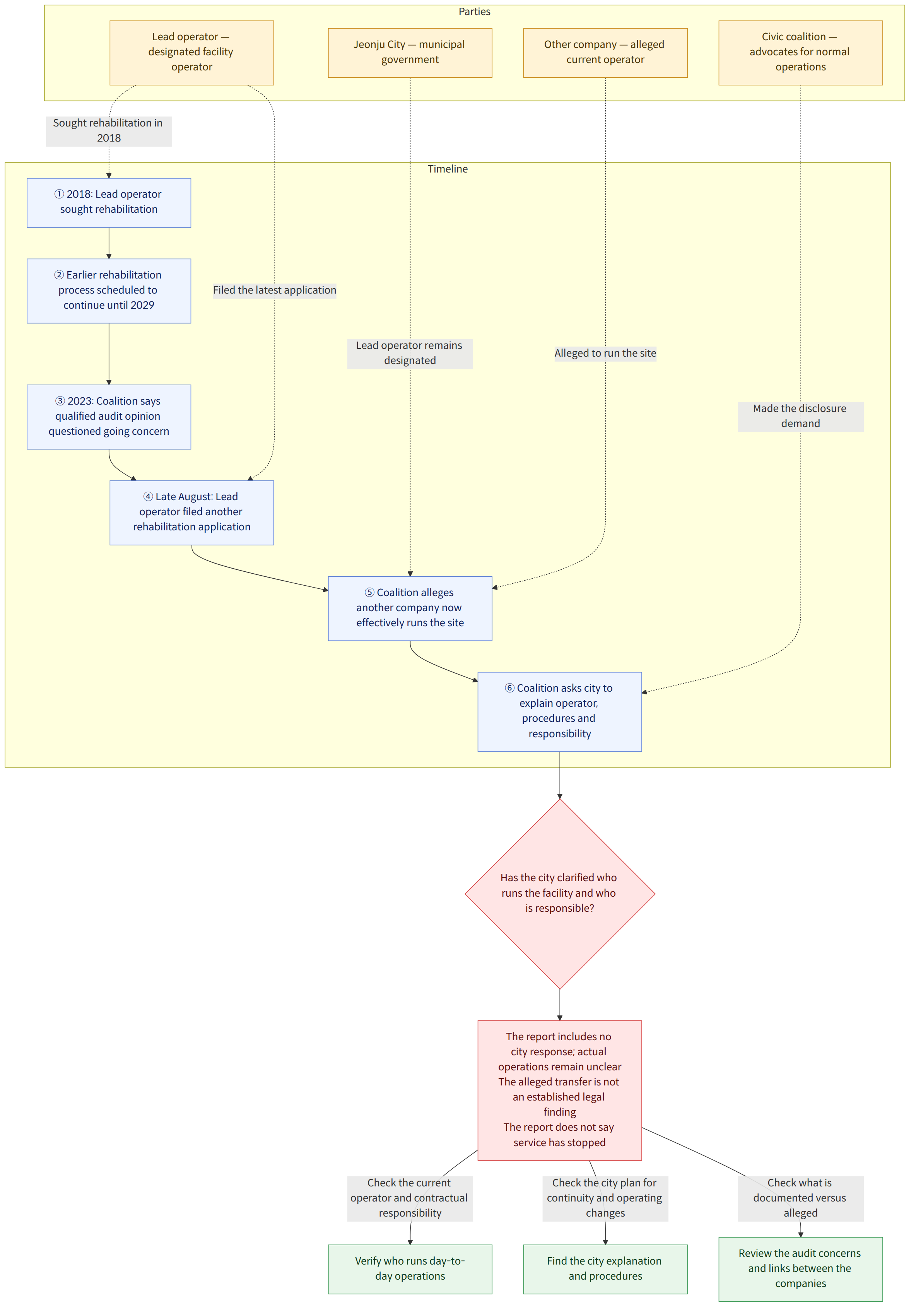
A coalition formed to press for the facility’s normal operation says the lead operator filed for rehabilitation with a court in late August. In a recent statement, the group called on Jeonju’s municipal government to disclose its plans and clarify responsibility for the facility.
“The city must tell residents how the facility will be operated,” the coalition said, arguing that the operating arrangement has become unclear while the lead contractor is undergoing financial restructuring.
A facility that processes hundreds of tons each day
The recycling town is designed to process large volumes of waste generated by households and municipal services. Its stated daily capacity is:
- 300 metric tons of food waste, which can be treated to recover usable resources.
- 60 metric tons of recyclable materials, which must be sorted into different material types.
- 150 metric tons of sewage sludge, the residual material produced by wastewater treatment.
The facility’s role is similar to that of a large, specialized sorting and treatment center: waste arriving from across the city must be handled reliably so it does not accumulate or disrupt downstream services. If operations are interrupted or poorly managed, residents may ultimately face consequences through delays in waste treatment, increased costs or environmental risks.
The available report does not say that service has stopped. The concern raised by the coalition is that the financial and management uncertainty could undermine stable operations unless the city explains how continuity will be ensured.
Earlier financial troubles are part of the dispute
The coalition says the lead operator had previously sought corporate rehabilitation in 2018, and that the earlier rehabilitation process was still scheduled to continue until 2029. It also points to an audit opinion issued in 2023 that, according to the group, raised doubts about whether the company could continue operating as a going concern.
A going-concern assumption is the accounting expectation that a business will remain in operation for the foreseeable future, rather than shutting down soon. In practical terms, it is like assessing whether a shop is likely to stay open long enough to pay its bills and serve its customers. The coalition says the operator received a qualified audit opinion concerning that assumption; an audit opinion with qualifications signals that auditors have reservations or limitations, but it does not by itself establish that a company has closed or that wrongdoing has occurred.
The group argues that the city should have taken the operator’s financial history into account when entrusting it with the facility. It says the repeated financial problems have contributed to instability. Those statements are the coalition’s criticism; the information provided does not include a response from the city or the operator addressing the claims.
Questions about who is actually operating the site
The coalition alleges that a different company is now effectively running the recycling town, despite the lead operator remaining the designated operating company. It says the two businesses appear to have links: their registered addresses are the same, and some of their registered directors overlap.
The group describes this arrangement as a possible case of “corporate laundering”—its term for shifting operations between related legal entities in a way that could make it harder to identify which company is responsible. This is an allegation, not an established legal finding. Shared addresses or overlapping directors can prompt questions, but they do not on their own prove that a company transfer was designed to avoid liability.
The coalition wants the city to identify the current operator and explain whether the operating company has changed. It is also asking the city to disclose the rules and procedures used for any change, including which company is contractually responsible for day-to-day operations and any resulting claims.
The central question raised by the coalition is whether the public, workers and injured people can clearly identify the organization responsible if something goes wrong.
Safety and environmental concerns add urgency
The dispute follows a 2024 gas explosion at the facility that killed one worker and injured four others. The coalition says the city must clarify who will cover the injured workers’ medical expenses, a question it says remains uncertain amid the current operating arrangement.
The group also points to environmental enforcement action taken early this year. It says the facility violated emissions standards and that the Ministry of Environment imposed administrative measures and a fine. The report does not specify the exact pollutant, the size of the fine or the detailed terms of the enforcement action.
These issues matter because waste-treatment plants combine heavy machinery, combustible gases and processes that can affect air and water quality. Clear operating procedures, workplace safety controls and environmental monitoring are important not only for workers inside a facility but also for nearby communities.
The coalition says the explosion and the reported environmental violations should be considered alongside the companies’ financial and management problems. It argues that a facility responsible for basic municipal services cannot be allowed to operate without transparent lines of responsibility.
What the civic coalition wants the city to disclose
The coalition says the project has been affected by a series of problems, including financial distress involving the project developer, the lead operator’s rehabilitation proceedings, accidents and alleged legal violations. It describes the private-investment project as having become badly compromised.
Its requests to Jeonju include:
- Identify the company currently operating the recycling town.
- Explain whether the designated operator has changed and, if so, describe the approval process.
- Set out how the facility will continue operating while the lead operator is in rehabilitation.
- Clarify which company is responsible for safety, environmental compliance and other operational duties.
- Explain who will pay medical costs and address other claims connected to the 2024 explosion.
Corporate rehabilitation does not automatically mean that a company has shut down. The process is intended to address financial distress under court supervision, but it can still create uncertainty for workers, contractors, public agencies and people who depend on the company’s services. For a municipal waste facility, the practical issue is whether treatment can continue safely and consistently while the company’s finances and management are being resolved.
The next test: continuity and accountability
The immediate challenge is to separate two questions that can easily become blurred: whether the facility can keep treating waste, and which legal entity is answerable for its operation. A clear public explanation could help residents understand the city’s contingency plan, the operator’s status and the route for raising safety or environmental concerns.
The coalition is also seeking clarity on responsibility for past harm, particularly the costs faced by workers injured in the explosion. Establishing those obligations may require examination of contracts, company records and the relevant legal proceedings; the claims made by the coalition do not by themselves settle who is legally liable.
For residents, the issue is more than a dispute between companies. The complex is part of the infrastructure that handles everyday waste, while its safety and environmental performance can affect workers and neighboring communities. The city’s response to the coalition’s demands will determine how much the public knows about the current operating structure and the safeguards in place during the rehabilitation process.