
A Fancy Title with a Familiar Routine
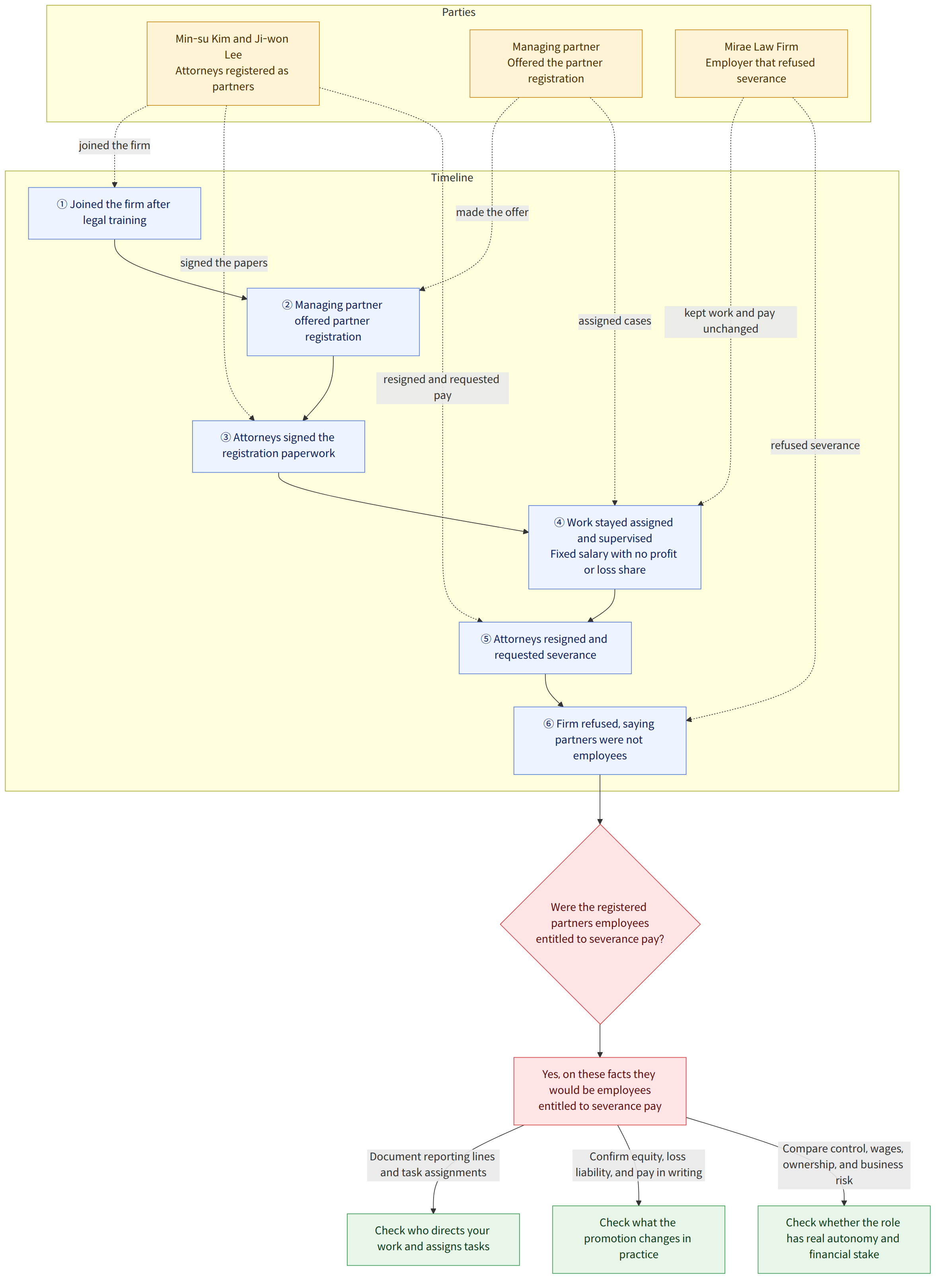
Min-su Kim and Ji-won Lee were promising young attorneys who joined 'Mirae Law Firm' right after finishing their training. They worked tirelessly, and by their second year, the managing partner offered them what sounded like a dream: "You are the future of this firm. We want to register you as 'Partner Lawyers' on our official documents. It will boost your professional prestige."
Proud and excited, they signed the paperwork. However, despite the fancy new title on their business cards, their daily lives remained unchanged. They still handled only the cases assigned by the managing partner and received the same fixed monthly salary. They didn't share in the firm's profits when business was booming, nor did they bear any losses during dry spells. When they eventually decided to resign, they requested their severance pay, expecting a smooth exit.
To their shock, the firm refused. "You were registered partners—owners of this firm, not employees. Partners don't get severance pay," the managing partner stated. Does a mere title on a registration document strip them of their rights?
The Legal Question: Is a Registered Partner Still an Employee?
The core of this dispute lies in whether an attorney registered as a partner is considered an 'employee' under the Labor Standards Act. The question is whether the reality of working under an employer's command overrides the formal title of 'Partner' or 'Executive.'
What Korean Law Says About Employee Status
The Korean Labor Standards Act (LSA) defines an employee based on the substance of the relationship, regardless of the job title or the type of contract.
Labor Standards Act, Article 2, Paragraph 1, Clause 1"The term 'employee' means a person who provides labor to a business or workplace for the purpose of earning wages, regardless of the type of occupation."
To determine if someone is an employee, Korean courts look for a "subordinate relationship" based on factors such as:
- Whether the employer exercises significant command and supervision over the work.
- Whether the employer dictates the time and place of work.
- Whether the worker owns the equipment and tools needed for the job.
- Whether the compensation is a reward for labor rather than a share of business profit.
- Whether the worker bears the economic risk of the business (profit/loss).
How Korean Courts Approach This: Substance Over Form
The Supreme Court of Korea has consistently ruled that even if an attorney is registered as a 'Partner' (구성원 변호사), they are still an employee if that status is merely formal. The courts look closely at equity ownership and operational autonomy.
If a lawyer did not buy or sell shares during their registration and withdrawal, and did not participate in profit-sharing or loss-bearing, they lack the characteristics of a true owner. Furthermore, if they primarily handled cases assigned by the firm rather than bringing in their own clients, they are viewed as working in a subordinate capacity.
Applying the Law to the Case of Min-su and Ji-won
When we apply these principles to Min-su Kim and Ji-won Lee, the conclusion becomes clear:
- Lack of Financial Stake: They never acquired or transferred equity. Without a stake in the firm's capital or a share in its financial risks, they cannot be seen as independent business owners.
- No Change in Work Nature: Their duties, hours, and reporting lines remained exactly the same before and after being registered as partners. This indicates a continuation of their employee-employer relationship.
- Command and Supervision: They didn't have the autonomy to choose their cases. By processing only the work distributed by the firm, they remained under the firm's direct control.
- Fixed Wages: Receiving a set monthly salary regardless of the firm's performance or their specific case outcomes is a classic hallmark of an employee receiving 'wages.'
Conclusion: Justice for the 'Partners' and Advice for You
Following these legal standards, the court would rule that Min-su Kim and Ji-won Lee were indeed employees entitled to full severance pay. Their titles were a matter of prestige or administrative convenience, but their reality was one of labor and service. The firm must pay them for their years of hard work.
If you find yourself in a similar situation, keep these tips in mind:
- Focus on the Reality, Not the Title: Whether you are called a 'Director,' 'Partner,' or 'Executive,' if you are working under someone else's direction for a fixed salary, you likely retain your rights as an employee. Document your reporting structure and how tasks are assigned.
- Verify the Terms of 'Promotion': If your company offers to register you as an executive or partner, clarify in writing whether this involves equity, liability for losses, and changes in your compensation structure. Knowing the difference between an 'Equity Partner' and a 'Contractual Partner' is crucial.
This column provides general information and does not constitute formal legal advice. Please consult with a legal professional for specific cases.