
1. Mirae Kim’s Final Lesson: A Sudden Denial
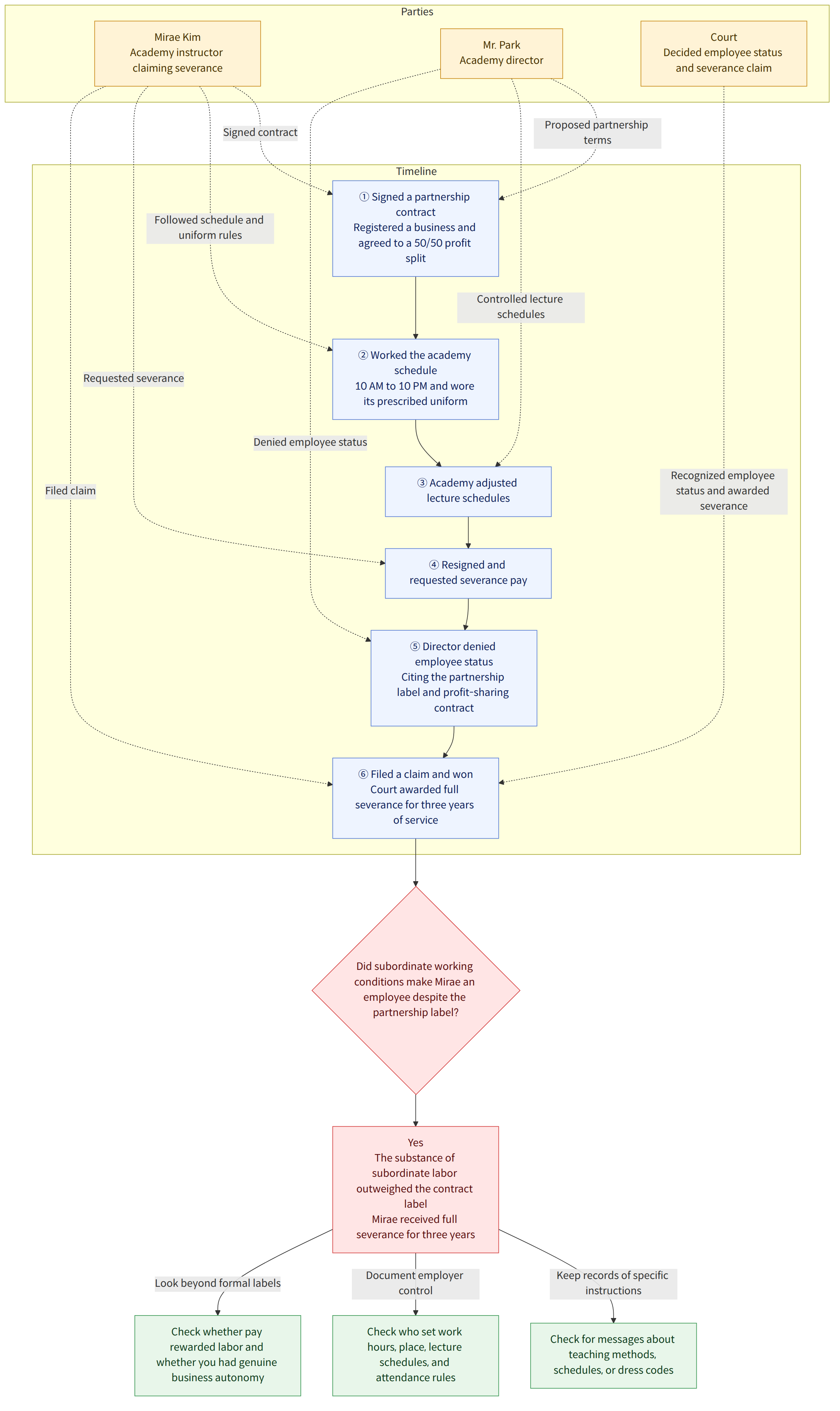
Mirae Kim was a dedicated English instructor who poured her heart into "Bright Future Academy" for three years. When she first signed her contract, the director, Mr. Park, suggested a "partnership" model. He had Mirae register as an independent business owner and agreed to a 50/50 profit split from her classes. Mirae felt empowered by this arrangement, diligently following the academy's 10 AM to 10 PM schedule and even wearing the uniform prescribed by the school.
However, when Mirae decided to resign due to personal reasons and requested her severance pay (Toejikgeum), Mr. Park’s attitude shifted instantly. "Mirae, you weren't an employee; you were a business partner. Why would a business owner ask for severance pay? Our contract clearly says it's a profit-sharing deal," he claimed. Mirae was stunned. She wondered if her three years of hard work were legally invisible simply because of the way her contract was phrased.
2. The Legal Question: Form vs. Substance
The core issue in Mirae’s case is whether she qualifies as an "employee" under the Labor Standards Act. The academy argues that she is an independent contractor because she held a business license and received a share of profits rather than a fixed salary. Does the law prioritize the label on the paper, or the reality of the daily grind?
3. What Korean Law Says
In Korea, the Supreme Court has consistently ruled that substance takes precedence over form when determining employee status. Even if a contract is labeled as a "partnership" or "service agreement," a person is considered an employee if they provided labor in a subordinate relationship to the employer for the purpose of earning wages.
Key Criteria from the Supreme Court:1. Does the employer determine the content of the work and apply internal rules or personnel regulations?2. Is the worker subject to specific and individual direction and supervision during the work process?3. Does the employer designate the time and place of work, and is the worker bound by them?4. Can the worker hire a third party to perform the work (substitutability)?5. Is the compensation essentially a reward for labor, and is there a fixed base pay?
4. How Korean Courts Approach Academy Instructors
Courts do not let formal elements—like business registration or paying business income tax—distract them from the truth of the working relationship.
In various cases, even when instructors split revenue 50/50 with an academy, courts have ruled them to be employees if the academy controlled the lecture schedule, prohibited the instructor from delegating work to others, and enforced strict attendance or dress codes. If an instructor works within the academy's command structure rather than running their own independent business risk, they are legally an employee.
5. Applying the Law to Mirae’s Case
Let’s look at Mirae’s situation through the lens of legal principles:
- Supervision and Control: Mirae had to follow a strict 10 AM to 10 PM schedule set by the academy and wear a specific uniform. This indicates a high level of employer control.
- Lack of Autonomy: The academy, not Mirae, adjusted the lecture schedule. This means the core business decisions were made by Mr. Park.
- Nature of Compensation: Although it was a 50/50 split, if the income was tied to her hours worked within the academy’s framework rather than her own independent entrepreneurial efforts, it functions as a wage.
Consequently, despite the "business owner" label, Mirae worked as a subordinate worker. Legally, she is an employee.
6. Conclusion: What Happened, and What Should You Do?
Ultimately, the law stood by Mirae. She filed a claim for severance pay and won, as the court recognized that the "substance of subordinate labor" outweighed the formal contract terms. She received her full severance pay for her three years of service.
If you are an instructor or freelancer in a similar position, keep these two tips in mind:
- Collect Evidence of Control: Save text messages, emails, or KakaoTalk logs where the academy gives specific instructions on teaching methods, schedules, or dress codes. These are vital for proving your employee status.
- Don’t Be Fooled by Labels: Do not assume you aren't entitled to severance pay just because you have a business license or pay the 3.3% freelance tax. If you work under someone else's direction and schedule, you have rights under the Labor Standards Act.
--- This column is provided for general informational purposes only and does not constitute formal legal advice. For specific cases, please consult with a legal professional.