
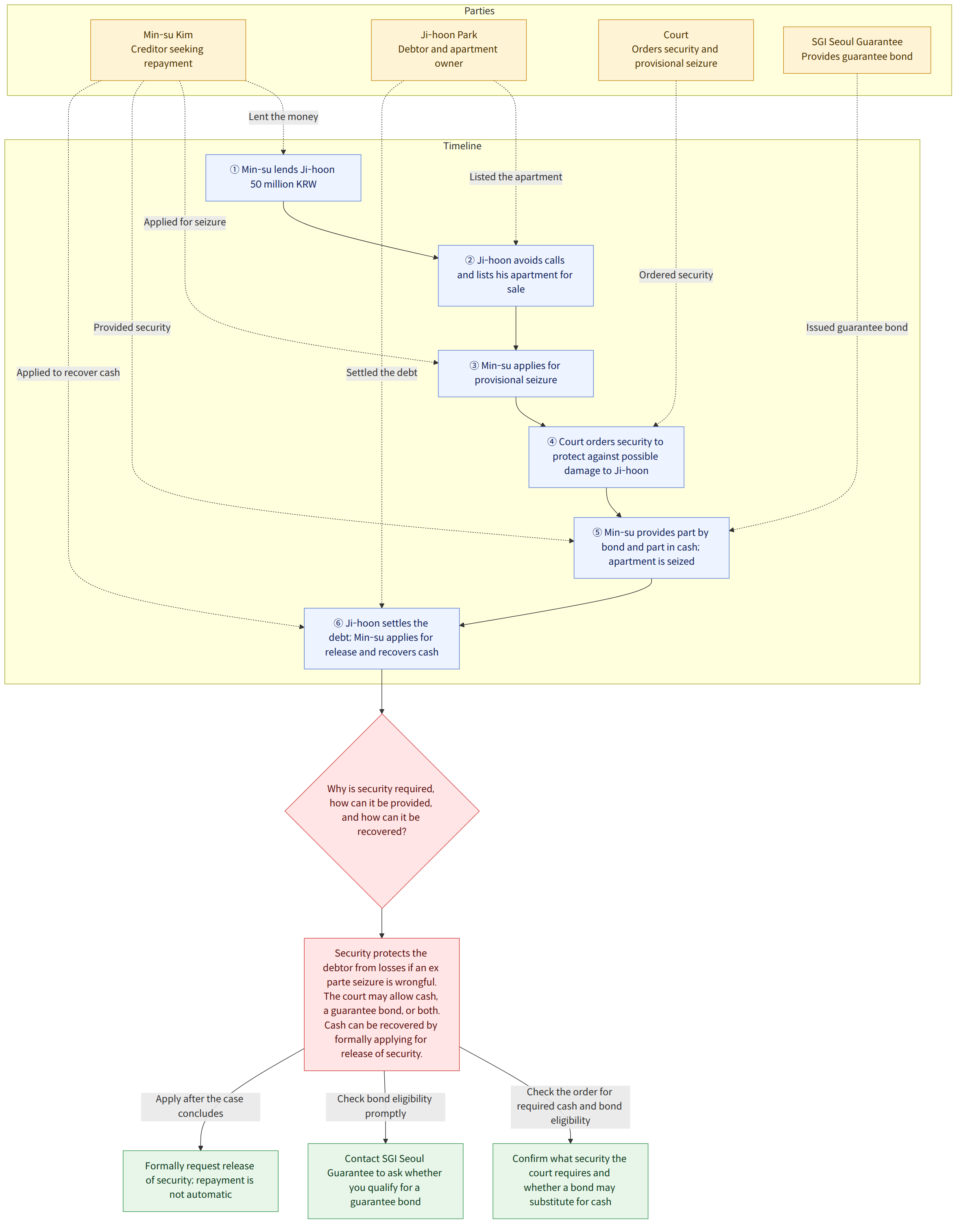
1. A Human Story: Min-su’s Growing Dilemma
Out of a 10-year friendship, Min-su Kim generously lent 50 million KRW to Ji-hoon Park, money he had saved for his own wedding. However, as the deadline passed, Ji-hoon began avoiding his calls. One day, Min-su heard alarming news: Ji-hoon had listed his only asset—an apartment in Gyeonggi Province—on the market. Min-su panicked, fearing that if the apartment were sold, Ji-hoon would hide the cash and never repay him.
Desperate, Min-su sought legal advice and decided to apply for a 'Provisional Seizure' to prevent the sale of the apartment. Shortly after filing, he received an unexpected order from the court. To grant the seizure, the court ordered Min-su to deposit a certain amount of money with the court as a 'Security Deposit'. "I'm the one who hasn't been paid!" Min-su thought, frustrated. "Why do I have to pay the court more money?"
2. The Legal Question
Why does a creditor have to pay a deposit to the court when applying for a provisional seizure, what are the methods for providing this security, and can this money be recovered later?
3. What Korean Law Says
The Civil Execution Act of Korea stipulates that a court may order the creditor to provide security when granting a provisional seizure. This is known as a 'Judicial Security Deposit'.
Article 280 (Order of Provisional Seizure) of the Civil Execution Act: The court may make an order of provisional seizure subject to the provision of security by the creditor for any damage that the debtor may suffer.
Key points include:
- Purpose of the Deposit: A provisional seizure is usually granted "ex parte"—meaning without hearing the debtor's side first to prevent them from hiding assets. If the seizure is later found to be wrongful, the debtor might have suffered financial loss. This deposit serves as a pre-secured fund for damages.
- Methods of Providing Security:
- Cash Deposit: Depositing the actual cash amount into the court's bank account.
- Guarantee Bond: With court permission, submitting a document certifying a guarantee contract with an entity like SGI Seoul Guarantee. This allows creditors to avoid tying up large sums of liquid cash.
4. How Korean Courts Approach This
Korean courts view provisional seizure as a powerful tool that significantly restricts a person’s property rights. Therefore, even if the creditor’s claim seems legitimate, the court almost always requires a security deposit as a safety net. The court determines the deposit amount based on the type of claim (e.g., a loan vs. compensation for damages) and the type of asset being seized. Generally, for real estate, courts are more lenient in allowing guarantee bonds instead of full cash deposits.
5. Applying the Law to the Case
In Min-su's case, his objective is clear: recovering a loan. The court acknowledges his claim but must also protect Ji-hoon from potential losses (like a failed real estate deal) if the seizure turns out to be unjustified.
Min-su doesn't necessarily need to pay the entire amount in cash. If the court's order states that the deposit "can be substituted by a guarantee insurance policy," Min-su can simply pay a small insurance premium to SGI Seoul Guarantee and submit the bond. However, if the court mandates a portion of it be in cash (common for bank account seizures, less so for real estate), he must comply to get the seizure order.
6. Conclusion: What Happened, and What Should You Do?
Ultimately, Min-su provided a portion of the security via a guarantee bond and the rest in cash as ordered. The apartment was successfully seized. Seeing that he could no longer sell his property freely, Ji-hoon eventually reached out and settled the debt. After the case concluded, Min-su filed for a 'Release of Security' and successfully recovered his cash deposit.
Practical Tips for Readers in Similar Situations:
- Prepare for Costs: When planning a provisional seizure, factor in that the court may require a cash deposit—usually 10% to 40% of the claim amount depending on the asset.
- Check Bond Eligibility: Contact SGI Seoul Guarantee as soon as you receive a security deposit order to see if you qualify for a bond, which will save you from having to deposit a large sum of cash.
- Follow Up After Winning: Winning the main lawsuit doesn't automatically return your deposit. You must formally apply for a 'Return of Security' (담보취소) to get your money back from the court depository.